Framing Insight
Learning does not stabilise an organisation. Judgement does.
In complex environments, learning creates variation, alternatives, and new interpretations.
Without a stabilising mechanism, this leads to ambiguity rather than clear direction.
Practical wisdom (phronesis) is the ability that turns learning into action that is sensitive to context and grounded in ethics.
The Problem: Improvement Without Stability
Organisations invest heavily in:
- Continuous improvement (PDCA, Kaizen, 6 Sigma).
- Knowledge management systems.
- Learning programmes.
Yet improvement often degenerates into:
- Optimisation within flawed assumptions.
- “best practice” monocultures.
- Efficiency without reflection.
- Defensive suppression of dissent.
This creates fragility rather than resilience. Because optimisation without reflection increases efficiency but reduces adaptive capacity.
Single-Loop vs Double-Loop Learning
- Single-loop learning improves performance within existing assumptions.
- Double-loop learning challenges underlying assumptions (Argyris, 1977).
Double-loop learning is necessary in complex environments. But it introduces instability:
- Competing interpretations.
- Loss of certainty.
- Disruption of established norms.
The Missing Element: Practical Wisdom (Phronesis)
Practical wisdom provides:
- Ethical orientation.
- Contextual sensitivity.
- Judgement under uncertainty.
It answers:
- What should be done?
- What matters in this situation?
- What are the consequences?
As highlighted in the literature:
Practical wisdom is a vital skill for responsible and sustainable knowledge management in complex environments, for example, look at Konno. (Konno, 2024).
🔷 Core Proposition
Double-loop learning destabilises flawed assumptions.
Practical wisdom stabilises what follows.
Without practical wisdom:
- Learning creates turbulence.
- Organisations oscillate between ideas.
- Decisions become inconsistent.
With practical wisdom:
- Learning translates into coherent action.
- Trade-offs are made consciously.
- Behaviour stabilises under uncertainty.
Learning → Judgement → Adaptive Capacity
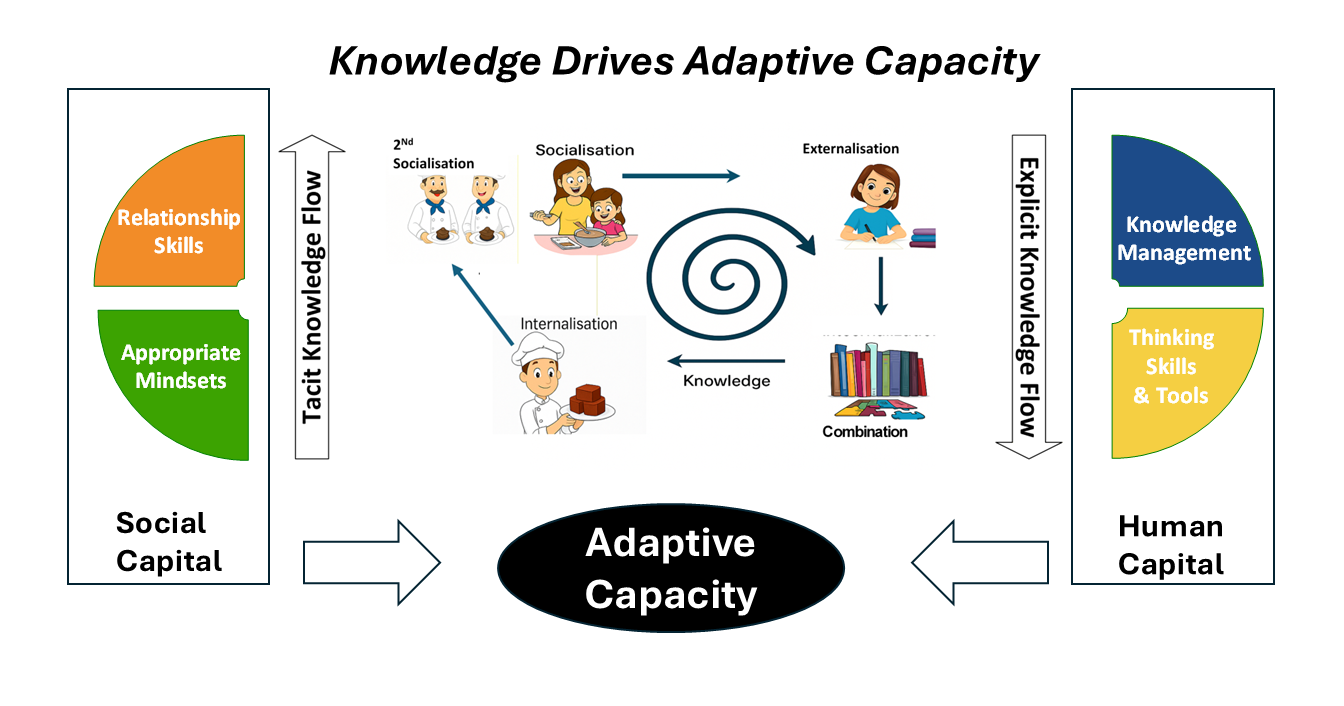
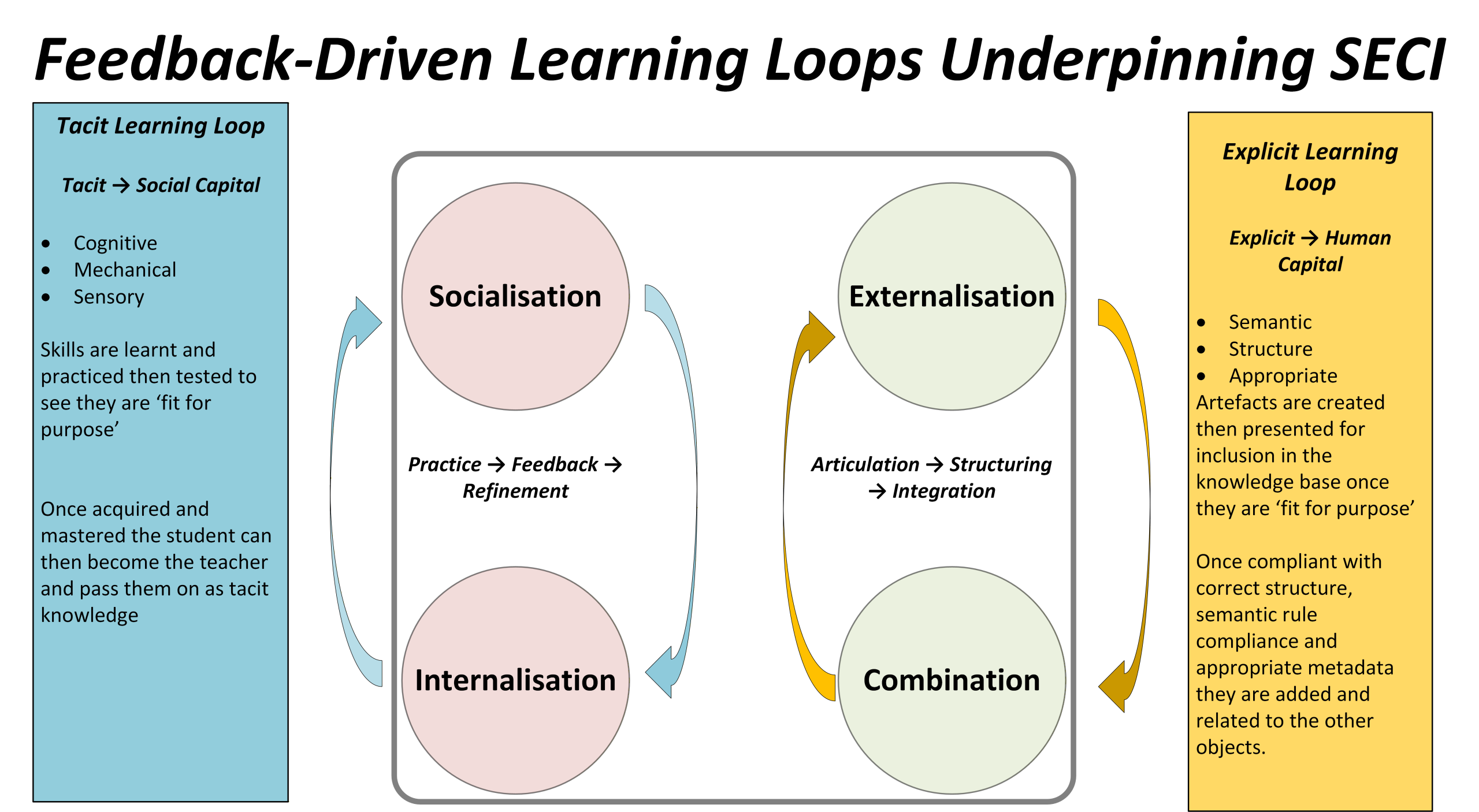
The diagrams taken together illustrate the role that SECI takes in building Adaptive Capacity and in Learning:
- Learning builds human capital (translates into capability).
- Learning builds social capital (builds shared understanding and common language).
- Together, these enable adaptive capacity.
But:
Adaptive capacity is only realised when learning becomes judgement in action.
Organisational Implications
Without practical wisdom:
- Reliance on rules and escalation increases.
- Decision-making becomes procedural.
- Learning remains theoretical.
With practical wisdom:
- People act with confidence under uncertainty.
- Ethical boundaries guide decisions.
- Organisations respond by considering all consequences rather than just reacting.
Consequential Intervention
Learning and judgement only become meaningful when translated into action.
But not all action is equal.
In Adapt, Survive and Flourish, the concept of a Considered Response was introduced as an alternative to reactive “quick fixes.”
Building on the role of practical wisdom and ethics, this has been extended here to Consequential Intervention.
In complex systems, actions change the environment in ways that cannot always be predicted. Each decision leads to both intended and unintended outcomes. By thinking holistically before acting across the realms of Planet, People, and Prosperity, we can reduce our impact and tackle some of the issues caused by our previous actions.
Consequential intervention is action taken with awareness of these effects—and responsibility for them.
Without this:
- Action becomes reactive.
- Responsibility diffuses.
- Consequences are externalised.
With it:
- Decisions are made deliberately.
- Trade-offs are acknowledged.
- Ethics is embedded in action.
Practitioner Takeaways
- Do not treat learning as an end state.
- Create conditions for judgement, not just knowledge.
- Embed reflection in real work (Gemba).
- Develop leaders’ capacity for ethical decision-making.
- Evaluate learning by behavioural change, not artefact production.
🔷 Closing Insight
Learning destabilises.
Wisdom stabilises.
Learning becomes valuable only when it becomes judgement in action.
- Argyris, C. (1977). Double loop learning in organizations. Harvard business review, 55(5), 115–125.
- Konno, N. (2024). Kōsō-ryoku: Conceptualizing Capability. Springer Books.