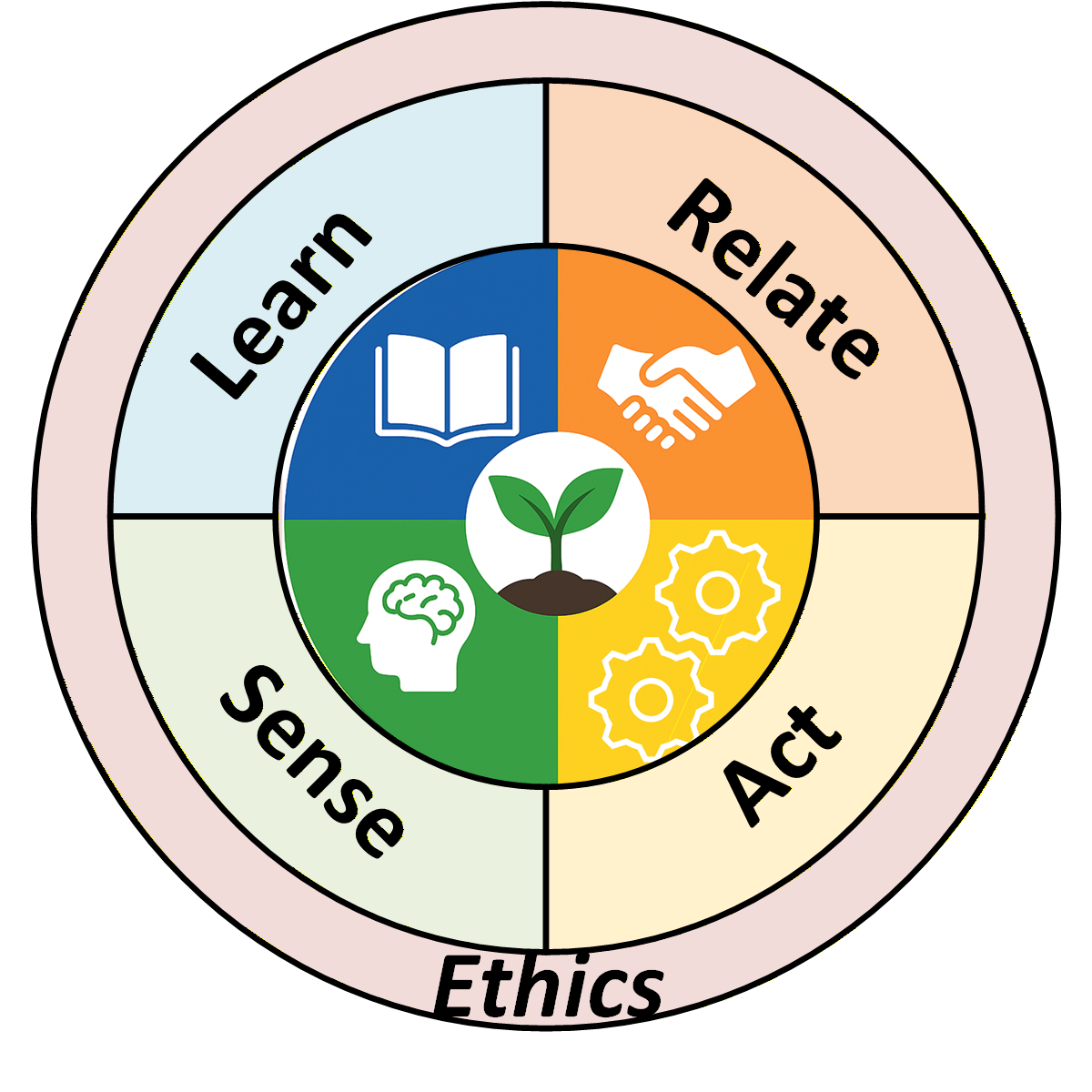
Part of the Adaptive Capacity model → View full model
Sensemaking Domain
Sensemaking is not analysis — it is the ongoing interpretation of reality in interaction.
Organisations do not perceive reality as a system.
Reality is continually constructed through the interactions between people — through conversation, disagreement, and shared experience.
Meaning does not sit in data.
It emerges in how people interpret, challenge, and respond to what is happening.
In complex environments:
- Cause and effect cannot be known in advance
- The future cannot be predicted from the past
- Decisions must be made under uncertainty, not after it is resolved
Sensemaking is therefore not a step in a process.
It is the continuous activity through which organisations understand what is going on and decide what to do next.
Sensemaking is one of the four core domains of Adaptive Capacity.
It operates alongside Learning, Relational, and Action — and is guided by Purpose and constrained by Ethics.
The organisation is not a thing that makes sense — it is the ongoing pattern of people making sense together.
👉 If sensemaking collapses, action becomes either delayed or dangerously confident.
🚩 High-Level Red Flags
- Leaders demand certainty where none exists
- Data is used to defend positions rather than explore reality
- Analysis replaces interaction and dialogue
- Disagreement is suppressed or escalates into politics
- Decisions are made quickly but revisited repeatedly
👉 These indicate that sensemaking has been replaced by control, opinion, or retrospective justification.
🧩 Core Patterns
Part 1 – Healthy Sensemaking (Seeing the System Holistically)
🌪 Managing Complexity
Modern organisations increasingly operate in environments that are:
- interconnected,
- uncertain,
- fast-changing,
- and difficult to predict.
In these conditions:
- cause and effect are often unclear,
- outcomes emerge through interaction,
- and actions create unintended consequences.
👉 Many organisational breakdowns occur not from lack of effort, but from misreading the situation itself.
In complexity:
- certainty becomes fragile,
- rigid plans weaken,
- and learning becomes essential.
👉 Complexity shifts leadership from:
- control,
toward: - sensing,
- participation,
- experimentation,
- and adaptive response.
Source Note: Managing Complexity
Source Note — At the Edge of Chaos
🌏 Seeing the System
Systems thinking is about how business reality is constructed and understood.
By applying systems thinking in sensemaking we:
- Expand perspectives beyond local views
- Surface interdependencies (capabilities, data, stakeholders)
- Reveals unintended consequences before action is planned and taken
- Prevents premature certainty
👉 Systems Thinking answers the question: “What is actually going on here?”
🔍 Meaning Emerges in Interaction
Meaning is not contained in data — it emerges through interaction between people.
- Organisations do not “see” reality — people do, together.
- Conversation, disagreement, and perspective-taking are essential.
- Stakeholder engagement is not optional — it is structural.
👉 This is where:
- Stakeholder analysis becomes real (not a template).
- Enterprise Architecture provides a broader lens.
- Multiple perspectives create a more complete view.
👉 Without interaction:
- meaning narrows
- blind spots increase
- decisions become increasingly fragile
👉 Result: Shared meaning develops through participation, not instruction (Stacey)
Source Note — Explicit Knowledge and Tacit Knowledge
Source Note — Basho and the Emergence of Collective Consciousness
Source Note: Enterprise Architecture – The Language of Business Design
Source Note: Knowledge Operating System
Business Capability Modelling — Beyond Organisational Charts and Process Maps
Common Data Models and Organisational Meaning
Stakeholder Engagement & Theory U
Meaning Emerges Through Interaction
Source Note — Operating Model in the Adaptive Capacity Architecture
🧠 Framing Determines Action
How a situation is framed determines how it is approached — and what actions are considered appropriate.
- Framing is an act of sensemaking.
- It shapes the mindset applied to the situation.
- That mindset directly influences action.
👉 If a complex situation is framed as simple:
- quick fixes are applied,
- underlying dynamics are ignored,
- and unintended consequences increase.
👉 If it is framed appropriately:
- action becomes proportionate,
- exploration replaces reaction,
- and capability is applied correctly.
👉 Result: Correct framing enables appropriate response (Snowden – Cynefin)
Source Note – Triple Bottom Line: From Profit to Prosperity
🔄 Learning Loops Close Through Action
- Sensemaking is not complete when understanding is reached — it is complete when that understanding is tested in action.
- The system only becomes fully visible when we act within it.
- Feedback from action reveals what was not seen.
👉 This means:
- Insight must be treated as a hypothesis.
- Action must be treated as a test.
- Learning emerges from the interaction between the two.
👉 In practice:
- Decisions are made under uncertainty, not after it is resolved.
- Outcomes are observed at Gemba.
- Assumptions are confirmed, refined, or overturned.
👉 Without this:
- Sensemaking remains incomplete.
- Fragility patterns persist undetected.
- Confidence grows without evidence.
👉 Result: Understanding becomes real only when it survives contact with the system
When sensemaking fails to see the system, fragility appears — predictably, not randomly.
Part 2 – Broken Sensemaking (Fragility Patterns)
🧊 False Certainty Drives Fragile Decisions
- Overconfidence replaces inquiry
- Assumptions are treated as facts
- Decisions become brittle
👉 Root cause: premature closure
👉 Certainty is claimed before reality is understood.
⚠️ One-Page Trap
-
Complex situations are compressed into a single, static representation — often through tools designed for simpler problems.
- nuance is removed
- assumptions remain hidden
- tension is suppressed
- plans fail under real conditions
👉 Clarity achieved by removing complexity is not understanding.
🐌 Analysis Paralysis Delays Learning
- Endless analysis substitutes for action
- Risk avoidance masquerades as rigour
- Learning is deferred
👉 Root cause: fear of the consequences of getting it wrong
👉 Delay is mistaken for diligence.
Systems Thinking as a Sensemaking Lens
⚠️ Do Not Force Certainty Too Early
Forcing clarity in a complex situation destroys the conditions for learning.
- Premature certainty shuts down exploration
- It replaces inquiry with control
- It creates false confidence
👉 Reinforces:
- Snowden (Cynefin) → not all problems are solvable through analysis
- Stacey → uncertainty and disagreement are inherent
👉 When certainty is forced:
- dissent disappears
- alternatives are not explored
- failure is amplified
👉 Constraint / anti-pattern within sensemaking
Framing Traps in Complex Environments
Source Note: Managing Complexity
🎭 Politics Replaces Sensemaking
- Power overrides inquiry
- Agreement is forced, not developed
- Decisions reflect interests, not understanding
👉 Root cause: breakdown of shared meaning and commitment between stakeholders
👉 When meaning collapses, power fills the void.
⚖️ Decisions Precede Certainty
Decisions must be made under uncertainty — not after it is resolved.
In complex environments:
- certainty comes after action, not before,
- waiting for clarity often increases risk.
🔑 The Paradox
You must act before you know —
but you are accountable for what follows.
This creates a permanent leadership condition:
- Act too quickly → poor judgement.
- Wait too long → missed opportunity.
👉 There is no correct point of certainty
👉 Only a responsible moment of commitment
🔷 Working Within the Paradox
This cannot be resolved — it must be managed through practice.
- Decisions are taken with incomplete understanding.
- Outcomes reveal what was not visible.
- Learning follows consequence, not prediction.
👉 This is where:
- Hansei (reflection on consequences) becomes essential.
- Learning is grounded in real outcomes, not assumptions.
- Unintended consequences become a primary source of insight
Delay often increases risk, not clarity.
Certainty is often claimed after the fact — responsibility is not.
🤿 Subject Areas
Subject Areas provide deeper and more structured exploration of specific disciplines, practices, and modelling approaches referenced throughout the pathways and Source Notes
Subject Area – Enterprise Architecture & Operating Model
Subject Area — Organisational Awareness
Subject Area: Knowledge Operating System
Subject Area – Co-Creating Purpose
Subject Area – Managing Complexity
Subject Area – The Learning Environment
Subject Area: Enterprise Architecture — Foundation of Shared Knowledge