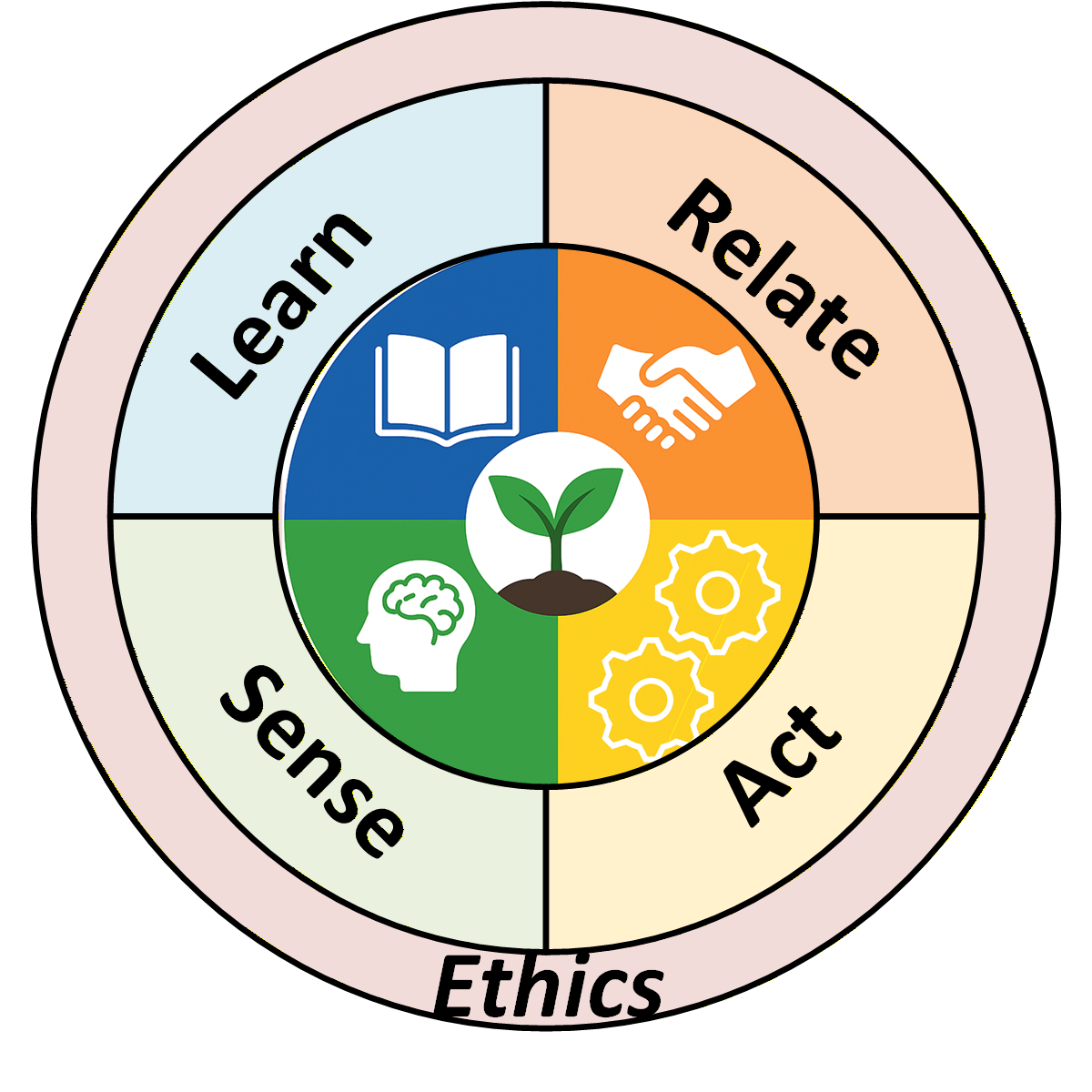
Part of the Adaptive Capacity model → View full model
Tools do not create capability by themselves.
They create value when they are connected into a coherent cycle of understanding, exploration, choice, design, action, and learning.
Used together, the tools help people move from what is known, through what might happen, to what should be done — and then test that thinking in reality.
👉 Without integration:
- tools become isolated techniques,
- assumptions remain hidden,
- decisions become disconnected from evidence,
- and learning fails to flow back into future action.
👉 Integrated tools allow:
- knowledge to inform scenarios,
- scenarios to challenge strategy,
- strategy to shape design,
- Gemba to test assumptions,
- and learning to renew the knowledge base.
👉 Result:
Tools become an adaptive system for organisational action and learning.
Action is the only place where organisations cannot pretend.
Action is not execution — it is where meaning, capability, and ethics are tested.
- Knowledge becomes real only when it is applied
- Models must survive contact with the work
- Learning is validated through consequences, not agreement
- Action reveals what people actually believe, not what they say
👉 If action is disconnected from learning, organisations become performative.
🚩 High-Level Red Flags
- Models are delivered but not used
- Work is performed outside the model
- Decisions are made without reference to shared artefacts
- Ownership is unclear or diffused
- Problems are explained rather than fixed
👉 These indicate that knowledge has not become practice.
🧩 Core Patterns
🛠 Meaning Must Be Built in the Open
- Shared understanding emerges through interaction
- Models evolve through visible challenge and refinement
- Language is negotiated, not imposed
👉 Result: Ownership and shared mental models develop through participation
Ba / Basho → Field Conditions for SECI
Stakeholder Engagement Protocol
Stakeholder Engagement & Theory U
🧪 Gemba Tests Everything
- Work reveals what is real
- Models must align with observable activity
- Assumptions are exposed through use
👉 Result: Only what survives practice becomes knowledge
Source Note: Human–AI Knowledge Base Development Guideline
⚖️ Accountability Is Structural
- Capabilities have owners, measures, and consequences
- Ethics is embedded in boundaries, not statements
- Responsibility cannot be abstracted
👉 Result: Action becomes auditable and consequential
⚖️ Accountability Is Structural
🔁 Learning Loops Close Through Action
- Learning isn’t finished when insight is achieved; it’s complete when action is taken.
- Understanding needs to be tested through practice, and feedback from these actions can refine or even invalidate previous beliefs.
👉 This means:
- insight without action remains untested,
- action without reflection leads to blindness,
- and true learning depends on both.
👉 In practice:
- Decisions are approached as experiments
- Outcomes are monitored at Gemba
- Assumptions are validated or revised
👉 Without this:
- Learning remains theoretical
- Mistakes are repeated
- Confidence grows without evidence
👉 Result: Knowledge becomes real only when it survives contact with reality
Source Note — Action & Learning Loops
Chris Argyris Perspective: Defensive Routines & Double-Loop Learning
Gemba — Where Learning Becomes Real
Source Note — Learning Loops & Sensemaking
🧑🤝🧑 Shared Action Builds Shared Understanding
⚙️🔦 Tools Patterns
Tools do not create capability by themselves.
They create value when they are connected into a coherent cycle of understanding, exploration, choice, design, action, and learning.
Used together, the tools help people move from what is known, through what might happen, to what should be done — and then test that thinking in reality.
👉 Without integration:
- tools become isolated techniques,
- assumptions remain hidden,
- decisions become disconnected from evidence,
- and learning fails to flow back into future action.
👉 Integrated tools allow:
- knowledge to inform scenarios,
- scenarios to challenge strategy,
- strategy to shape design,
- Gemba to test assumptions,
- and learning to renew the knowledge base.
👉 Result:
Tools become an adaptive system for organisational action and learning.
- Source Note – Tools Core Pattern
- Source Note: Human–AI Knowledge Base Development Guideline
- Source Note – Human-AI Scenario Planning
- Using the Human–AI Knowledge Base Tool: A NaturFlourish Example
🤿 Subject Areas
Subject Areas provide deeper and more structured exploration of specific disciplines, practices, and modelling approaches referenced throughout the pathways and Source Notes
Subject Area: Human–AI Knowledge Base Development
Subject Area – Support note for the Human AI Knowledge Base Guideline
Subject Area — Human–AI Kanban Architecture
Subject Area: Business Capability Model — Structuring What the Organisation Must Do
Subject Area: Data Modelling — Negotiating Meaning
Subject Area – Scenario Planning
Subject Area — Adaptive Thinking Systems, Design Thinking and Strategic Thinking