Adaptive Capacity
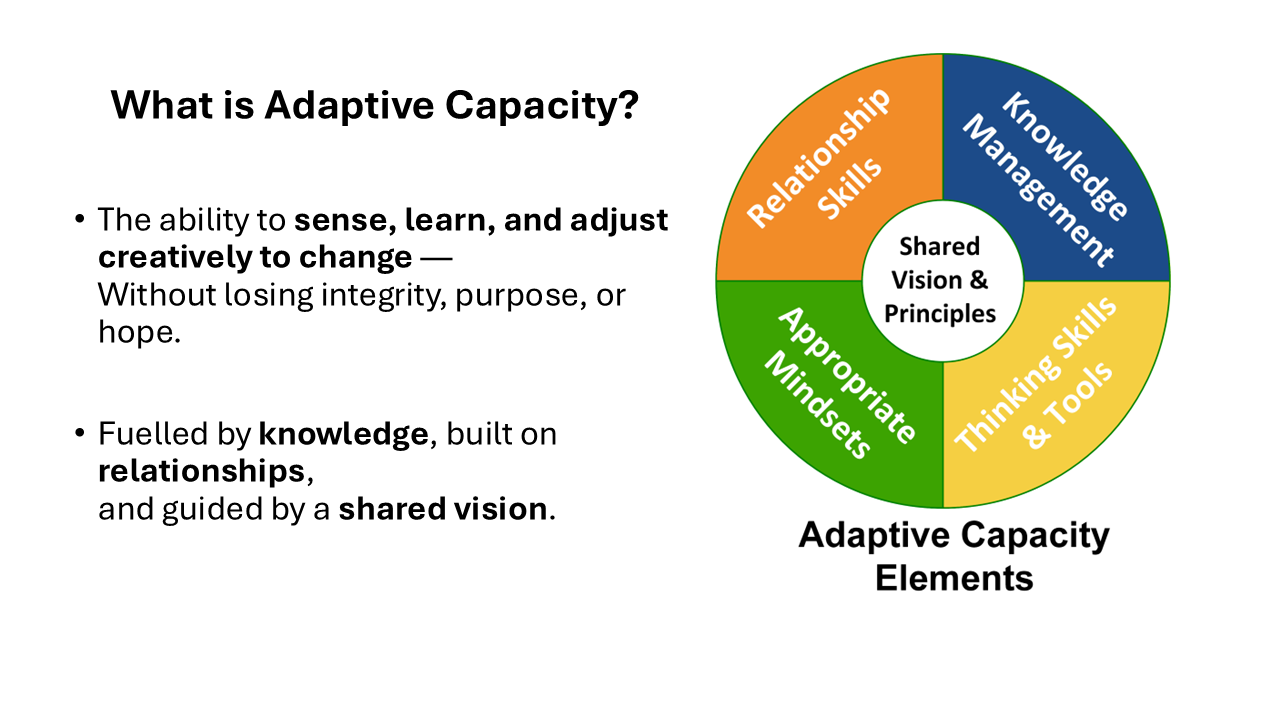
Adaptive capacity is simply the ability to sense, learn, and adjust creatively to change — without losing integrity, purpose, or hope.
- It’s built on knowledge.
- It utilises thinking Skills and tools.
- It depends on relationships. And appropriate mindsets
- And it’s guided by a shared vision or purpose.
This is the foundation of any sustainable organisation.
Knowledge Drives Adaptive Capacity
This picture captures the very heart and soul of Adapt, Survive and Flourish.
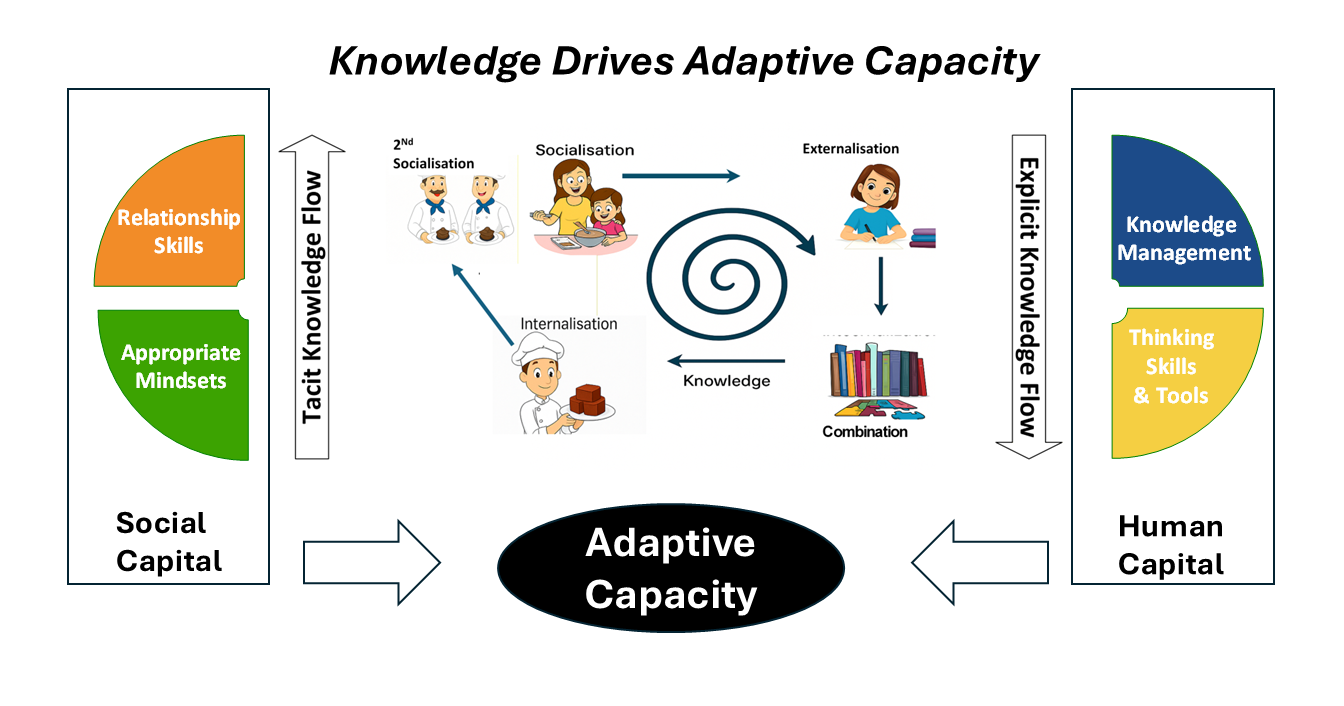
Everything we do to build sustainability and resilience — in business, in communities, even in ecosystems — depends on adaptive capacity: the ability to adjust creatively to change without losing integrity, purpose, or hope.
And at the centre of that capacity is knowledge — not data, not information, but living knowledge. This spiral is Nonaka’s SECI model for learning.
SECI (Briefly):
SECI describes a cycle of organisational learning through Socialisation, Externalisation, Combination, and Internalisation.
-
Socialisation – sharing experience directly.
-
Externalisation – articulating insights.
-
Combination – integrating explicit knowledge.
-
Internalisation – embedding learning into practice. Internalisation is the point at which new knowledge changes how people actually behave, not just what they agree with.
On the left-hand side, we see tacit knowledge in action — what we call social capital.
It’s the way people learn by doing together — the mum teaching her child to bake, or the apprentice chef learning from the master.
That’s socialisation: shared experience, trust, and story — the foundation of culture.
As that experience is reflected on and written down, it becomes explicit knowledge — what we see on the right-hand side, the realm of human capital: the skills, frameworks, and models that make knowledge transferable.
That’s externalisation and combination: the moment insight becomes structure — a recipe, a process, a method.
And then, when someone internalises that recipe and makes it their own — like the young chef creating something new — the cycle renews.
The Knowledge spiral creates ever-widening and growing ripples as it becomes richer and more widely shared.
So social capital gives knowledge its heart — human capital gives it a mind.
Together, they drive adaptive capacity — the engine of sustainability in a VUCA world.
The Knowledge Base
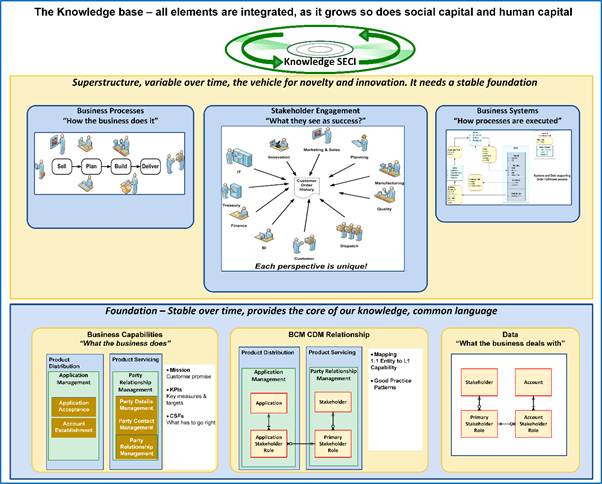
The Knowledge Base captures explicit organisational knowledge.
Knowledge — shared knowledge — is the flywheel of adaptive capacity. It fuels sensemaking, it shapes decisions, and it helps organisations stay coherent even as everything around them changes.
In our approach, we build the foundational knowledge first. Foundation, because everything else can be built on it, just like the concrete foundation of a house. The foundation, like all foundations, is stable over time.
Once the foundation is in place, the superstructure can be built, Processes, System maps and so on.
Sensemaking: Sensemaking is the collective process of interpreting ambiguous situations to determine how to act.
The Business Capability Model
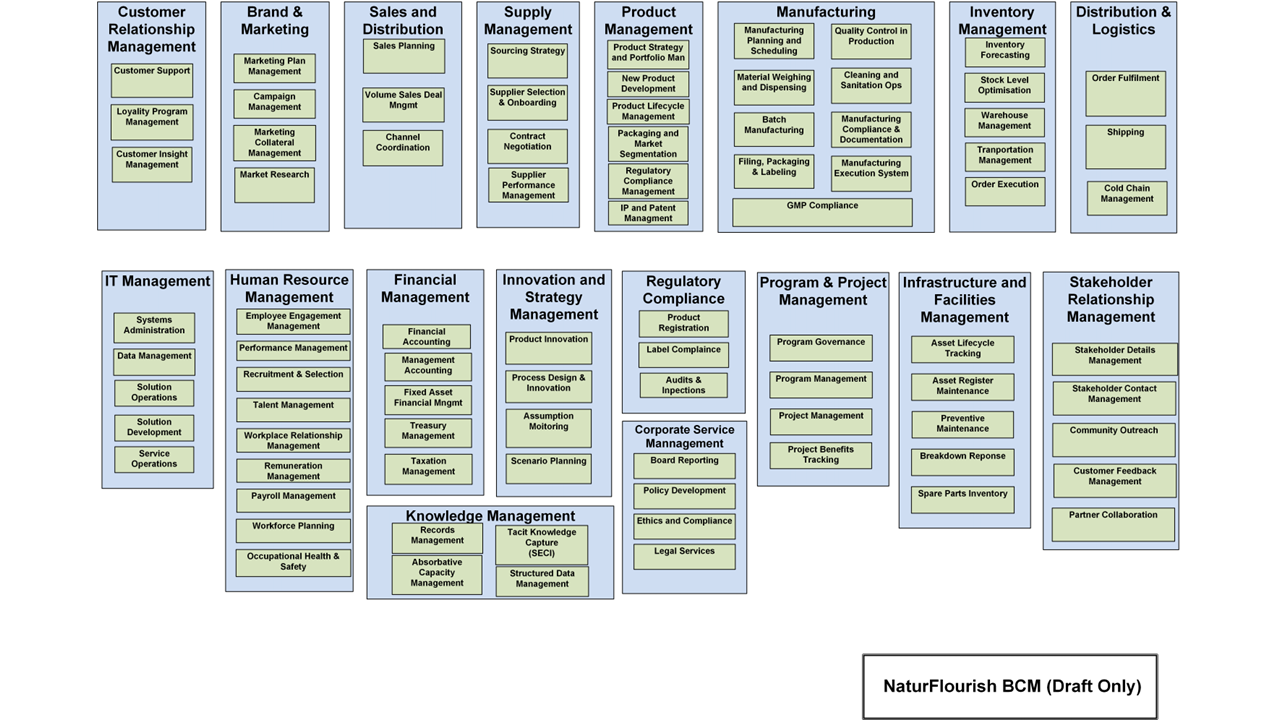
Business Capability Model (BCM) is a model of what the business does.
• Mind-sized – CxO-level appeal
• Mission – Use stakeholder engagement to develop ‘Capability Promise’ = Mission Statement
• Data Quality Management – Use as the basis for Data Ownership
• Overlays heat maps – The only limit is imagination. Capture perspectives, current and planned systems.
• Corporate Structure– Use it as the basis for business unit structure.
The Business Capability Model provides a clear overview of what the organisation needs to be able to do. It is a model of the business’s key functions.
- We can derive missions and capability pledges directly from stakeholder engagement.
- We can utilise it to anchor data ownership, heatmaps, and perspectives.
- And we can even use it as the basis for the corporate structure.
It’s incredibly adaptable and a mind sized tool that provides an excellent tool for group discussions.
Mind-sized describes information, models, or representations that are scaled to what people can realistically hold, understand, discuss, and act on — individually and collectively — without cognitive overload.
The Common Data Model
Common Data Model: Business Use
If the BCM is the map of our actions, the Common Data Model (CDM) is the organisation’s semantic backbone. The CDM represents what the business deals with.
It fosters interoperability by providing a common language.
It links business concepts, metrics, and lineage.
And it gives AI the context it needs to be trustworthy and valuable.
- Doing it is a Socialisation opportunity – builds Social Capital:
-
- Builds Trust and Cooperation – a Virtuous Cycle.
- Creates empathy and shared understanding – Silo Smashing.
- Network Building – Puts people in touch with each other and encourages good relationship skills.
- The tool for Proactive Data Quality Management’
- uilds Shared Language – the basis for your Glossary.
Common Data Model: Technology’s Semantic Backbone
- Interoperability:The CDM defines a shared language of meaning for metadata, APIs, and data products.
- Semantic Layer:It connects business concepts, metrics, and lineage — linking human understanding with machine reasoning.
- AI Enablement:Provides the trusted map AI needs for context, definition, and consistent insight.
In essence:The CDM is the semantic backbone connecting people, data, and intelligent systems
Shelfware to Workwear
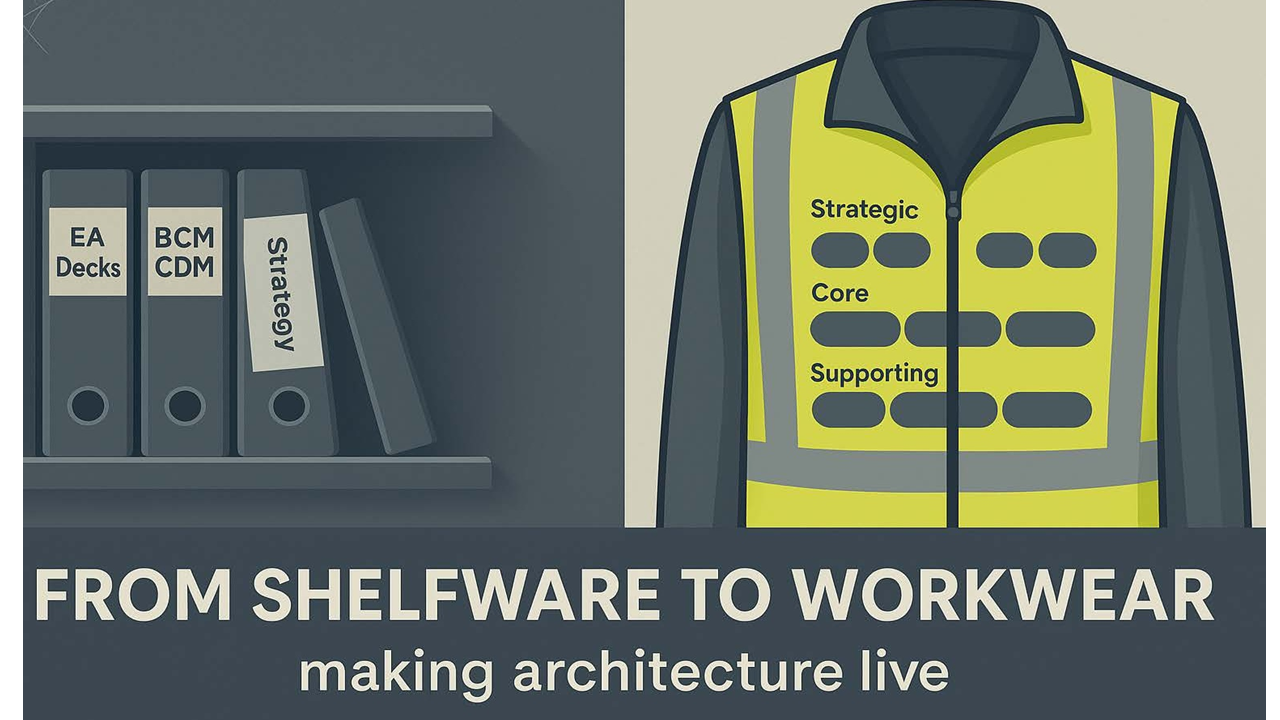
Shelfware to Workwear: If your not using them as part of your business as usual and in innovation thay are shelf ware, doomed to be lost foreever.
I spent the last 10 years practising Data Modelling as a consultant. Consultants are not usually hired to develop a data model; it’s typically part of a much larger engagement, and the socialisation of the finished model was rare. It costs money and time. As a result, I know most of my work becomes shelfware, not workwear. I hate waste!!!
DSPR and EA
DSPR is an approach developed by Derek and Laura Cabrera that gives a way to view the world as a system – Systems Thinking.
- Distinction – What is included in our consideration, what is outside.
- System – What is the ‘element’ of the system we are cosideriung in the hierarchy of all systems elements. What does it contain? What is it contained in?
- Perspective – What are the perspectives we should consider? Why are they important?
- Relationships – What are relationships it has with other elements?
This table shows how DSPR is realted to Enterprise Architecture.
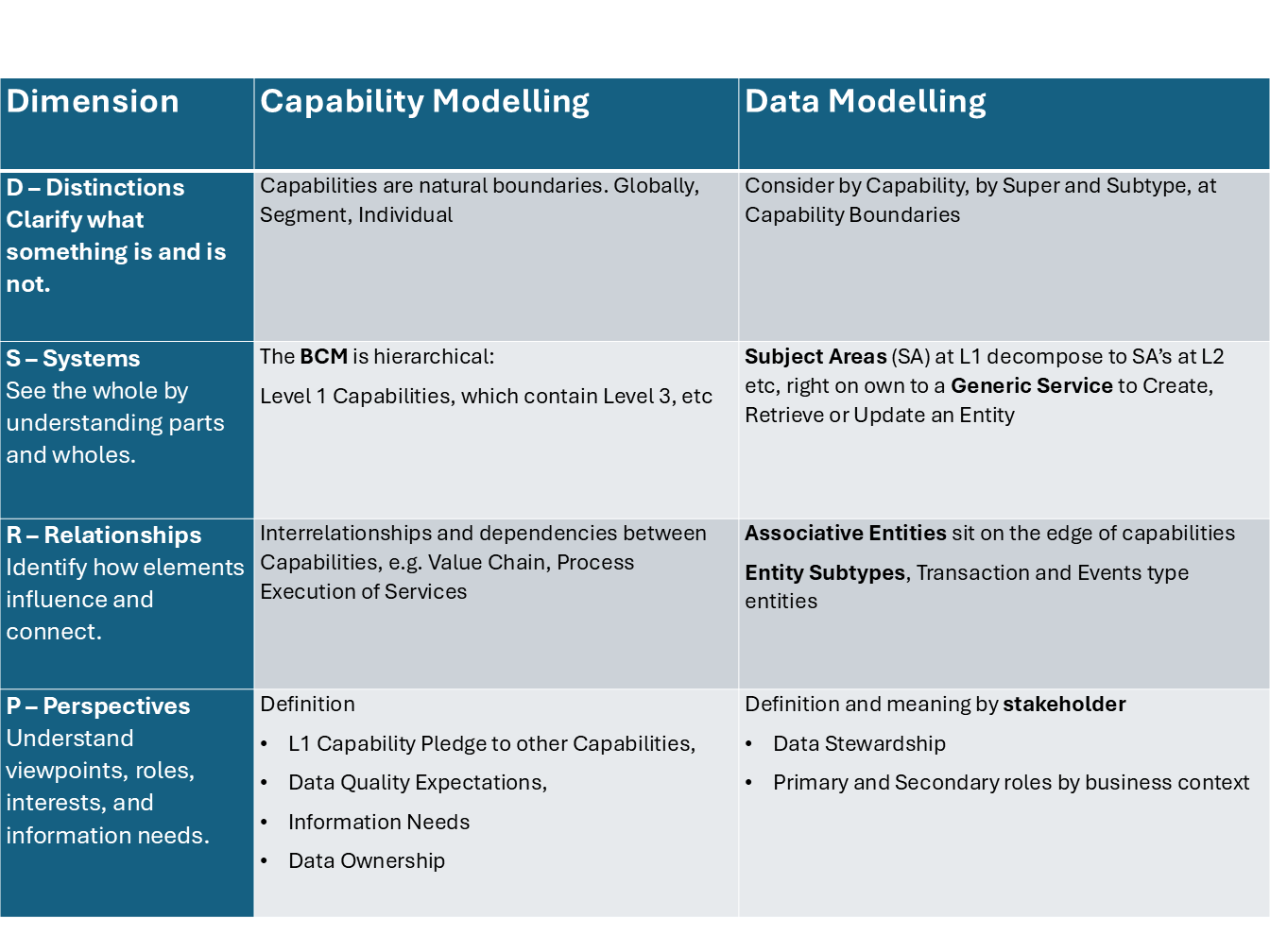
DSPR related to Capability Model and Data Model
SECI and DSPR
DSPR also has a strongrelationship as a sensemaking approach to apply in the Socialisation stage of SECI.
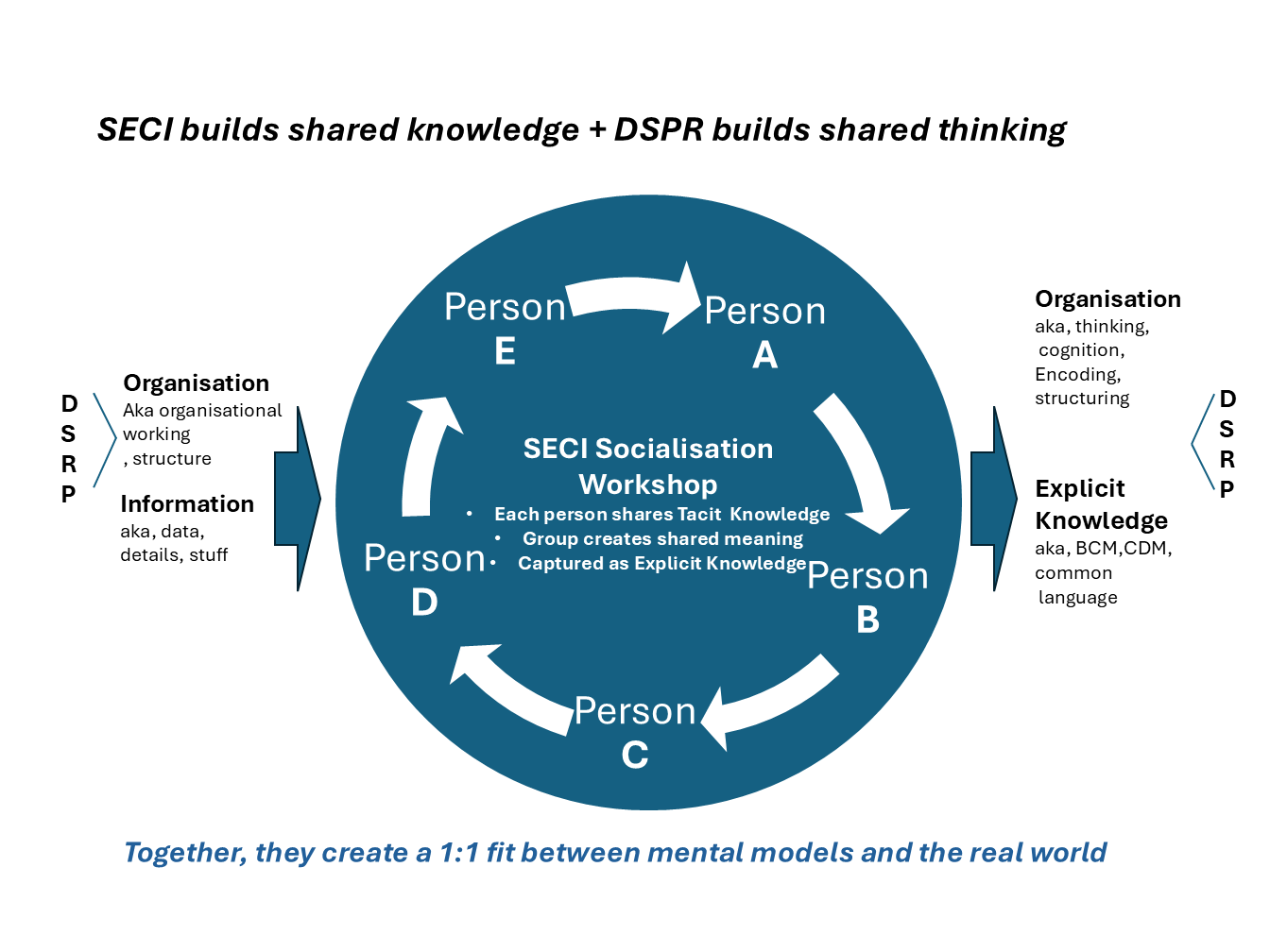
DSRP and SECI
The SECI model describes how organisations generate shared knowledge through cycles of socialisation, externalisation, combination, and internalisation. However, SECI mainly overlooks the mental processes through which groups solidify meaning into clear representations of reality.
To address this, we combine SECI with the DSRP framework, which explains four universal patterns of human sensemaking:
Distinction: Making a distinction to determine what something is or what it is not.
This provides a boundary for discussions. If something is raised that falls outside this boundary, it can be set aside for further discussion. Distinction is a focusing tool.
System: How is the system ecosystem organised?
What are the parts – What higher system is ours a part of? See the whole by understanding its parts and how they connect. Consider what larger system this part belongs to and where it fits in the bigger picture.
Relationships: Identify how elements influence and connect.
How do the elements work with each other? If I am baking a cake what order should I add the ingredients to the bowl? What is the relationship between oven temperature and cooking time?
Perspectives: Understand viewpoints, roles, interests, and information needs.
Who are the other stakeholders involved, and what are their interests? Iif we are habking a cake, do the people who will eat the cake have food allergies we need to consider? How many people are we going to feed?
SECI mainly works when people interact within a shared Ba, a shared space where people feel valued, included and safe. Workshops and modelling sessions help everyone bring out their tacit experiences, understand each other better, and develop a common language. On the other hand, DSRP focuses on collective thinking: it shows how those newfound insights are structured into solid ideas that can be thought about, questioned, and applied throughout the organisation.
We therefore distinguish between shared knowledge and shared thinking. SECI creates shared knowledge by aligning experience and interpretation; DSRP develops shared thinking by aligning how participants structure and interrogate that knowledge. Together, they establish a one-to-one link between organisational mental models and the realities they aim to represent.