(An Argyris-aware view of coherence, learning, and leadership)
Purpose
This note explains why large-scale reform often fails despite strong evidence, moral clarity, and broad agreement — and what transformational leadership needs to do differently.
Islands of Coherence
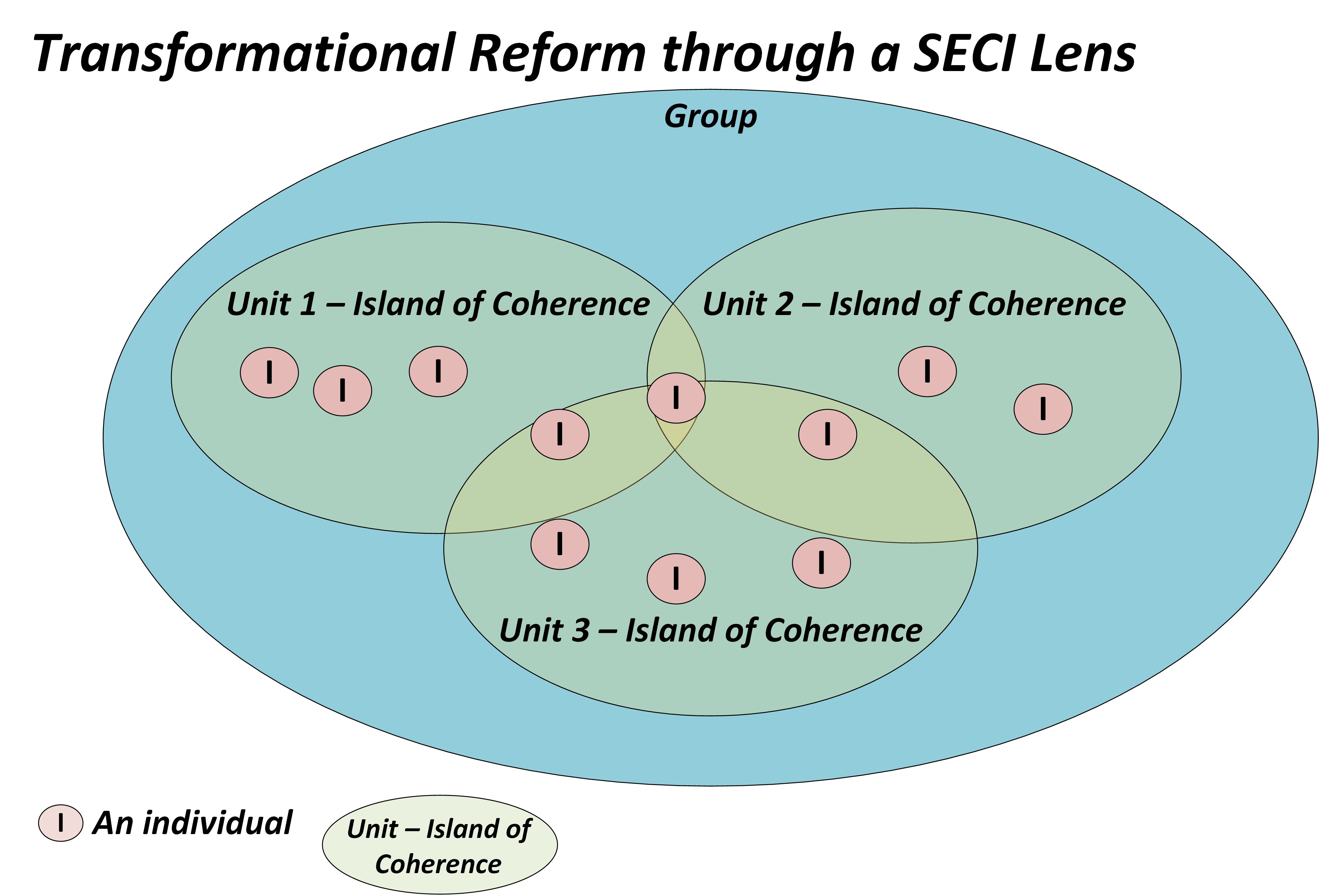
The diagram above frames reform as a knowledge creation and internalisation problem, not a communication or policy problem.
________________________________________
Islands of Coherence
An Island of Coherence is a bounded social system where, within a specific context, individuals’ theories-in-use are sufficiently aligned with their stated intent and ethical commitments, so that patterns of action stay consistent — even when those theories are brought to the surface and challenged under pressure.
Coherence is therefore not agreement, consensus, or compliance.
It is the stability of behaviour when it would be easy to revert.
________________________________________
Units (the smallest islands that matter)
A Unit is the smallest trusted social group where individuals are willing to share tacit knowledge — including doubts, intuitions, and ethical discomfort — without fear of reprisal or loss of status, within a specific context.
A unit isn’t a formal team. It’s more like “the people I trust with my innermost thoughts in this context.”
Most people belong to multiple units simultaneously, across different contexts (professional, ethical, cultural, political). This creates overlapping islands — and complexity accelerates very quickly.
________________________________________
The Group Context
The Group represents the broader organisational or societal system within which multiple units coexist.
Crucially:
- The Group may appear coherent.
- Language may be aligned.
- Policies may be agreed.
- Reports may be compelling.
…while coherence exists only locally, inside certain units. This is where reform stalls.
________________________________________
Reform as a SECI problem
SECI (Briefly):
SECI describes a cycle of organisational learning through Socialisation, Externalisation, Combination, and Internalisation.
-
Socialisation – sharing experience directly.
-
Externalisation – articulating insights.
-
Combination – integrating explicit knowledge.
-
Internalisation – embedding learning into practice. Internalisation is the point at which new knowledge changes how people actually behave, not just what they agree with.
Transformational reform requires movement through SECI, not just information flow.
In particular:
- Socialisation occurs within units and across boundaries on the edge.
- Internalisation must occur within individuals.
- Artefacts (reports, policies, frameworks) sit largely in Combination.
Most reform efforts stop at Combination and mistake Socialisation for success.
________________________________________
The hard part: overlapping units
In figure 1, Unit 1 signifies a cohesive, reform-oriented unit within a specific ethical setting.
Some individuals belong solely to Unit 1. Others are part of both Unit 1 and either Unit 2 or Unit 3, which may not share the same ethical commitments.
These shared individuals become the only viable bridges for reform.
However, reform does not spread through persuasion or documentation.
It spreads only if those individuals internalise the ethical case strongly enough to influence their behaviour across different contexts.
________________________________________
The Reform Condition
For reform to take hold at Group level:
Unit 1 must maintain internal coherence while creating overlapping spaces of Socialisation with non-aligned individuals in Unit 2 and Unit 3 — ensuring that shared individuals can Internalise the ethical case within their own practice.
- This is slow.
- This is relational.
- This is uncomfortable
- And it cannot be delegated to PowerPoint.
________________________________________
Why most reform fails
Because leaders confuse:
- Shared language with shared commitment.
- Articulation with adoption
- Reflection with change.
This produces a dangerous illusion of progress. Which brings us to the central distinction.
________________________________________
The knockout distinction
Socialisation is demonstrated by shared language.
Internalisation is demonstrated by constrained action.
- If nothing has become unavailable to someone,
- if no option has been quietly taken off the table,
- if behaviour does not change under pressure.
then Internalisation has not occurred.
No matter how eloquent the explanation.
________________________________________
The leadership challenge
Internalisation cannot be:
- Mandated.
- Self-reported.
- Audited directly.
- Accelerated safely.
It can only be inferred retrospectively, from behaviour over time, especially when:
- Incentives pull the other way.
- Status is at risk.
- No one is watching.
This is why transformational leadership is rare — and why glossy reforms fail.
________________________________________
Final note
- Producing reports creates artefacts.
- Socialisation creates understanding.
- Only Internalisation creates change.
- Everything else is theatre.
________________________________________The Bridge Condition
Reform cannot propagate abstractly
Reform does not move via:
- Reports.
- Evidence.
- Argument.Policy.
- Moral exhortation.
Those sit in Combination and, at best, Externalisation. Consider this table, this is what can happen when there is not time and resources allowed for both Soclialisation and Internalisation.
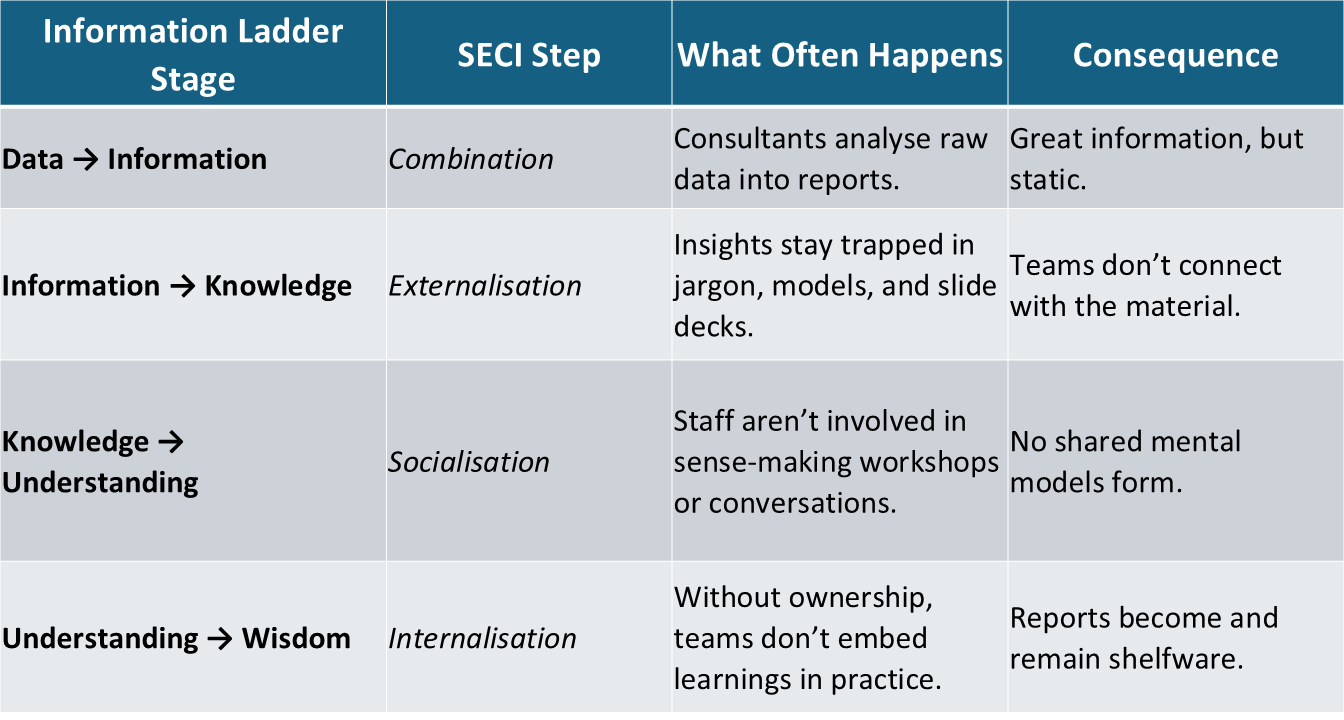
Reform can only propagate via people who have internalised it and who operate credibly in more than one coherent context.
This is not opinion. It follows directly from SECI.
________________________________________
Shared individuals are structurally necessary
The bridging design constraint:
Reform across Islands of Coherence requires individuals who are members of more than one island and are willing to uphold ethical commitments across different contexts.
Without such individuals:
- Socialisation cannot cross boundaries.
- Internalisation remains local.
- The Group cannot change.
This explains why reform often looks successful locally and fails globally.
________________________________________
Why polarisation is systemically destructive
This is not political commentary; it is a structural observation.
In polarised systems:
- Units harden into identity-bound islands.
- Overlapping membership collapses.
- Shared individuals are attacked or expelled.
- “If you’re not with us, you’re against us” becomes a gatekeeping rule.
When that happens:
The system destroys its own learning pathways.
At that point, reform is no longer difficult — it is structurally impossible, regardless of intent or evidence.
________________________________________
The crucial distinction: diversity vs tolerance of diversity
This is an important clarification:
- Diversity describes difference.
- Tolerance of diversity describes the ability to maintain relationships despite differences.
Only the second enables:
- overlapping membership.
- ethical socialisation.
- internalisation across contexts.
Therefore:
- Diversity does not enable reform.
- Tolerance of diversity enables the bridges reform requires.
Anxiety, Defensive Behaviour, and the Collapse of SECI
Transformational reform is frequently blocked not by lack of information or analytical capability, but by anxiety-driven defensive behaviour. Two such behaviours recur consistently in reform efforts: knowledge hiding and knowledge hoarding. Both inhibit learning, but they do so at different points in the SECI cycle, and both ultimately prevent Internalisation.
Knowledge hiding is driven by fear of personal harm. Individuals withhold what they know because surfacing it would expose them to risk — reputational, relational, or professional. This behaviour blocks Socialisation at its source. Tacit knowledge never enters the shared space, ethical discomfort is not voiced, and problematic practices remain unnamed. The absence of dissent is mistaken for agreement, and silence is misread as coherence.
Knowledge hoarding is driven by fear of loss. Individuals may participate in conversation and contribute to shared language, but withhold the full substance of their knowledge because sharing would erode status, power, or perceived indispensability. This behaviour allows superficial Socialisation to occur, but actively resists Internalisation. Shared understanding may appear to form, yet individuals remain unwilling to bind themselves to new constraints on action.
In both cases, learning collapses before it reaches Internalisation. Where knowledge is hidden, ethical options are never surfaced. Where knowledge is hoarded, ethical options are known but not adopted. Behaviour remains unconstrained, and reform remains illusory. Defensive routines persist, consistent with Argyris’ observation that theories-in-use override espoused intent.
Transformational reform therefore requires more than dialogue or artefacts. It requires conditions in which individuals can surface tacit knowledge without fear of harm, and share knowledge without fear of loss. Without addressing these anxiety-driven behaviours, SECI degenerates into language and documentation, while patterns of action remain unchanged.
A final note on reform
Reform spreads primarily through people, not just ideas within organisations or societies. When individuals are able to operate within multiple coherent contexts, reform can propagate. Conversely, when those shared individuals are attacked, expelled, or pressured into binary identity choices, reform progress stalls. Polarisation is more than mere disagreement; it involves dismantling the social pathways that facilitate ethical internalisation. Merely having diversity is not enough for reform; it is the tolerance for diversity — the ability to maintain relationships despite differences — that preserves the social bridges necessary for reform to thrive.