Organisational Learning Ecosystem is the living network of purpose, relationships, knowledge, culture, structures and interactions that enables an organisation to sense, learn, adapt and act.
It is not the whole ecosystem around the organisation. It is the organisation’s internal learning ecology: the social and structural environment through which people notice change, interpret meaning, share knowledge, test assumptions, reflect on experience and adjust practice.
In Adapt, Survive and Flourish, the Organisational Learning Ecosystem matters because organisations do not adapt through strategy, process or technology alone. They adapt through the interaction of purpose, social fields, learning, structure and action.
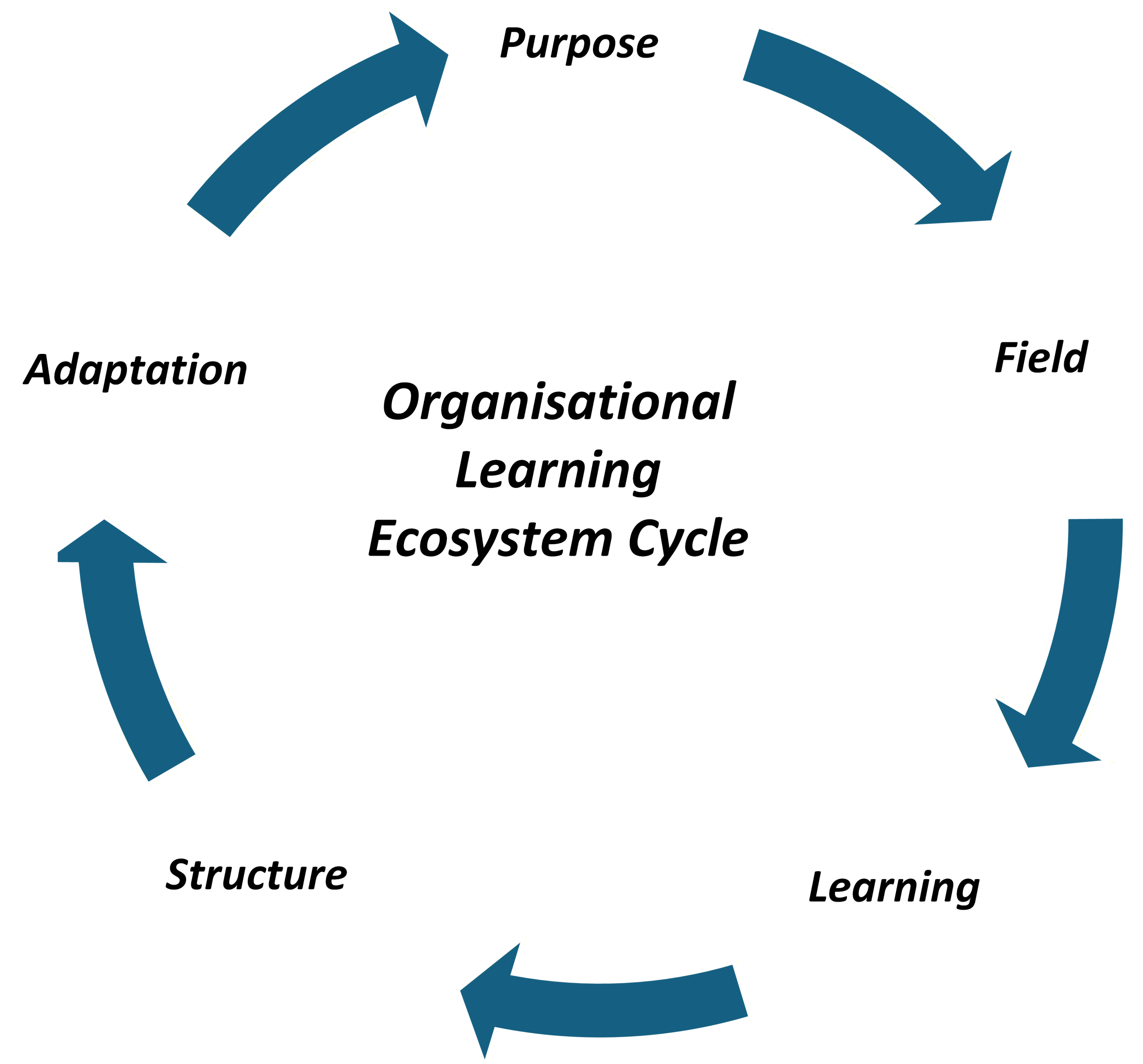
This creates a simple but powerful cycle:
The Organisational Ecology Cycle
Purpose
Purpose provides direction, meaning and ethical boundaries.
It helps people understand why the organisation exists, who and what it serves, and what kinds of action are acceptable. In the framework, this connects strongly to Basho: the deeper grounding of meaning, ethics and shared intention.
Field
Field refers to the social and relational environment in which people interact.
It includes trust, relationships, shared context, psychological safety, power, identity, culture and the quality of conversation. This connects strongly to Ba: the lived social space where knowledge can be shared, created and evaluated.
Learning
Learning transforms experience into shared understanding.
It happens through dialogue, reflection, Gemba, Hansei, practice, feedback and the movement between tacit and explicit knowledge. SECI helps explain how knowledge is created, shared, combined and internalised.
Structure
Structure embeds learning into the organisation.
It includes roles, capabilities, routines, processes, systems, data, decision pathways, constraints and governance. Structure matters because learning that is not embedded often disappears when people move on, attention shifts, or pressure returns.
Adaptation
Adaptation changes how the organisation responds to reality.
It is not just a reaction. It is the ability to adjust behaviour, structure and understanding as conditions change. Adaptation then creates a new experience, which can renew purpose and begin the cycle again.
An Organisational Learning Ecosystem is therefore not just a description of organisational life. It is a way to understand how Adaptive Capacity is created, weakened, or renewed over time.
Why Organisational Learning Ecology Matters
Organisations frequently attempt to boost performance by altering their structures, systems, processes, roles, or technology. While these changes might be necessary, they are rarely enough on their own. An organisation’s capacity to adapt also relies on the quality of its relationships, the trust among its members, how knowledge is shared, the prevailing assumptions, and whether learning aligns with real-world realities. The concept of Organisational Learning Ecology sheds light on why identical strategies, systems, or processes can lead to vastly different results across organisations. Often, the key difference is the environment—or ecology—into which the change is implemented.
A healthy organisational learning ecology supports:
- Trust and participation.
- Shared purpose and ethical boundaries.
- Dialogue and reflective learning.
- Knowledge creation and sharing.
- Connection between structure and lived reality.
- Adaptation without fragmentation.
- Resilience under pressure.
An unhealthy organisational learning ecology may produce:
- Siloed thinking.
- Defensive behaviour.
- Quick-fix cycles.
- Silver-bullet solutions.
- Performative consultation.
- Validation without learning.
- Structures that no longer match reality.
- Strategy that sounds coherent but does not change practice.
Organisational Ecology and Leadership
Organisational ecology shifts the leadership question from:
Do we have the right strategy?
to:
Are we learning, adapting and acting responsibly in response to reality?
This does not make strategy unimportant. It places strategy within a living system of relationships, knowledge, behaviour and consequence.
Leaders influence organisational ecology by shaping what is noticed, what is safe to say, how disagreement is managed, whether weak signals are heard, how learning is treated, and whether structures remain connected to reality.
In Plain Terms
Organisational ecology is the way an organisation lives.
It is how people relate, learn, decide, remember, structure work and respond to change.
An organisation does not adapt as a machine. It adapts as an ecology.
Related Concepts
- Adaptive Capacity
- Basho
- Ba
- SECI
- Gemba
- Hansei
- Social Capital
- Knowledge Operating System
- Business Capability Model
- Trust
- Sensemaking
- Islands of Coherence
- Triple Bottom Line
- Stewardship
For more for information see:
- Source Note: Organisational Ecology – How Organisations Learn and Adapt
- Ba / Basho → Field Conditions for SECI
- SECI: Not a Knowledge Model — A Learning System in Motion
- Gemba — Where Learning Becomes Real
- Hansei — Reflection That Forces Correction
- Source Note – Line of Sight
- Source Note — Learning Loops & Sensemaking
- Source Note: Managing Complexity
- The Great Inertia
- Trust — Why People Stop Contributing
- Culture, Social Capital, and the Flow of Knowledge
- Subject Area – The Learning Environment
- Subject Area — Feedback
- Subject Area: Knowledge Operating System
Subject Area — Gemba: Where Learning Becomes Real