A Navigation Map for Working in Complexity
Framing Insight
Most organisational failures are not failures of effort.
They are failures of interpretation.
People act on incomplete understanding, hidden assumptions, fragmented knowledge, and overly simplified representations of reality. They confuse information with meaning, agreement with understanding, and planning with learning.
As organisations grow in scale and complexity, this challenge becomes more pronounced.
- Information increases.
- Reports increase.
- Models increase.
- Data Lakes are created.
- Dashboards become more sophisticated.
- Meetings increase.
Organisations often invest heavily in mechanisms for storing information and creating dashboards while investing far less in mechanisms for creating shared meaning, building coherence, and improving the health of the social ecology.
Yet shared understanding often declines.
The challenge is not a lack of information.
The challenge is creating the conditions through which people build mutual trust and respect, collectively make sense of reality, learn, and act coherently.
This navigation map brings together the major concepts explored throughout Adapt, Survive and Flourish and the associated Source Notes and Subject Areas.
Sensemaking — Understanding Reality
The initial challenge lies in comprehending what is occurring. Organisations function in settings marked by uncertainty, complexity, conflicting viewpoints, incomplete data, and delayed outcomes.
Before making decisions, they need to build a clear understanding of their situation. Sensemaking entails:
- viewing the system as a whole rather than isolated incidents,
- identifying assumptions,
- considering various perspectives,
- recognising constraints,
- detecting patterns,
- questioning seeming certainty,
- and staying open to the possibility of being wrong.
The goal is not to attain certainty but to develop a sufficiently coherent understanding to proceed with action.
To strengthen your ability to make sense of complex situations, explore these essential skills:
- Managing Complexity
- Systems Thinking
- Line of Sight
- Shared Mental Models
- Questioning
- Design Thinking and Strategic Thinking
Relational Field — Creating the Conditions for Understanding
Understanding does not arise in isolation.
People can attend the same meeting, read the same report, and use the same systems, yet still leave with fundamentally different interpretations of reality.
Meaning emerges through interaction.
The quality of the relational field determines whether assumptions are questioned, uncertainty can be openly discussed, disagreements are tolerated, tacit knowledge is shared, feedback is received, and learning occurs.
Trust, mutual trust, respect, psychological safety, dialogue, and voluntary contribution are not soft cultural issues.
They are essential conditions for adaptive learning.
As relational coherence deepens, organisations move beyond information exchange toward shared understanding.
Under favourable conditions, Basho moments can arise—fleeting collective experiences where participants temporarily go beyond their individual views and encounter heightened shared awareness, coherence, and resolve.
To strengthen your ability to make sense of complex situations, explore these essential skills:
- Ba and Basho
- Trust
- Psychological Safety
- Social Ecology
- Dialogue
- Voluntary Contribution
- The Learning Environment
Learning — Transforming Understanding into Capability
Learning is the process through which understanding evolves.
Learning requires more than information transfer.
It requires:
- reflection,
- experimentation,
- challenging the status quo,
- giving and receiving feedback,
- adapting to uncertainty and complexity,
- and the willingness to revise assumptions and move on.
Organisations learn when people challenge existing mental models, develop new understanding, test ideas against reality in practice, and integrate the results into future action.
To strengthen your ability to make sense of complex situations, explore these essential skills:
- SECI
- Knowledge Operating System
- Learning Loops
- Hansei
- Feedback
- Shared Mental Models
Learning is not the accumulation of knowledge.
Learning is the development of personal competency and organisational capability.
Practice — Where Reality Teaches
Learning becomes real when it encounters consequences. When it becomes real, it becomes useful.
This is the role of Gemba.
At Gemba:
- assumptions are evaluated,
- plans meet reality,
- trade-offs become visible,
- consequences emerge,
- and learning becomes unavoidable.
Without practice, learning remains theoretical.
Without consequence, understanding remains untested.
Reality is the ultimate teacher.
To strengthen your ability to learn through action and consequence, explore these essential skills:
- Gemba
- Enterprise Architecture
- Stakeholder Engagement
- Feedback
- Adaptive Inquiry
Knowledge becomes capability only when it survives contact with reality.
Consequence, Renewal and Adaptive Capacity
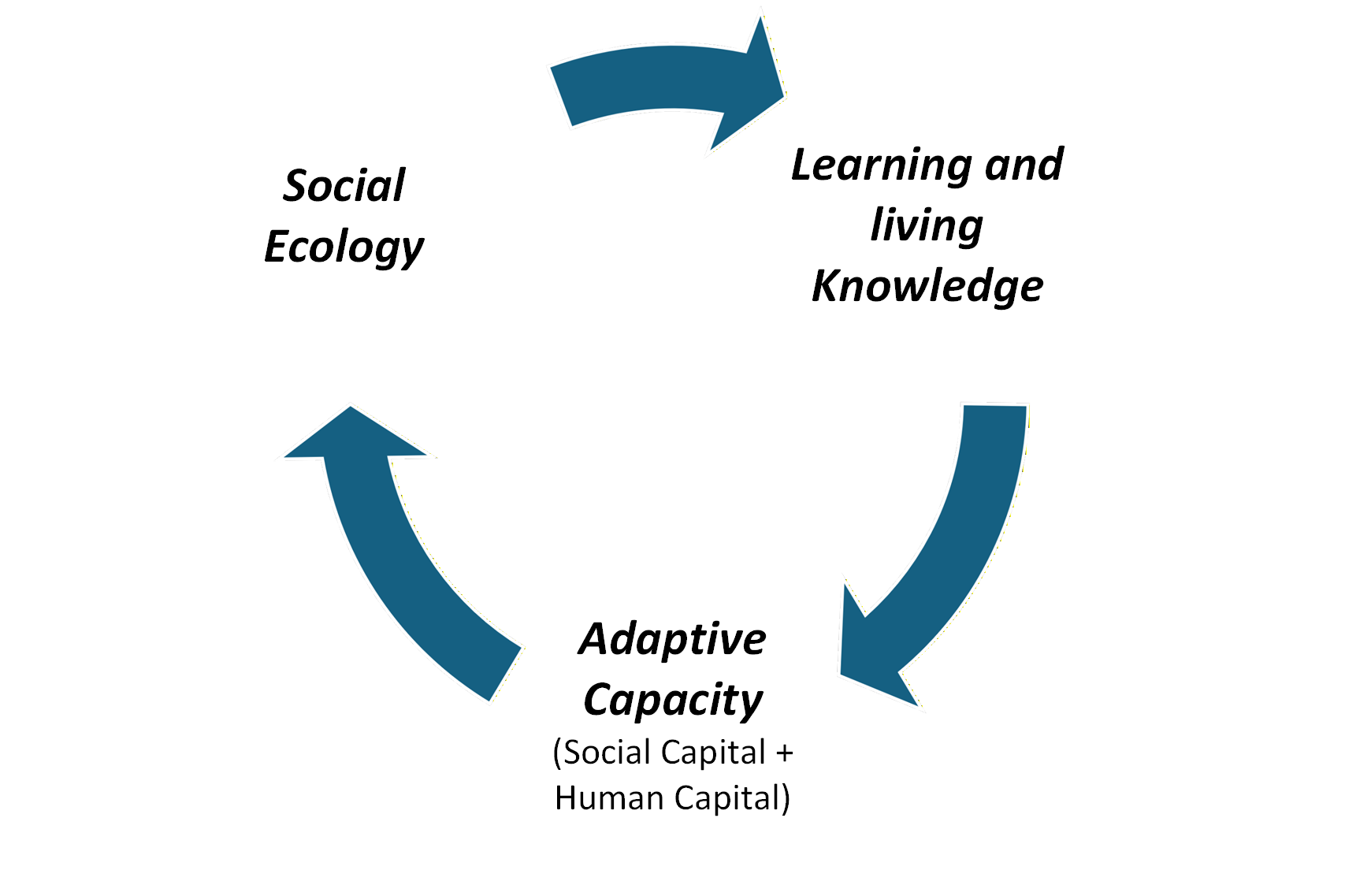
Adaptive Capacity Cycle
The cycle never ends.
Adaptive organisations do not seek permanent certainty.
They continually renew their understanding through interaction with reality.
As the cycle repeats, organisations strengthen their adaptive capacity — their ability to learn, coordinate, respond, and flourish in changing conditions.
The One-Page Trap
A common failure mode occurs when organisations attempt to bypass this cycle.
Complex situations are compressed into metrics, charts, and indicators.
This creates:
- apparent clarity,
- superficial alignment,
- hidden assumptions,
- suppressed tension,
- and fragile decisions.
A dashboard may fit on one page or a few screens.
Reality does not.
Understanding emerges through participation, learning, dialogue, consequence, and experience over time.
Core Insight
Systems do not integrate.
Meaning does.
Learning does not emerge from information alone.
It emerges through sensemaking, relational coherence, learning, practice, and consequence.
Adaptive Capacity develops when these elements operate together as a living system.
Explore further
This article connects to the broader framework:
- Ethical Domain — how constraints shape decisions
- Sensemaking Domain — how organisations interpret reality
- Relational Domain — how trust and coordination emerge
- Learning Domain — how knowledge is created and tested
- Action Domain — how intent becomes capability
To understand more on Purpose detailed Subject Areas, visit the Deep Dive section.
📖See the Books