The ability of people, teams, organisations, and communities to learn, adapt, and respond effectively to change.
In Adapt, Survive and Flourish it is the combination of Social Capital and Human Capital.
Mario’s definition: “…. social capital is about connections and trust. Human capital is the capability side: what people know, how they think, their abilities, and what they can do”.
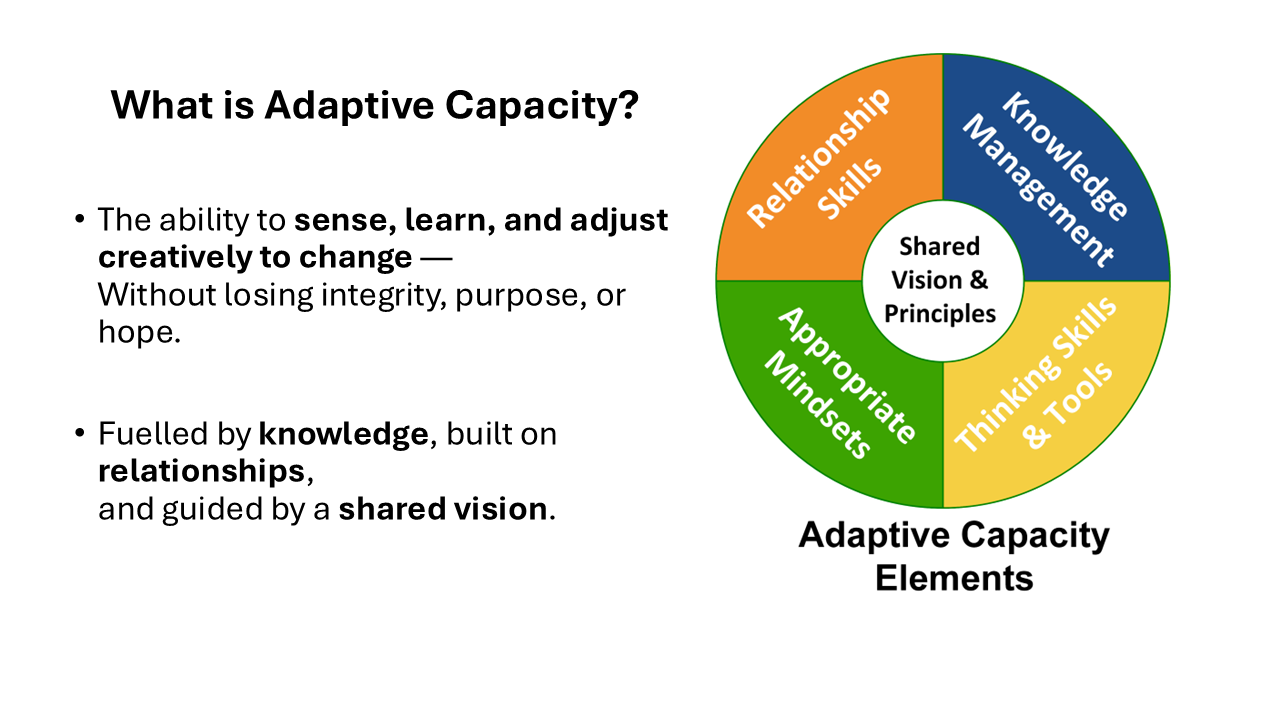
Shared Vision and Shared Principles
Shared vision is precisely that: a vision shared and owned by all, not merely a motherhood statement on a website or a boardroom wall. It represents an opportunity to co-create a future with which all can engage.
Shared principles are core guidelines offering a framework for planning and implementing action. The keyword here is ‘shared’. Sharing means engaging multiple stakeholders across different disciplines in the discussion. Shared vision and principles are core components of the cognitive dimension of social capital.Appropriate Mindset
The shared vision and shared principles offer motivation and direction. A suitable mindset for a specific context establishes a framework for the right attitudes, beliefs and perceptions that influence how we react to situations, challenges and opportunities. Mindset determines how we choose to think, act and adapt.
Relationship Skills
No matter how good all the other elements are, we are always totally reliant on how well people relate to each other; how much they respect one another and how effectively they communicate, listen (or not), handle their differences, and ultimately collaborate. Healthy and practical relationship skills are essential in building both social capital and human capital.
Knowledge Management
In our context, knowledge management encompasses discovering, acquiring, building and sharing knowledge. It also involves recognising, capturing and disseminating tacit knowledge. Our collective understanding powers our thinking. It’s important to understand that information does not equate to knowledge. We find ourselves inundated with information, often lacking the necessary expertise for effective responses at individual and team levels. As discussed in depth regarding knowledge management, one outcome of knowledge building and sharing is the creation of a shared language and mental models. These elements significantly contribute to the cognitive dimension of social capital.
Thinking Skills and Tools
With the right vision, appropriate mindset and valuable knowledge, we can apply a set of well-proven thinking tools to tackle our challenges. Thinking broadly divides into two types: (1) possibility thinking and (2) practicality thinking. Both have different purposes and approaches and are applied in a coordinated manner to drive business strategy, business design, innovation and continuous improvement.
See the book, Adapt, Survive and Flourish