Every so often, an old idea shakes the walls. This week, my windows were literally rattling as I rediscovered the work of Ralph D. Stacey, a key influencer from more than a decade ago.
Rereading his words, I realised how deeply they still resonate — not as nostalgia, but as a kind of echo from the future.
We live in a time when the word ‘complexity’ is used so freely that it risks losing its meaning. Yet Stacey never used it lightly. Long before complexity theory became a management cliché, he was exploring what happens inside organisations when certainty evaporates — when plans stop working, when agreement fractures, when leadership becomes something other than control.
His insight was both radical and liberating: knowledge can’t be managed. It emerges in the relationships between people. It’s alive, unpredictable, and constantly co-created.
Here, “knowledge” refers to the meaning that emerges through interaction — not information stored in systems or documents.
The management illusion
For half a century, our management culture has been built on a seductive illusion: that if we collect enough data, codify enough knowledge, and design the perfect plan, we can control the future.
That logic works beautifully for problems that are close to certainty and close to agreement — routine operations, repetitive processes, stable environments. Stacey called this the zone of order.
But as the world becomes more interconnected and volatile, most of our real challenges move outside that comfort zone. We face uncertainty about what will work and disagreement about what matters. In those spaces, our usual tools — planning, budgeting, risk matrices — begin to fail.
Stacey didn’t see that as a failure of management. He saw it as a call to leadership of a different kind — one that invites participation, curiosity, and experimentation.
The Agreement–Certainty Matrix
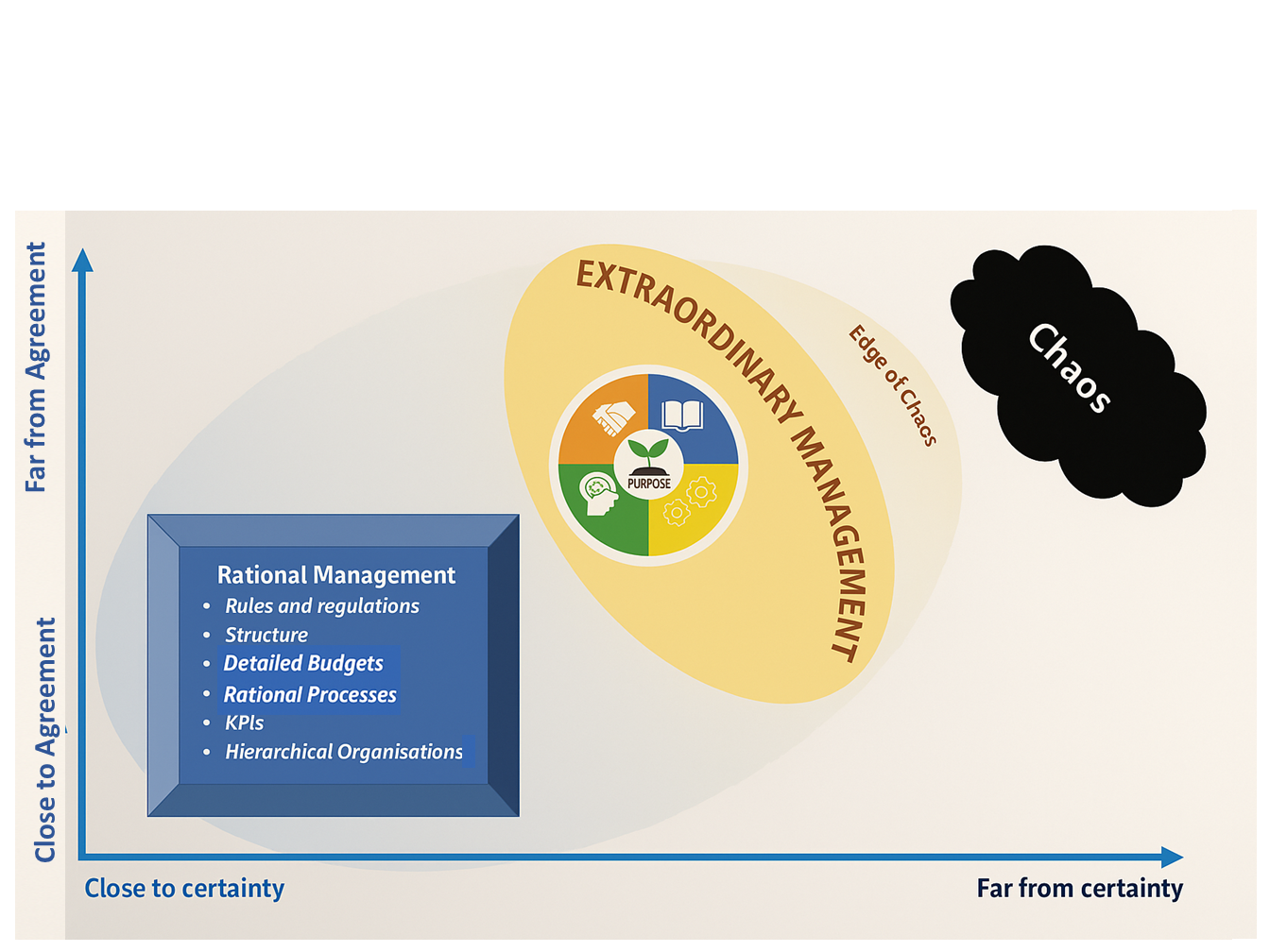
Stacey’s matrix is not a model for control, but a way of noticing how patterns of interaction change as certainty and agreement dissolve.
Each quadrant tells a different story:
- Close to certainty, close to agreement – the domain of classical management. Here we can plan, measure, and optimise. Efficiency reigns.
- Close to certainty, far from agreement – politics and negotiation dominate. We know how to achieve outcomes, but not which outcomes we want.
- Far from certainty, close to agreement – vision and shared purpose guide us when we can’t predict the path. We move by sense and adaptation, not by plan.
- Far from both – chaos and breakdown. No stable ground, no shared purpose.
Between these zones lies the edge of chaos — the zone of complexity.
The edge of chaos is not permanent instability, nor a rejection of order — it is a transient zone where learning outpaces control.
Here, the old rules no longer apply, yet new patterns can form. It’s a place of creative tension, where novelty and learning emerge.
The edge as crucible
This edge is not an accident. In nature, the most diverse ecosystems exist at the boundaries — where forest meets meadow, where river meets sea.
Ecologists call it the edge effect: the boundary zone where systems overlap, interact, and evolve.
Stacey’s organisational version of the edge effect is where innovation, renewal, and adaptive capacity arise.
It’s the beating heart of the final book in the trilogy: Ecology of Organisations — the dynamic zone between order and chaos, where people experiment, reflect, and learn from one another.
If you’ve read Adapt, Survive and Flourish, you’ll recognise this pattern. The same “edge of chaos” is where social capital and human capital intertwine — trust meeting skill, conversation meeting insight, tacit knowledge meeting explicit understanding.
________________________________________
The impossibility of managing knowledge
Stacey was never interested in buzzwords like “knowledge management.” He dismantled them with precision.
“Knowledge emerges in the interactions between us — it cannot be managed.”
He saw that most corporate attempts to “manage” knowledge produce only counterfeit quality. We measure what’s easy — course attendance, document counts, system updates — and call it learning. But authentic knowledge lives in dialogue, in shared reflection, in the subtle exchanges that build understanding.
That’s why he called it an impossibility — not because knowledge is unimportant, but because it’s alive. Like a mycelial network beneath a forest floor, it grows through connection, not control.
________________________________________
From control to cultivation
For leaders, this realisation is both confronting and freeing.
If knowledge can’t be managed, what then is our role?
It shifts from commanding outcomes to cultivating conditions.
From predicting and planning to listening and learning.
From certainty and control to relationship and responsiveness.
In practice this means:
- Building psychological safety, where people can challenge assumptions.
- Encouraging reflective dialogue, where tacit knowledge surfaces and recombines.
- Designing systems that learn, not just perform — feedback loops, after-action reviews, communities of practice.
- Holding shared purpose as the attractor when certainty and agreement are both in flux.
In other words, leadership becomes ecological rather than mechanical.
This is not a critique of management competence, but a recognition that different conditions demand different forms of leadership.
________________________________________
Adaptive capacity and the zone of complexity
In the Adaptive Capacity model, Stacey’s matrix translates directly.
- Social Capital: Social capital pertains to the quality of relationships, networks, trust, and shared norms that enable people to collaborate effectively.
- Human Capital: Human capital encompasses the skills, experience, and judgement possessed by individuals within an organisation.ocial capital pertains to the quality of relationships, networks, trust, and shared norms that enable people to collaborate effectively.
When both are strong, the system is stable and efficient. When both are weak, it disintegrates.
But when they overlap dynamically — when relationships and learning intertwine at the edge of uncertainty — the organisation becomes adaptive.
That’s the sweet spot — the zone of creativity, emergence, and renewal.
It’s not a place you can live in permanently, but it’s where transformation happens.
Explore further
This article connects to the broader framework:
- Ethical Domain — how constraints shape decisions
- Sensemaking Domain — how organisations interpret reality
- Relational Domain — how trust and coordination emerge
- Learning Domain — how knowledge is created and tested
- Action Domain — how intent becomes capability
To understand more on Purpose detailed Subject Areas, visit the Deep Dive section.
📖See the Books