Hansei is a Japanese practice focused on deep self-reflection. It involves honestly assessing one’s actions, assumptions, and results to learn, grow, and act more wisely in the future. In Japanese culture, Hansei has a moral and personal significance. It’s not just about reviewing performance or identifying process issues. Instead, it encourages individuals or groups to sincerely reflect on what transpired, what was overlooked, what could have been improved, and what responsibilities they should now accept.
Hansei later became a key element of Toyota’s culture of learning and continuous improvement. In that context, it is closely linked to Kaizen, Gemba, and ongoing development. Nevertheless, its core meaning extends beyond management techniques. Hansei embodies a disciplined humility—the willingness to examine oneself first, rather than blaming the system, process, or others.
In the Adapt, Survive and Flourish framework, Hansei is central to adaptive learning. Gemba is where reality teaches. Hansei is the reflective practice that allows people to learn from what reality has shown them.
Why Hansei Matters
Organisations often move too quickly from one action to the next.
- A project finishes.
- A problem is patched.
- A workshop concludes.
- A decision is made.
- A report is filed.
Then everyone moves on.
Reflection is essential to avoid wasting the experience. Without it, people might repeat errors, cling to outdated assumptions, and rely on explanations that no longer match reality.
Hansei interrupts this pattern. It asks people to stop, notice and learn.
Hansei and Gemba
Hansei is most powerful when connected to Gemba — the place where work meets consequence.
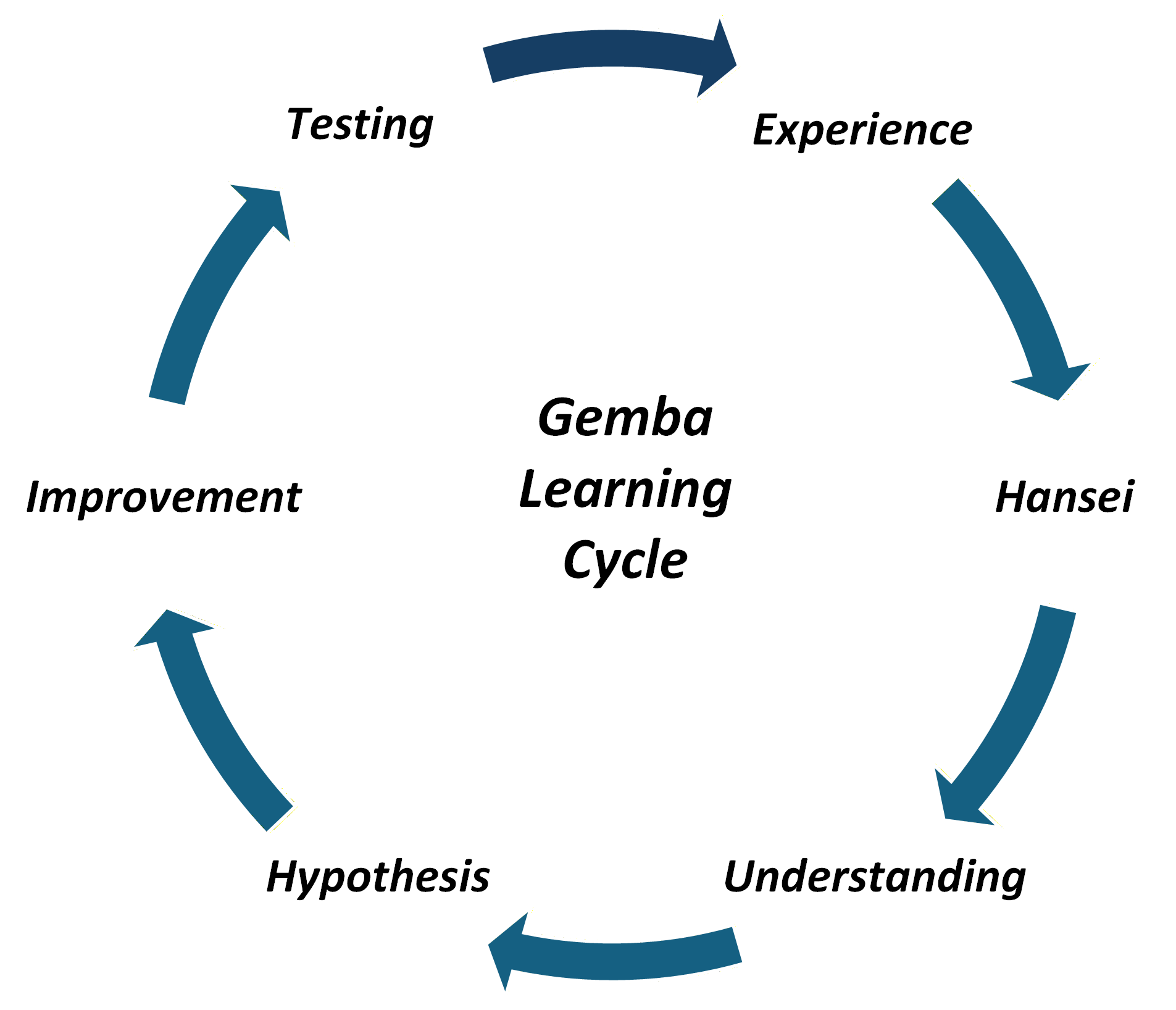
Gemba reveals what actually happened. Hansei asks what should be learned from it?
Together, they form a learning cycle:
- Experience — participate in the reality of the work.
- Hansei — reflect honestly on what happened.
- Understanding — identify what the situation is teaching.
- Hypothesis — form a better way forward.
- Improvement — test the change.
- New experience — return to Gemba and learn again.
This makes Hansei more than reflection after the fact. It is part of a continuous discipline of learning, improvement and adaptation.
Hansei and Adaptive Capacity
Adaptive Capacity depends on the ability to learn from experience before failure becomes unavoidable.
Hansei helps build that capacity by making reflection normal rather than exceptional. It creates space for people to ask difficult questions without immediately becoming defensive.
- What did we assume?
- What did we miss?
- What surprised us?
- Where did the model fail?
- Where did reality push back?
- What will we do differently next time?
These questions help organisations move beyond blame. They focus attention on learning, responsibility and improvement.
Hansei Is Not Blame
Hansei is not about humiliation, fault-finding or forcing people to confess mistakes.
It is about disciplined honesty. A healthy Hansei practice enables individuals to recognize gaps without compromising their dignity. It understands that mistakes, surprises, and failures can serve as valuable learning opportunities if approached with honesty.
Without psychological safety, Hansei turns into mere performance; people stick to safe topics, protect themselves, and steer clear of significant lessons.
With trust, Hansei becomes one of the most powerful practices of organisational learning.
In Plain Terms
Hansei means stopping long enough to ask: What happened, what did we learn, and how must we now change?
Related Concepts
- Gemba
- Kaizen
- Toyota Production System
- Organisational Learning
- Adaptive Capacity
- Double-loop Learning
- Psychological Safety
- Reflective Inquiry
- Consequential Intervention
- Learning Environment
For more information, see