(From Deep Listening to Organisational Learning)
The Core Problem
Organisations face a fundamental challenge:
How do we ensure all voices are heard — and that what is heard leads to meaningful learning and action?
Most approaches fail in one or two ways:
- Superficial engagement → a large group where everyone speaks, but nothing changes because the commentary is superficial. Sometimes, participation is only symbolic — people are invited to give input, but it rarely leads to meaningful learning or change.
- Deep engagement without scale → deep and powerful insights, but only with a small group. The problem is how our other stakeholders are engaged. In other cases, deep insights develop within a small group, but this learning does not spread across the wider organisation or stakeholder network.
This creates a disconnect between listening and acting. While organisations may effectively collect opinions, perspectives, and feedback, they often struggle to turn what they hear into shared understanding, coordinated efforts, or real change.
As a result, there is often fragmentation: insights are present, but shared understanding, alignment, and adaptive responses do not scale.
Theory U — Developing the Capacity to Listen
Otto Scharmer developed the Theory U framework. (Scharmer & Kaufer, 2025) It is widely used globally by the Presencing Institute for ‘Leading transformation for social, ecological, and systemic regeneration’ (see: https://www.presencing.org/).
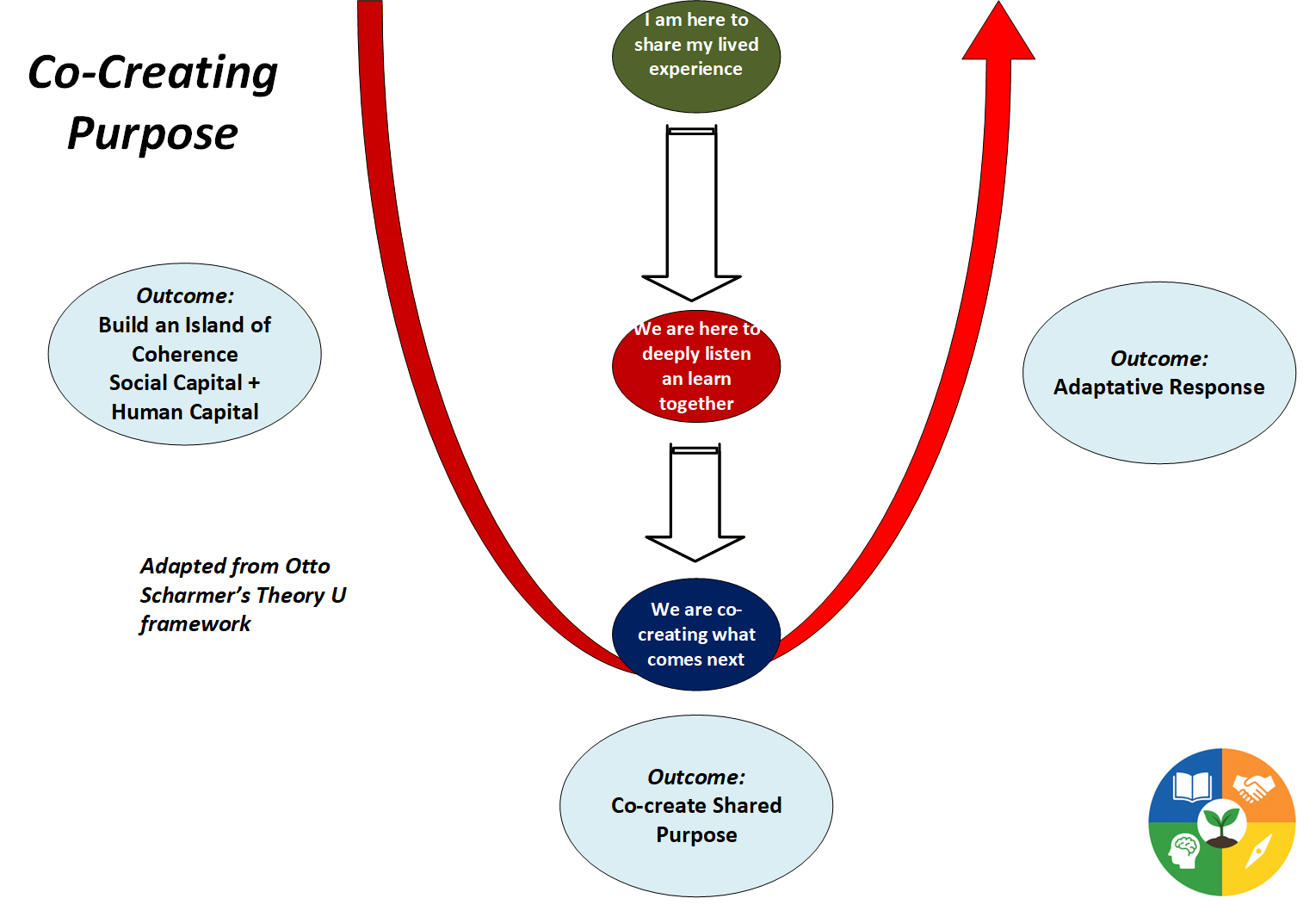
This diagram illustrates how mindsets influence attention, dialogue, and adaptive outcomes within Theory U.
Theory U addresses the quality of attention. Büttner et al. provide supporting evidence that different mindsets materially alter attentional breadth, openness to peripheral information, and sensitivity to weak signals.(Büttner et al., 2014)
It enables individuals and groups to:
- Suspend judgement.
- Recognise assumptions.
- Engage with multiple perspectives.
- Gain a sense of the system.
Through practices such as co-sensing and deep dialogue, participants develop:
- Empathy
- Self-awareness.
- Individual and collective reflection.
The result is not simply better decisions, but a transformation in how people relate to one another and to the entire system.
This makes Theory U particularly suited to:
- complex, systemic challenges
- highly polarised environments
- situations requiring a mindset shift.
However:
- It is time-intensive,
- requires skilled facilitation,
- and is not easily applied to everyday operational work.
Stakeholder Engagement Protocol — Structuring Participation
Stakeholder Engagement addresses a different problem:
How do we engage in many voices quickly, without losing meaning?
Using structured interaction (including Speed storming techniques) enables:
- rapid participation across diverse stakeholders,
- repeated exposure to different perspectives,
- a way to ensure all have a voice, including introverts,
- and it enables the rapid and disciplined capture of insights.
The focus is not on forcing immediate agreement. Instead, the process surfaces:
- recurring themes and concerns,
- differences in perspective,
- conflict and address tensions, contradictions, and trade-offs,
- emerging risks, opportunities, and weak signals across the organisation
These insights help people better understand the system they are working within before deciding how to respond.
Complementary Roles
These approaches work at distinct levels:
| Capability | Theory U | Stakeholder Engagement |
| Focus | Quality of attention | Structure of interaction |
| Outcome | Deep listening, empathy | High-throughput insight |
| Use | Strategic, complex issues | Operational, repeatable engagements |
| Time horizon | Extended | Short, iterative |
From Development to Practice
A practical synthesis appears:
- Theory U builds the capacity to listen.
- Stakeholder Engagement applies that capacity at scale.
Together, they enable organisational learning at both depth and scale.
Implication for Adaptive Capacity
Adaptive capacity requires both the ability to perceive clearly and to respond coherently.
Without this balance, listening becomes superficial, and insights may not land or scale.
Core Insight
- Deep listening yields insight.
- Structured interaction enables scale.
- Adaptive capacity requires both.
Theory U develops the social field. Stakeholder Engagement works in that field.
Explore further
This article connects to the broader framework:
- Ethical Domain — how constraints shape decisions
- Sensemaking Domain — how organisations interpret reality
- Relational Domain — how trust and coordination emerge
- Learning Domain — how knowledge is created and tested
- Action Domain — how intent becomes capability
To understand more on Purpose detailed Subject Areas, visit the Deep Dive section.
📖See the Books
Büttner, O. B., Wieber, F., Schulz, A. M., Bayer, U. C., Florack, A., & Gollwitzer, P. M. (2014). Visual attention and goal pursuit: deliberative and implemental mindsets affect breadth of attention. Pers Soc Psychol Bull, 40(10), 1248-1259. doi:10.1177/0146167214539707
Scharmer, C. O., & Kaufer, K. (2025). Presence: 7 practices for transforming self, society, and business: Berrett-Koehler Publishers.