Introduction
Many organisations believe learning happens in workshops, presentations, strategy sessions, planning exercises, and training programs.
These activities may contribute to learning, but they are not where learning is ultimately established.
Learning only becomes real when knowledge survives contact with reality.
This is the role of Gemba.
Often translated from Japanese as “the real place,” Gemba represents far more than physical location. It is the point at which ideas encounter consequences, assumptions encounter evidence, and plans encounter the complexity of real-world conditions.
Throughout this work, Gemba is presented not as an operational technique but as a fundamental mechanism through which organisations learn, adapt, and maintain connection to reality.
What is Gemba?
Gemba is commonly described as “the place where value is created for the customer.”
This definition remains useful, but it only captures part of its significance. ‘Customer’ includes internal customers as well as the person who finally pays for the goods or services. For an IT department, this includes the people who use technology and systems to do their work.
Gemba is where:
- value is created for customers and stakeholders,
- decisions produce consequences,
- trade-offs become visible,
- assumptions are tested,
- and reality pushes back.
Importantly, Gemba is not limited to factory floors or operational settings.
- For a customer service representative, Gemba may be a difficult conversation with a frustrated customer over the phone.
- For a financial adviser, it may be the moment a client makes a life-changing decision.
- For a CEO, it may be the consequences of a strategic decision becoming visible months or years later.
Gemba exists wherever actions encounter reality.
It is where abstractions become concrete.
Where reality teaches.
Toyota did not simply create a quality system.
They created a culture where participation in learning was a condition of membership (Spear & Bowen, 1999).
Why Gemba Matters
Without Gemba, discussion is easy.
- Agreement is easy.
- Alignment is easy.
- Models appear coherent.
- Language appears shared.
- Plans appear sensible.
However, none of these guarantees learning.
When knowledge is disconnected from operational reality, organisations often confuse agreement with understanding and plan for progress.
This can create a false sense of security. Although the organisation may seem to be learning, it remains detached from the actual outcomes of its decisions.
True learning goes beyond mere discussion; it involves testing ideas in practice. Gemba offers a way to surface assumptions and challenge understanding effectively.
Without Gemba, organisations risk becoming increasingly confident while becoming progressively less connected to reality.
Gemba provides the bridge between intervention and learning. Every consequential intervention creates both intended and unintended consequences, but those consequences can inform future action only if they are observed, understood, and reflected upon. This requires direct engagement with operational reality rather than reliance on reports, dashboards, models, or assumptions alone.
Without Gemba, organisations can easily mistake agreement for understanding and planning for progress. Strategies appear coherent, decisions appear sound, and shared language creates the impression of alignment. Yet the consequences of action remain largely invisible. Gemba reconnects decision-makers with reality by exposing interventions to their consequences. It is here that assumptions are tested, understanding is challenged, and learning becomes possible. A consequential intervention therefore requires more than thoughtful action; it requires ongoing participation in the reality that follows.
See: Source Note – Consequential Intervention
Gemba and SECI
The SECI model describes knowledge creation through four interconnected processes:
- Socialisation
- Externalisation
- Combination
- Internalisation
Much organisational effort focuses on the first three stages.
- People share experiences.
- Ideas are articulated.
- Knowledge is organised into models, plans, frameworks, and procedures.
Yet many organisations struggle with the final stage.
Internalisation is often believed to happen after a document approval, workshop completion, or decision-making. However, it occurs when knowledge is actively applied and tested in practice.
Gemba serves as the connection between explicit knowledge and experience. It is the point where knowledge transitions from being a concept to becoming a real capability.
Without Gemba, organisations may produce increasingly sophisticated artefacts while learning very little.
Schema Failure: Where Learning Begins
One of the most important functions of Gemba is exposing the limitations of existing mental models.
At Gemba:
- assumptions are challenged,
- contradictions emerge,
- gaps become visible,
- and consequences appear.
This situation often leads to what can be called schema failure.
Schema failure happens when reality no longer aligns with the mental model used to interpret it. The model might still seem coherent and logically consistent, but it no longer sufficiently explains people’s experiences. This creates discomfort, reduces confidence, and raises disagreements and questions.
However, this discomfort is often the first sign that real learning is underway.
If assumptions remain unchallenged, learning remains largely theoretical.
Gemba Learning Cycle
Based on our understanding of the Toyota Production System (TPS) (Spear & Bowen, 1999) Our definition is “Gemba is where learning and improvement occur from ideas applied and tested in reality, or more simply, Gemba is where reality teaches.”
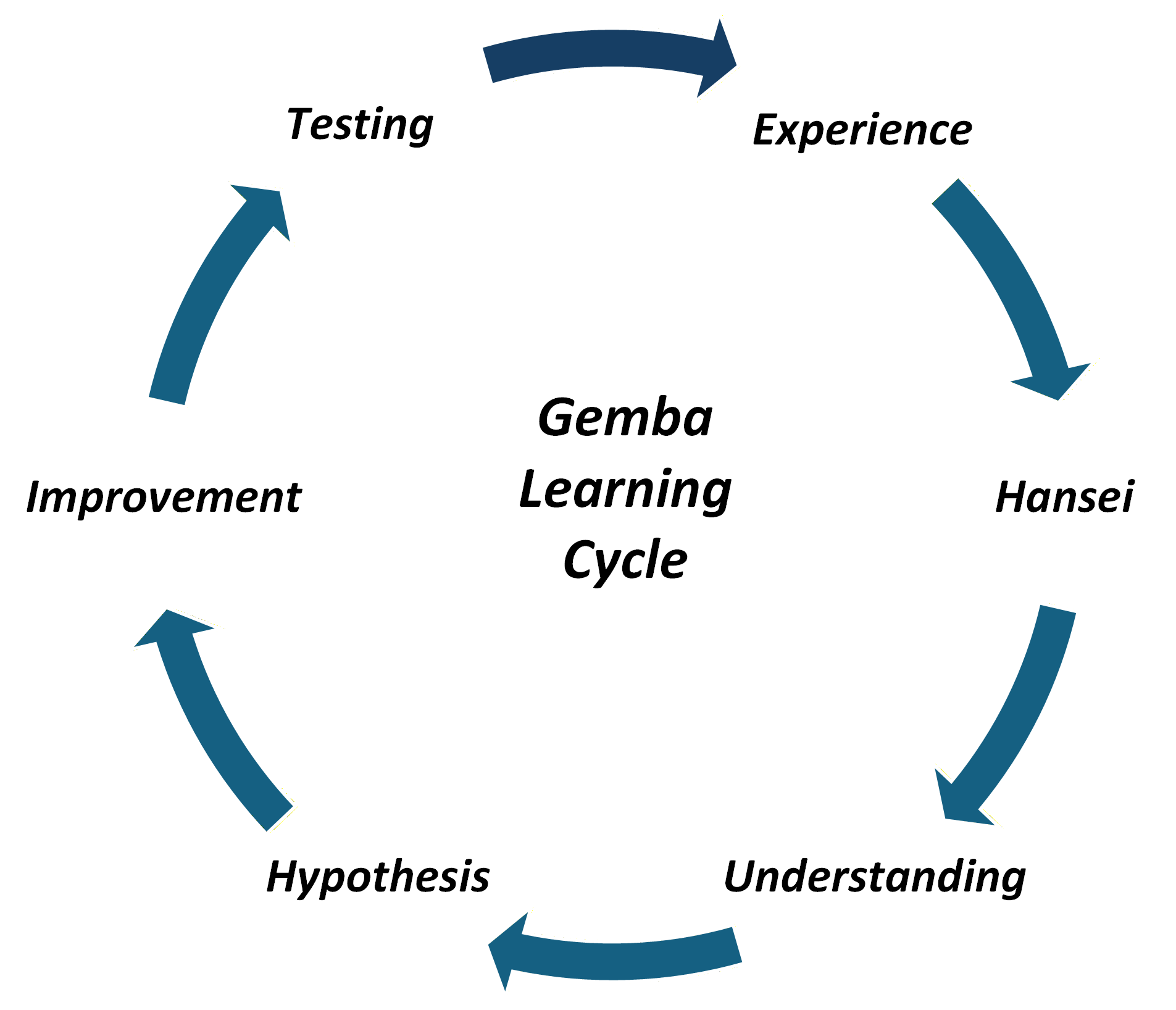
The cyclic nature of Gemba Learning
The cycle is continuous. In the TPS, the Kaizen process is ongoing; it is not stop-and-go. At Toyota, employees are urged to embrace Job = Work + Kaizen.
- Experience
This is living in the reality of Gemba and experiencing how well are going. It is listening to peers, supervisors, customers, suppliers and other stakeholders. It is experiential awareness.
- Hansei
This is a personal and group reflection. “How can I (we) be better at what I (we) do?” This involves challenging current mental models, assumptions and the status quo. I develop what Robert Fritz calls “Creative Tension” (Fritz, 1989), a profound sense of dissatisfaction and a strong motivation to find a better way.
- Understanding
Understanding and recognising the problems and opportunities. “This is what I (we) need to work on!” Yet again, this is a group activity where understanding is tested with other stakeholders by asking “Have I got this right?”
- Hypothesis
Improvement is based on the Western scientific method. A hypothesis is developed and agreed upon by the team. Developing the hypothesis may involve consultation with peers, experts and those with prior knowledge. A mini SECI cycle that completes with the person internalising the knowledge gained to formulate the hypothesis.
- Improvement
Ideas and options are formulated as an experiment to test the hypothesis. This again may be a cycle of consultation and learning. In the TPS, all of this is collated into an A3 report for communication, feedback, and, hopefully, approval.
- Testing
The chosen option (experiment) is then tested in the Gemba reality. Does it prove the hypothesis? Are the results what we expect? Are there any consequences? If all is well, it is implemented. If not, then back to the drawing board
And so the cycle continues…
What is interesting about this approach is the synthesis of Western and Eastern thinking.
Ba at Gemba
Ba is often defined as a shared space dedicated to knowledge creation. It involves dialogue, reflection, and interaction, but dialogue by itself is not enough.
When conversations lack real impact, Ba can become merely performative — people might participate, workshops may take place, and discussions can be lively, but little genuinely changes. Gemba offers the grounding that keeps Ba from turning into mere theatre.
At Gemba:
- assumptions carry consequences,
- decisions produce outcomes,
- knowledge is tested rather than merely discussed,
- and relationships are formed through shared experience.
Dialogue becomes connected to reality.
Reflection becomes connected to action.
Wisdom becomes visible through behaviour.
Different Forms of Ba
The nature of Ba varies according to the context, purpose, and outcomes at Gemba. Different circumstances create different social fields.
Examples include:
| Type of Ba | Example | Dominant Characteristic |
| Consequence Ba | Emergency Department, Incident Response Team
|
Immediate consequences, rapid learning, coordinated action |
| Creative Ba | Symphony Orchestra, Jazz Ensemble, Innovation Nursery
|
Collective creation, experimentation, emergence |
| Learning Ba | Regenerative Agriculture Field Day
|
Shared learning directed toward a common good |
| Service Ba | Wayside Chapel, Community Kitchen
|
Service, compassion, stewardship |
| Reflective Ba | Hansei session, After Action Review
|
Reflection, correction, and learning from consequences |
These are not maturity levels.
They are different forms of social fields that emerge in response to different purposes and contexts.
Learning Ba and the Common Good
Not every gathering of professionals creates Learning Ba.
Professional associations, conferences, and networking groups may facilitate the exchange of valuable information.
However, Learning Ba requires something more.
It requires:
- a shared purpose,
- voluntary contribution,
- willingness to learn together,
- and commitment to a common good beyond individual advancement.
This distinction helps explain why regenerative agriculture field days often exhibit strong Learning Ba.
Participants share failures, successes, observations, and practical experience as they collectively pursue healthier landscapes, healthier communities, and more sustainable farming systems.
Learning is not merely exchanged.
It is co-created.
Reciprocity and Mutual Trust
Gemba creates opportunities for reciprocity.
- People help one another.
- Knowledge is shared.
- Commitments are honoured.
- Problems are solved collectively.
Over time, these reciprocal interactions build mutual trust and respect.
The process can be understood as a reinforcing feedback loop:
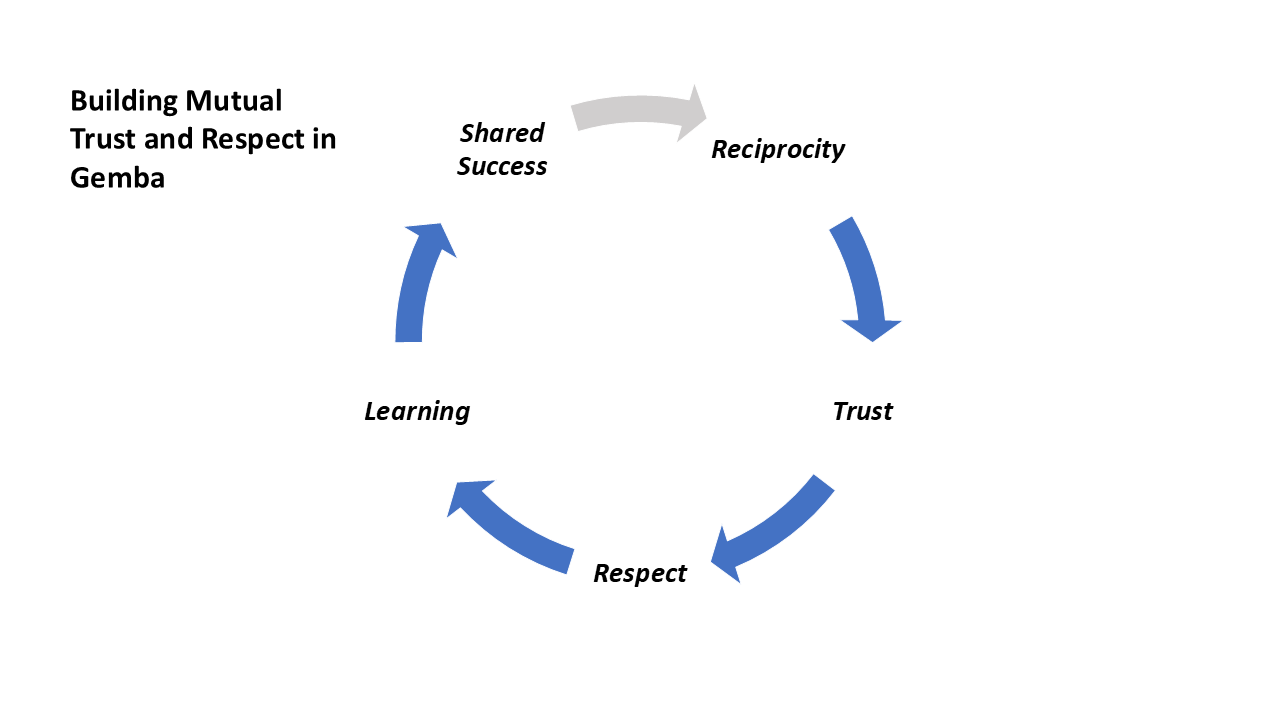
Figure 1: Ba Reciprocity Cycle
Trust is not established through declarations, slogans, or trust-building exercises. Instead, it develops through repeated mutual interactions that have meaningful consequences. In this way, Gemba is more than just the place where work happens; it is the environment where trust and respect are fostered.
In summary:
- Reciprocity builds mutual trust and respect.
- Gemba provides the conditions where reciprocity occurs.
- Different forms of Ba emerge depending on the purpose and consequences present at Gemba.
The Voluntary Contribution Test
Traditional indicators of organisational health often focus on participation.
- People attend meetings and functions.
- People complete employee satisfaction surveys.
- People engage in workshops.
These indicators are helpful but not comprehensive. A more profound question arises: do people contribute without being compelled? Voluntary contributions are among the most compelling signs that learning is active.
When people willingly raise concerns, offer ideas, challenge assumptions, contribute discretionary effort, and surface uncomfortable truths, they signal that:
- trust is present,
- accountability is survivable,
- truth can be tolerated,
- and learning remains possible.
This doesn’t symbolise empowerment; rather, it indicates the system’s acceptance of reality. In numerous organisations, silence isn’t an indication of agreement but reflects that individuals have learned speaking out is risky. They may fear criticism, blame, embarrassment, political repercussions, or being ignored.
Consequently, they hold back concerns, shy away from tough conversations, and keep vital observations to themselves. What seems like agreement might be self-preservation.
Voluntary contribution provides a powerful test of organisational coherence.
Permitted Reality
People don’t always interpret the same situation in the same way.
One individual might view a problem as an opportunity, while another views it differently. Similarly, what one person perceives as a risk, another might ignore as insignificant.
Consequently, people’s reactions are often based not just on actual events but also on their perceptions of those events.
Factors such as procedures, norms, incentives, culture, and power dynamics shape which information is deemed valid and which signals are overlooked.
- This creates a form of constrained learning.
- Information may exist.
- Evidence may be available.
- Consequences may already be visible.
However, many organisations still cannot respond or choose not to.
Gemba breaks this pattern by revealing the consequences of decisions that are hard to conceal.
It links decisions directly to their results and pushes the limits of what is considered acceptable reality. Without this disruption, organisations tend to focus on improving performance but gradually lose touch with the systems they rely on.
The One-Page Trap
Simple frameworks can be extremely powerful.
The Toyota A3 demonstrates how disciplined thinking can be captured within a single page when the problem is bounded, observable, and directly connected to the operational reality of a specific Gemba. This is where:
- the problem is bounded,
- the actors are known,
- the consequences are visible,
- feedback cycles are relatively short,
- and the relevant Gemba can be directly observed.
In other words, the problem remains sufficiently mind-sized that the key relationships, assumptions, consequences, and feedback loops can be understood and discussed by the people involved.
The issue arises when similar approaches are applied more broadly over larger areas to address complex, adaptive challenges.
Strategy, transformation, culture, and stakeholder systems rarely conform to neat boundaries.
When complexity is compressed into a static representation, organisations often achieve clarity by removing complexity rather than understanding it. You can’t do an A3 for a complex supply chain breakdown across a whole set of interdependent suppliers.
The result is premature convergence.
- Assumptions remain hidden.
- Trade-offs remain unexplored.
- Consequences emerge later.
Gemba acts as a corrective mechanism. Reality reveals what the framework omitted.
This is not a failure of the framework.
It is a reminder that understanding emerges through interaction with reality rather than through representation alone.
Workshop Design: Building Learning Through Gemba
Learning does not happen automatically; it can be intentionally structured. A practical process involves four interconnected stages.
- Purpose
Start with your intent. Define the value being generated, for whom, and why it’s important. Purpose offers the context that helps make sense of decisions and trade-offs.
- Structure
Establish a common language and shared understanding. Business Capability Models, Common Data Models, process models, and other artefacts serve as valuable frameworks for collective sensemaking.
- Gemba
Take the model into operational reality.
- Test assumptions.
- Observe consequences.
- Challenge interpretations.
- Expose contradictions.
This is where learning begins.
- Feedback
Reintegrate the knowledge gained.
- Update models.
- Revise assumptions.
- Modify behaviour.
Without this final step, observations remain disconnected from future action.
Together, these stages form a continuous cycle linking purpose, understanding, action, and adaptation.
Customer Service and the Missing Gemba
Many organisations redesign customer service based on call volumes, transaction data, website usage, FAQs, and cost analyses. These metrics make minimising human interaction seem logical.
Data may indicate that most customers prefer digital channels, that routine questions can be automated, and that Call Centre expenses can be lowered. From the dashboard’s view, the decision seems reasonable.
However, the customer experience itself often exists outside the dashboard.
- The frustration in a customer’s voice.
- The hesitation of someone lacking confidence with technology.
- The anxiety of a vulnerable person trying to resolve an important problem.
- The relief when a knowledgeable human finally understands the problem.
- The abandoned calls where the customer gave up.
- The 6-hour wait for the promised call back, after being told ‘Your call is important to us’.
The customer doesn’t experience the dashboard. The customer experiences the service.
The same principle applies beyond customer service.
- Employees do not experience organisational charts. They experience leadership.
- Suppliers do not experience procurement metrics. They experience commercial relationships.
- Communities do not experience sustainability reports. They experience organisational behaviour and its real impact on the lived environment.
- Shareholders do not experience strategy documents. They experience the consequences of strategic decisions on their investment.
- Citizens do not experience government policy statements and spin. They experience public
In each case, reality exists at Gemba.
Reports, dashboards, models, and metrics are useful tools, but they only represent reality, not the reality itself. When organisations focus on optimizing these representations without staying connected to Gemba, they risk improving measured aspects while neglecting actual experiences.
These realities are rarely visible in reports; they are observed at Gemba. By prioritising transaction analysis over customer experiences, organisations might optimise their metrics but distort the true picture.
This can result in a process that appears more efficient on paper but delivers a poorer customer experience.
This isn’t a failure of analysis; it’s a failure to stay connected to Gemba.
A helpful example comes from a study on warranty and customer complaint management in the motorcycle industry (Soares, Sousa, & Nunes, 2012). The researchers discovered that relying solely on reports and complaint data was not enough to identify the causes of quality issues. Managers needed to observe the actual processes where failures happened. Conducting Gemba walks on-site was essential for pinpointing root causes, gaining a clear understanding of the situation, assigning responsibility, and implementing effective corrective measures.
The authors highlight that the Toyota approach emphasises managers needing to “go to the Gemba” because firsthand observations often reveal details that reports overlook.
Relying solely on summaries, dashboards, and metrics can cause decision-makers to miss crucial aspects of reality that are only apparent through direct engagement.
This lesson is applicable well beyond manufacturing. Whether addressing customer service, organisational transformation, culture, stakeholder involvement, or strategy, the true signals of reality are often not fully captured in reports, presentations, or performance metrics.
Gemba serves to reconnect decision-makers directly with these underlying truths.
Closing Reflection
- Learning does not occur when knowledge is created.
- Learning does not occur when a workshop concludes.
- Learning does not occur when agreement is reached.
- Learning occurs when knowledge survives contact with reality.
Gemba is the place where reality confronts us. It is where assumptions are challenged, consequences show up, and understanding improves through hands-on experience. Without Gemba, organisations might become more internally consistent but lose touch with reality.
With Gemba, learning stays rooted, flexible, and dynamic.
If it has not been tested at Gemba, then it is not true knowledge.
Fritz, R. (1989). The path of least resistance: Learning to become the creative force in your own life: Ballantine Books.
Soares, J. C., Sousa, S. D., & Nunes, E. (2012). Application of the three realities approach to customer complaints analysis in the motorcycles industry. Paper presented at the Int. Conf. Ind. Eng. Oper. Manag.
Spear, S., & Bowen, H. K. (1999). Decoding the DNA of the Toyota production system. Harvard business review, 77(5), 96.