Definition
The Three Capacity Lens is an ASF adaptation of the six capitals from Integrated Reporting and Integrated Thinking (Dimes et al., 2025).
Rather than treating the six capitals as separate reporting categories, ASF groups them into three connected forms of capacity:
Adaptive Capacity = Social Capital + Human Capital
Economic Capacity = Intellectual Capital + Manufactured Capital + Financial Capital
Ecological Capacity = Natural Capital
This transforms the six capitals from just an accounting framework into a useful tool for sensemaking. Instead of asking, ‘What did we report?’, the focus shifts to: ‘What kinds of capacity are we enhancing, using, changing, or destroying?’
Why It Matters
Organisations often mistake financial results for overall system well-being. A decision that boosts short-term profits might harm trust, exhaust staff, damage ecological health, or deplete valuable knowledge for the future. While cutting costs can seem efficient, it may also shift burdens onto employees, suppliers, customers, communities, ecosystems, or future generations. The Three Capacity Lens helps identify these hidden shifts. It prompts us to consider whether organizational actions are strengthening the core capacities necessary for resilience and renewal, or just optimizing one metric at the expense of the larger system.
The Three Capacities
Adaptive Capacity
In Adapt, Survive, and Flourish, we determined that Adaptive Capacity is built from Social Capital and Human Capital (Malcolm, 2025).
It includes:
- trust
- relationships
- cooperation
- judgement
- skills
- health
- learning
- tacit knowledge
- willingness to speak and listen
- ability to adapt under uncertainty
Adaptive Capacity answers the question: Can this organisation notice, learn, cooperate, and change?
Without adaptive capacity, organisations can stay operational but risk becoming fragile. While people may comply, they might cease to contribute discretionary effort, tacit knowledge, and judgment. Relationships persist, but trust diminishes. The organisation keeps moving forward, yet its learning becomes fragmented and sporadic.
Economic Capacity
Economic Capacity is built from Intellectual Capital, Manufactured Capital, and Financial Capital.
It includes:
- money
- assets
- systems
- infrastructure
- data
- methods
- intellectual property
- production capability
- business models
- shared knowledge
- operating disciplines
Economic Capacity answers the question: Can this system organise resources to create and sustain useful work?
Without economic capacity, good intentions can be fragile. The organisation might understand what’s important but lack the necessary knowledge, assets, funding, systems, or operational ability to act effectively, and ultimately fail.
Ecological Capacity
Ecological Capacity is built from Natural Capital.
It includes:
- ecosystems
- water
- soil
- air
- biodiversity
- climate stability
- resource availability
- waste absorption
- ecological renewal
Ecological Capacity answers the question: Can the natural systems we depend on continue to sustain life, work, and renewal?
Without Ecological Capacity, both economic and adaptive capacities eventually deteriorate. An organisation might seem successful within its own limits while harming the living systems that support that success.
From Capitals to Capacity
The term “capital” often seems to refer to accounting, implying that all important aspects can be measured, priced, owned, or recorded. However, ASF redirects this focus. It’s not about expanding report details, but about understanding its true ability to support ongoing operations and foster the planet, people, and prosperity.
Each capability might use one type of capacity to develop another. For example, a project could boost economic capacity but diminish adaptive or ecological capacity. Conversely, a sustainability effort might enhance ecological capacity at the expense of economic and adaptive capacities. Additionally, a learning program can develop human and social capital, thereby strengthening adaptive capacity over time.
The useful question is: What capacity is being converted into what other capacity, and at what consequence?
Link to Triple Bottom Line
The Three Capacity Lens sits naturally beneath the Triple Bottom Line.
- Planet depends on Ecological Capacity.
- People depends on Adaptive Capacity.
- Prosperity depends on Economic Capacity.
But the three cannot be managed separately.
- Ecological ambition without Economic Capacity may remain an aspiration.
- Adaptive Capacity without Economic and Ecological grounding may become conversation without consequence.
- Prosperity without Adaptive Capacity becomes extraction, burnout, compliance, and brittleness.
- Prosperity without Ecological Capacity becomes depletion.
The work is to integrate and optimise the three capacities together.
Resilience and Regeneration
Resilience is not created by maximising one form of capacity.
It emerges when Adaptive, Economic, and Ecological Capacity support one another.
An organisation becomes more resilient when:
- people can learn and cooperate,
- economic systems can sustain useful and meaningful work,
- ecological systems are protected and regenerated,
- feedback exposes consequences before they become harmful,
- trade-offs are faced honestly,
- and action strengthens the wider system rather than shifting harm elsewhere.
Regeneration goes further.
Regeneration means the organisation does not merely survive disturbance or reduce harm. It contributes to the renewal of the human, social, economic, and ecological systems on which it depends.
The Three Capacity Lens, therefore, helps distinguish between:
- performance and resilience
- efficiency and depletion
- growth and regeneration
- reporting and learning
Practical Use in the Triple Bottom Line Balanced Scorecard
The Three Capacity Lens can be used as a practical test within the Triple Bottom Line Balanced Scorecard.
The scorecard highlights the areas the organisation aims to enhance in terms of Planet, People, and Prosperity. The Capacity Lens then asks what is happening underneath those outcomes.
For each objective, measure, initiative, or major activity, ask: What Adaptive, Economic, or Ecological Capacity is this action building, protecting, consuming, degrading, or regenerating?
This question helps prevent false success.
A measure can show improvement even as the system as a whole weakens. For example, productivity might increase while trust, learning, safety, or tacit knowledge decrease. Similarly, a cost measure could improve if the burden is transferred to suppliers, customers, communities, ecosystems, or future periods. An environmental metric might also improve internally, even if the environmental impact shifts elsewhere in the value chain.
Thus, the Capacity Lens incorporates a consequence check into the scorecard.
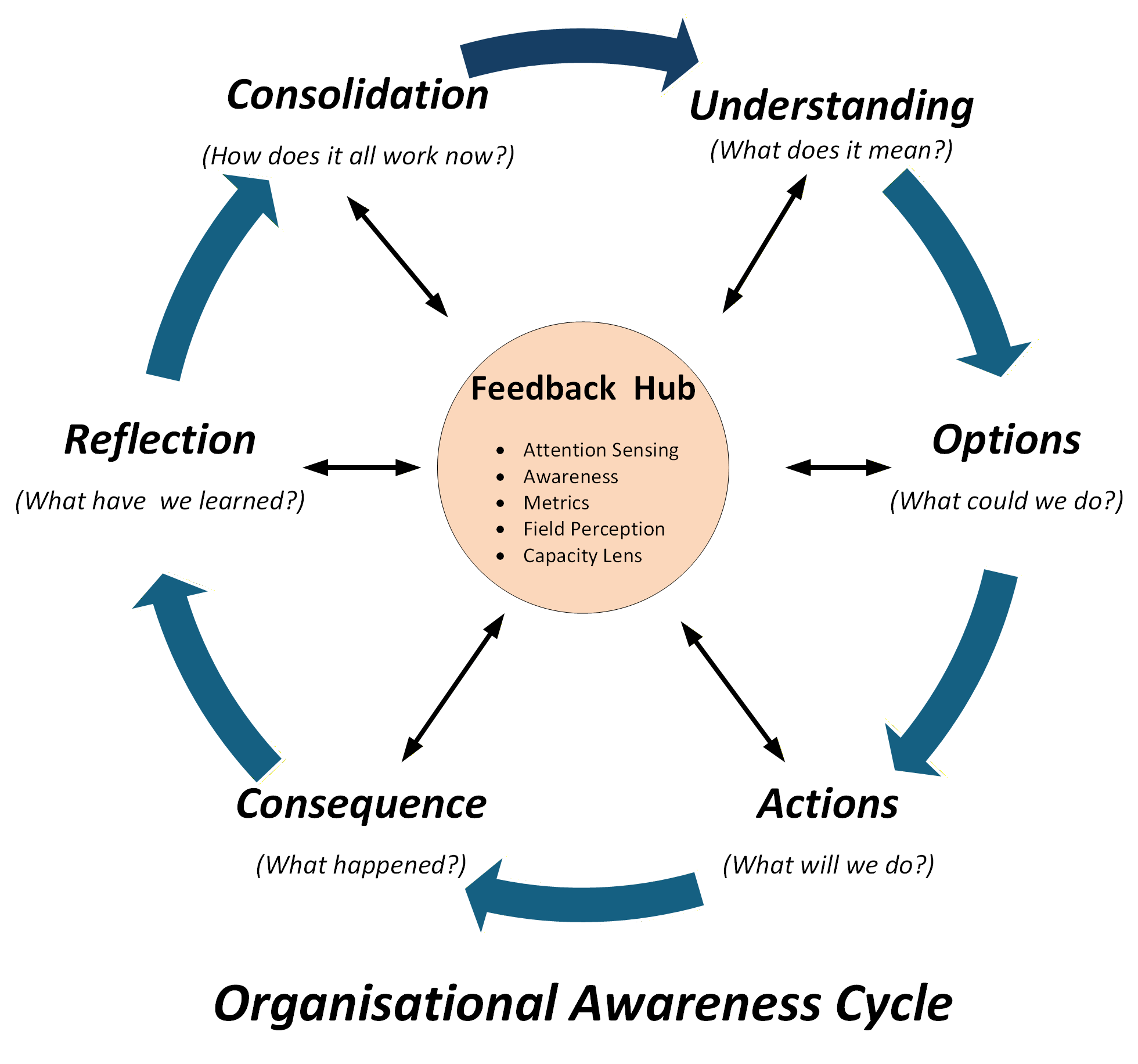 The Organisational Awareness Cycle as used in the TBL Balanced Scorecard
A practical scorecard entry should identify:
- The Triple Bottom Line outcome being pursued.
- The primary capacity affected: Adaptive, Economic, or Ecological.
- Whether that capacity is being built, protected, consumed, degraded, or regenerated.
- Any other capacity placed at risk.
- The stakeholders who experience the benefit, burden, or consequence.
- The L3 capability, activity, task, or cost object through which the action occurs.
- The feedback signals that would show whether the effect is real.
This turns the scorecard from a list of indicators into a capacity management system.
The practical logic is:
- TBL Outcome: What are we trying to improve across Planet, People, and Prosperity?
- Capacity Lens: What Adaptive, Economic, or Ecological Capacity is this action building, protecting, consuming, degrading, or regenerating?
- Stakeholder Experience: Who feels the benefit, burden, risk, or consequence?
- L3 Capability / Activity / Cost: What real work, data, capability, and resource use created the effect?
- Feedback Hub: What is the system telling us, and what must change?
This activates the Three Capacity Lens, providing leaders with a method to evaluate if their actions are fostering resilience and regeneration, or merely enhancing one aspect at the expense of the broader system.
Link to the Feedback Hub
In the Adaptive Capacity Cycle, the Feedback Hub uses the Three Capacity Lens as a consequence test.
After an action, intervention, project, or strategy, it asks:
- What happened to Adaptive Capacity?
- What happened to Economic Capacity?
- What happened to Ecological Capacity?
- Which capacity was strengthened?
- Which capacity was consumed?
- Which capacity carried hidden costs?
- Did improvement in one area weaken another?
- Did the action build resilience?
- Did it enable regeneration?
This prevents Triple Bottom Line reporting from becoming three separate columns of good intentions. It keeps the attention on relationships, trade-offs, and system consequences.
Example
A productivity initiative may improve short-term Economic Capacity by reducing cost and increasing output.
But if it increases workload, reduces psychological safety, damages trust, or accelerates loss of tacit knowledge, it consumes Adaptive Capacity.
If it also increases waste, emissions, or resource depletion, it weakens Ecological Capacity.
The apparent gain may therefore be a transfer, not an improvement.
The Feedback Hub asks: Did this action create value, or did it move cost into another capacity?
Red Flags
The Three Capacity Lens becomes weak when:
- Capacities are categorized as reporting segments.
- Financial performance overshadows all other capacity types.
- Human and social capital are simplified to workforce metrics.
- Natural capital is considered an external factor.
- Trade-offs are not visible.
- Short-term economic benefits are mistaken for resilience.
- Stakeholder experience remains untested.
- Feedback does not influence future actions.
When this happens, Integrated Thinking collapses into integrated reporting theatre.
In Summary
The six capitals are useful only if they improve thinking.
In ASF, they are translated into three connected capacities:
Adaptive Capacity — can we learn and change?
Economic Capacity — can we organise resources to create useful work?
Ecological Capacity — can the living systems we depend on continue to sustain and renew?
By integrating and optimising these capacities, organisations build resilience and enable regeneration.
The test is simple: Did this action strengthen the capacities the system needs to flourish?
If not, the gain may be temporary, local, or illusory.
Explore further
This article connects to the broader framework:
- Ethical Domain — how constraints shape decisions
- Sensemaking Domain — how organisations interpret reality
- Relational Domain — how trust and coordination emerge
- Learning Domain — how knowledge is created and tested
- Action Domain — how intent becomes capability
To understand more on Purpose detailed Subject Areas, visit the Deep Dive section.
Dimes, R., Granà, F., Busco, C., & de Villiers, C. (2025). Integrated Thinking to address social and environmental grand challenges. Accounting, Auditing & Accountability Journal, 38(7), 1725–1745.
Malcolm, R. (2025). Adapt, Survive and Flourish. Green Hill Publishing.