Gemba is a Japanese term often translated as “the real place.” In organisational practice, it is commonly described as the place where value is created for the customer.
In the Adapt, Survive and Flourish framework, Gemba has a deeper meaning. It is the place where ideas, assumptions, decisions and models encounter reality. It is where plans meet consequences, where trade-offs become visible, and where learning either becomes real or remains theoretical.
Gemba is not limited to a factory floor. It exists wherever action meets consequence.
For a manufacturing team, Gemba may be the production line.
For a customer service team, it may be a difficult conversation with a frustrated customer.
For a financial adviser, it may be the moment a client makes a life-changing decision.
For a CEO, it may be the long-term consequences of a strategic choice becoming visible.
Gemba is where reality teaches.
Why Gemba Matters
Without Gemba, agreement can be mistaken for understanding. A model may appear coherent, a strategy may sound convincing, and a workshop may produce apparent alignment. But none of these proves that the organisation has learned.
Learning occurs when knowledge is applied, tested and changed through experience. Gemba provides that test. It exposes assumptions, reveals contradictions, shows unintended consequences and challenges mental models that may have seemed sound in the boardroom.
This is why Gemba is central to adaptive capacity. It reconnects decision-makers with the reality their decisions affect.
Gemba and Organisational Learning
Gemba connects explicit knowledge with lived experience.
Models, frameworks, procedures, dashboards and reports are useful, but they are representations of reality. They are not reality itself. Gemba is where those representations are tested against what actually happens.
In the SECI knowledge-creation cycle, Gemba is especially important for internalisation. Knowledge does not become capability simply because it has been documented, approved or communicated. It becomes capability when people apply it, test it, reflect on it and change their behaviour.
Without Gemba, organisations can create increasingly sophisticated artefacts while learning very little.
Gemba and Consequence
Gemba is also the bridge between intervention and learning.
Every consequential intervention produces outcomes, both intended and unintended. Those outcomes can only inform future action if they are observed, understood and reflected upon. This requires direct engagement with the reality that follows from decisions.
When leaders rely only on reports, dashboards or summaries, they may lose sight of what people actually experience.
- A dashboard can show that call times are down, while customers are becoming more frustrated.
- An organisation chart can show clear reporting lines, while employees experience confusion, overload or silence.
- A procurement metric can show lower costs, while suppliers experience pressure, mistrust or unsustainable margins.
- A sustainability report can show progress, while communities experience pollution, disruption or loss of trust.
The report is not the reality. It is only a representation of reality.
Gemba matters because it takes leaders back to the place where the consequences are actually felt.
Gemba Learning Cycle
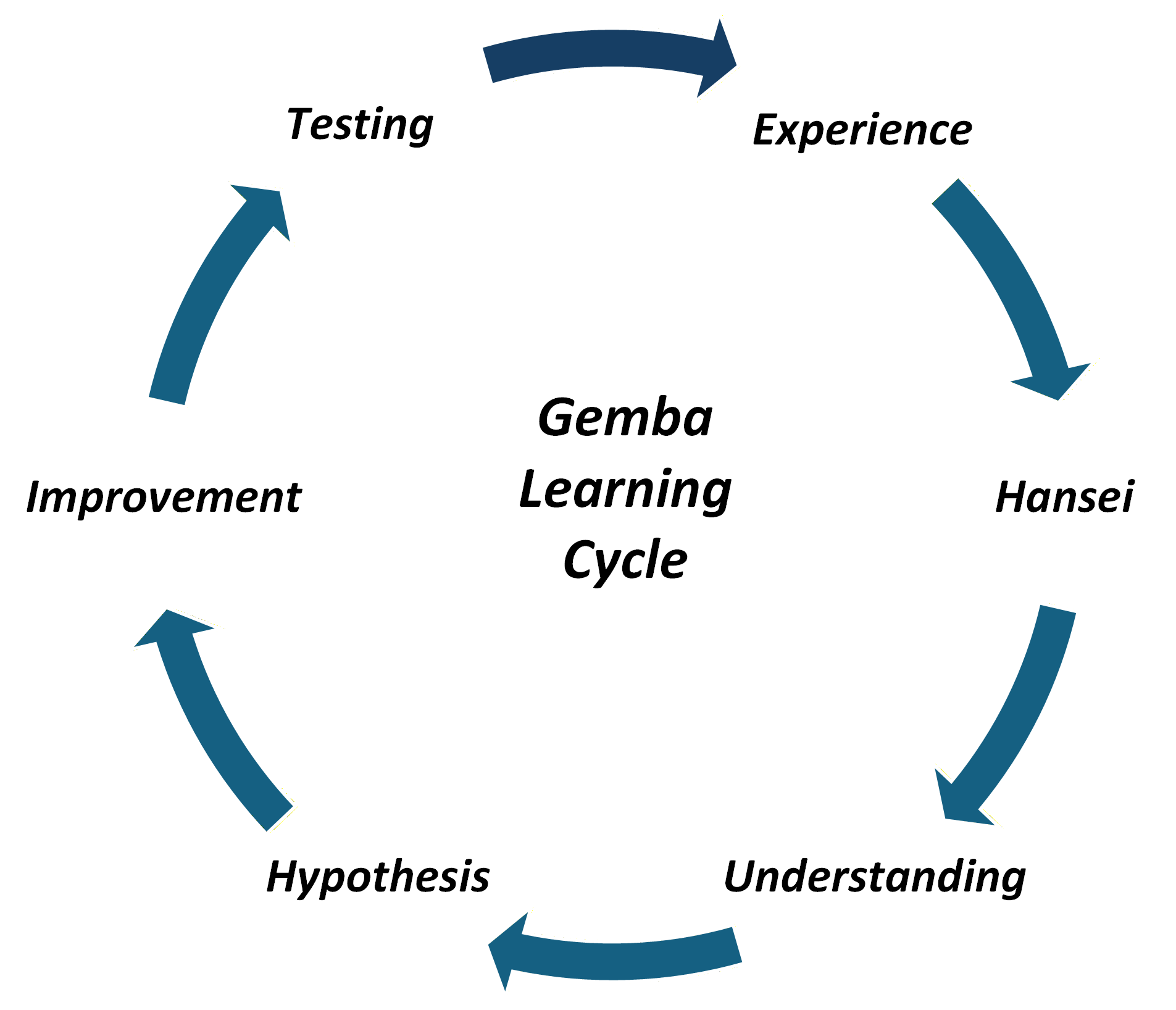
Gemba learning is cyclical and continuous. It follows a practical rhythm:
- Experience — observe and participate in the reality of the work.
- Hansei — reflect honestly on what is happening and what could be better.
- Understanding — identify the real problem or opportunity.
- Hypothesis — develop a proposed improvement.
- Improvement — design the change or experiment.
- Testing — apply it at Gemba and learn from the result.
The cycle then continues.
This is why Gemba is not simply observation. It is participation in learning.
Gemba in the NaturFlourish Story
In Lead, Transform and Navigate, Gemba serves as the corrective to abstraction. The Business Capability Model, Capability Pledge and product development work all become more meaningful when they are tested where consequences occur.
When the BCM is taken into manufacturing, it ceases to be a boardroom artefact and becomes a living question. People such as Alnis, Helen, Elena, Lindy, Bruno, Josh and Mallory test whether the model reflects the actual work and the promises the organisation must uphold.
That is the power of Gemba. It reveals what the model could not know from a distance.
Related Concepts
- Hansei
- Kaizen
- Ba
- SECI
- Business Capability Model
- Knowledge Base
- Consequential Intervention
- Adaptive Capacity
- Organisational Learning
- Toyota Production System
For more information:
- Gemba Tests Everything🧪
- Gemba — Where Learning Becomes Real
- Source Note – Consequential Intervention