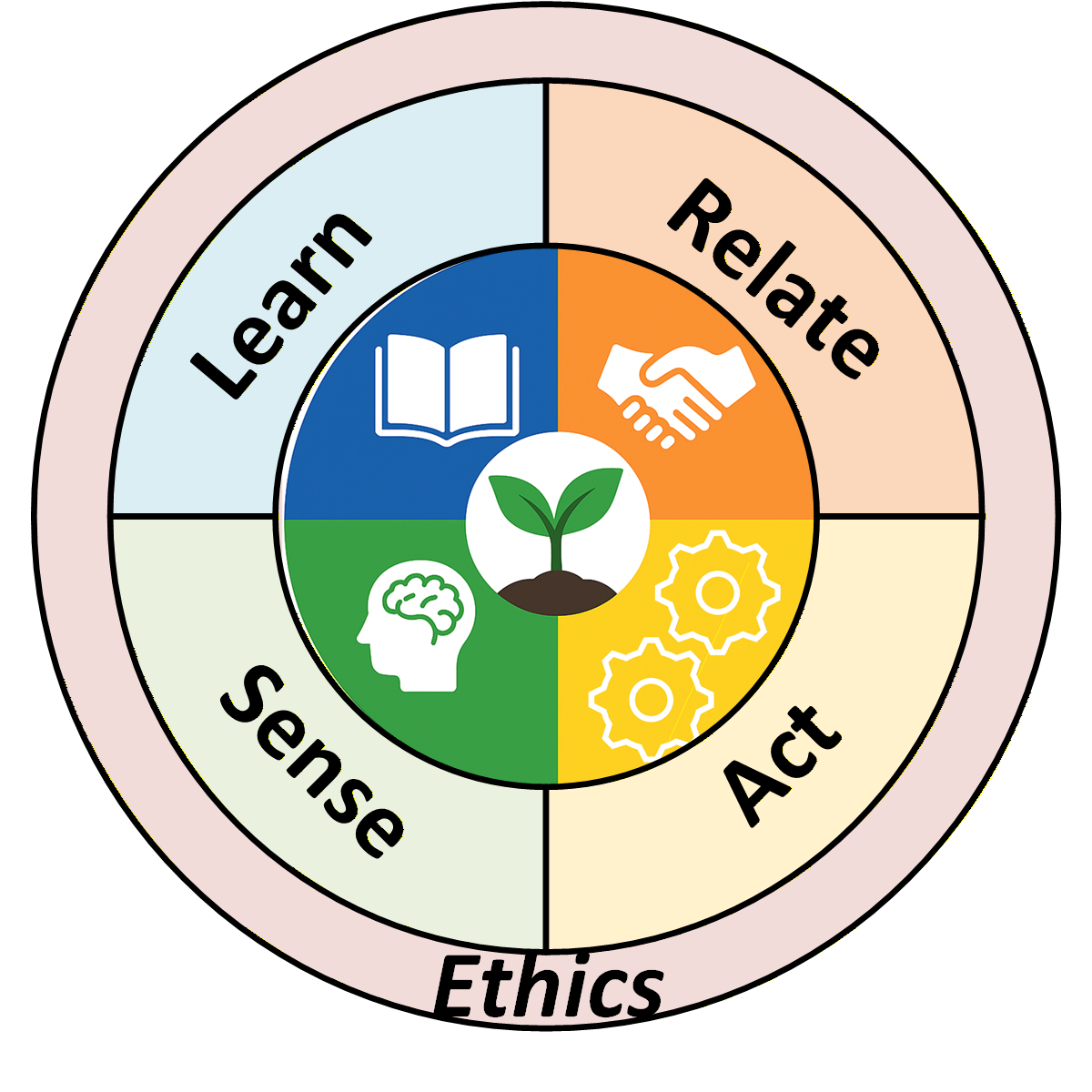
Part of the Adaptive Capacity model → View full model
Ethical Domain
How ethical alignment shapes decision-making
Ethics is not a statement of values.
- Ethics isn’t just about values.
- It is the pattern of decisions an organisation makes — especially under pressure.
- Ethical integrity shows itself through actions — not intentions.
- In complex environments, there is rarely a single “right” answer. What truly matters is whether decisions stay aligned with purpose, responsibility, and consequences.
Drifting into failure is not random — It follows patterns.
The question is whether those patterns are recognised early enough to change course.
🚩 Red Flags (Early Warning Signs)
- Values are stated but not enacted
- Decisions are justified after the fact
- Trade-offs are hidden or avoided
- Accountability is unclear or displaced
- Consequences are not investigated — they are ignored
- Short-term outcomes override long-term consequences
- People remain silent when something feels wrong
These are not exceptions. This is the pattern.
🧩 Core Patterns
Sensemaking → What’s going on
Framing Insight → Meaning / Orientation
Clarity is not achieved through answers, but through disciplined questioning.
Without ethical grounding, inquiry becomes performance rather than understanding.
Source Note – Triple Bottom Line: From Profit to Prosperity
Buddhist Teachings for a VUCA World
For a deeper dive:
Structural / Philosophical Anchor → Why it works this way
Socratic inquiry was never a checklist. It was a discipline of exposing uncertainty.
But inquiry alone is insufficient.
Without ethics, questioning becomes:
- rhetorical
- performative
- used to dominate rather than clarify
As Socrates understood, truth matters because action depends on it.
Socratic Discipline and the Ethics of Inquiry
Permitted Reality: Why Organisations Cannot See What Matters
Observation → What’s actually happening
Organisations often claim to value critical thinking, yet reward speed and certainty.
Terms like strategy, capability, and value are used confidently — but rarely defined.
What appears as alignment is often shared language masking different meanings.
Pattern Diagnosis → What’s going wrong
This pattern can be identified through observable behaviours:
- Decisions consistently reinforce existing assumptions
- Contradictory evidence is dismissed, reframed, or ignored
- Metrics improve while underlying problems persist
- Conversations avoid uncomfortable or consequential topics
- Responsibility becomes unclear or displaced
- Learning activity increases, but outcomes do not materially change
👉 When these conditions are present, the organisation is not responding to reality.
It is operating within a constrained version of it.
How AI amplifies Ethical Failure
Permitted Reality: Why Organisations Cannot See What Matters
Action → What to do about it
Organisational Implication → What this does to the system
In practice:
- unclear language leads to broken systems
- undefined ownership leads to lost accountability
- untested assumptions lead to failure
Meaning Emerges Through Interaction
Questions to Ask Before Acting
- What do we actually mean by this?
- What assumptions are we relying on?
- Who is accountable for the consequences?
- What would cause us to rethink this decision?
- What are the ethical consequences of acting this way?
In Complex Environments, Framing Errors Are Structural
Hansei — Reflection That Forces Correction
Personal Implication → What this means to you
In practice, ethics is not just an organisational abstraction.
It is expressed through individual choices — moment by moment.
Every time you:
- stay silent when something feels wrong
- accept unclear language without challenge
- prioritise speed over understanding
- justify a decision you know is questionable
you are shaping the conditions of the system.
Organisations do not “hold” ethics. They reflect the accumulated behaviour of individuals.
The same mechanism applies at the personal level:
- when it feels unsafe to speak, you withhold judgement
- when consequences are unclear, you default to compliance
- when incentives conflict with values, you experience tension
The question is not whether the organisation is ethical.
It is: What are you choosing to contribute — or withhold?
Permitted Reality: Why Organisations Cannot See What Matters
Source Note: The Ego as the Engine of Inertia
When Compliance Replaces Judgement
Questioning — The Discipline That Prevents Organised Self-Deception
🤿 Subject Areas
Subject Areas provide deeper and more structured exploration of specific disciplines, practices, and modelling approaches referenced throughout the pathways and Source Notes