Culture, Social Capital, and the Flow of Knowledge
(SECI and the Knowledge Operating System integration)
Why Culture Is So Difficult to Define
Culture is one of the most used—and least understood—concepts in organisations.
It is often described as:
“The way we do things around here.”
This works because it is observable.
But it is incomplete.
It describes behaviour, not the mechanisms that produce behaviour.
A Structural Definition
From both research and practice, and aligned to the Knowledge Operating System:
Culture is the pattern of behaviours that emerges from shared mental models, shaped by purpose, identity, principles, and ethics, and reinforced through experience.
This definition introduces four critical elements:
- Shared mental models → the knowledge layer.
- Purpose & identity → directional coherence.
- Ethics → boundary conditions.
- Experience → the testing ground (Gemba).
Knowledge and Practice — The Living Foundation
Knowledge in organisations is not simply stored or transferred. It is formed, shared, and refined through practice.
Practitioners draw on a combination of:
- Know-what — facts, structures, and information.
- Know-how — how work is performed in practice.
- Know-why — understanding of cause, effect, and consequence.
Much of this begins as tacit knowledge which is:
- experience-based,
- context-specific,
- and shaped through action, reflection, and interaction, including individual introspection.
It is not stored in systems. It lives in people, relationships, and practice.
Through experience and dialogue, aspects of this knowledge can be articulated.
Externalisation is the process of making aspects of know-what, know-how, and know-why explicit. It is always partial — never a complete representation of what is known.
Through this process:
- practices can be described,
- reasoning can be explained,
- and shared understanding can begin to form.
However:
- judgement,
- timing,
- and context,
remain tacit, and must be developed through shared experience.
This is why:
- Documentation alone does not create capability.
- Training alone does not embed understanding.
- Systems alone do not produce coherence.
Knowledge only becomes real when it is:
- shared,
- tested in practice,
- and reinforced through experience.
Social Capital — The Enabling Condition
Social capital is:
The trust, relationships, and shared norms that enable people to work together and share knowledge.
It is not “soft”. It is structural.
Without social capital:
- People share less of what they know, or only when required.
- Knowledge remains local and fragmented.
- Coordination becomes slower, more fragile, and dependent on formal mechanisms.
- Collaboration is limited and often superficial.
Social capital is what allows tacit knowledge to be surfaced, shared, and activated in practice.
SECI — The Mechanism of Culture Formation
🧭 In the Knowledge Management Guideline of Adapt, Survive and Flourish (KM Guideline):
- Socialisation — tacit knowledge is shared through experience, observation, and interaction.
- Externalisation — aspects of tacit knowledge (know-how, know-why, know-what) are articulated and made explicit (always partially).
- Combination — explicit knowledge is organised, integrated, and structured into coherent forms.
- Internalisation — explicit knowledge is absorbed and becomes tacit through application in practice.
👉 These are not discrete steps. These are interdependent processes that occur continuously within the organisational field. This is only a thumbnail sketch; see the original text for details.
Critical Insight
Knowledge is not created through documentation alone.
It is created through:
- Shared experience
- Dialogue and articulation
- Inegration into coherent structures
- Application in practice
Learning appears to occur when knowledge is documented.
But it only becomes real when it is internalised through use.
SECI — A Cultural Perspective
Nonaka’s SECI model provides the missing dynamic (Nonaka, Toyama, & Konno, 2000).
This is a cultural perspective:
Socialisation (Tacit → Tacit)
By example in a Master/Apprentice context:
- The master demonstrates practice and shares experience,
- The apprentice observes actions, including subtle cues and context,
- The apprentice questions to seek clarification and guidance.
It requires social capital to happen:
- trust,
- willingness to engage,
- and shared norms of learning,
Externalisation (Tacit → Explicit)
Through iterative sensemaking between the individual and the group:
- Individuals reflect and form their own understanding.
- That understanding is expressed through dialogue, modelling, and articulation.
- The group tests, challenges, and refines these emerging views.
- Shared meaning develops through repeated cycles of expression and feedback.
In practice, this is not a single step. It is a continuous movement between:
- Individual sensemaking (internal reflection)
- Collective sensemaking (dialogue and mutual confirmation)
Understanding grows as each cycle:
- surfaces assumptions,
- exposes differences,
- and builds alignment.
Externalisation is therefore a process of forming and refining shared mental models, not simply expressing knowledge
Exteralisation Requires:
- Trust and psychological safety.
- Willingness to express incomplete thinking.
- Openness to challenge and refinement.
Externalisation is always partial and shaped by context.
Combination (Explicit → Explicit)
- Structuring
- Itegrating
- Systemising
Explicit knowledge (Codified Knowledge) and is:
- organised into coherent structures,
- integrated across business capabilities,
- stabilised into shared models, artefacts, and systems.
This is where the Knowledge Base is formed (see below).
It provides:
- A common language.
- A shared reference point.
- The foundation for coordination and decision-making
Consideration of a knowledge base is often dominated by platforms and systems, rather than the coherence and cohesion of the underlying content.
Combination works in concert with Externalisation to stabilise codified knowledge.
Internalisation (Explicit → Tacit)
- Practice
- Embodiment
- Learning by doing
👉 Learning is confirmed at Gemba, where knowledge is tested in real work.
🔁 Learning Loops
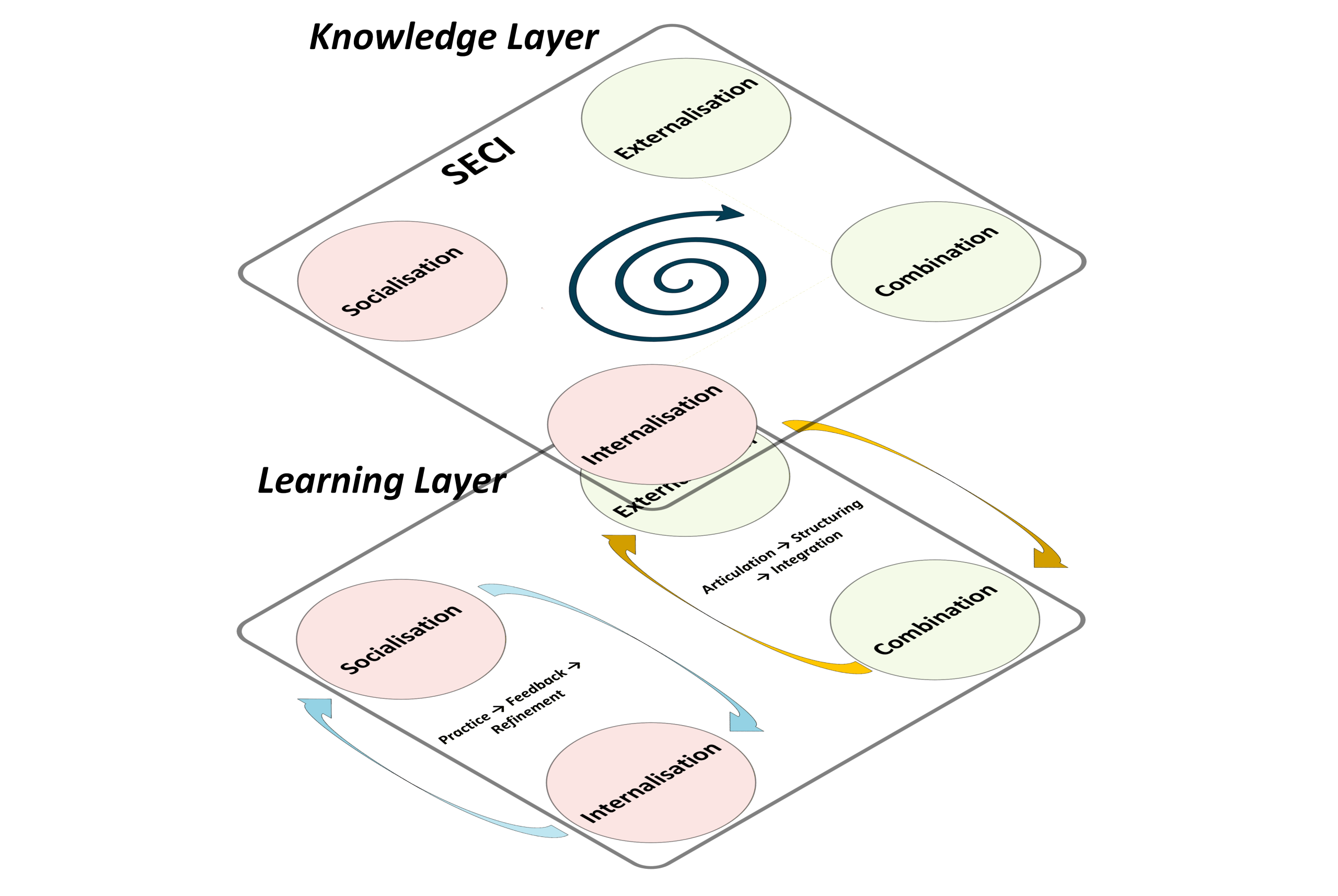
Figure 1: Layered Learning Loops in SECI
The Knowledge Layer (top)
- Externalisation + Combination
- builds the shared knowledge base.
The Learning Layer (bottom)
- Socialisation + Internalisation
- builds individual and collective capability.
The bridge between them:
- Articulation → Structuring (downward flow)
- Practice → Feedback → Refinement (upward flow)
The Knowledge Layer organises what is known.
The Learning Layer develops what can be done.
Internalisation is the process by which knowledge becomes real capability.
It is not:
- reading,
- training,
- or exposure to information.
It is:
- repeated application in real work,
- under real constraints,
- with real consequences.
Through this process, explicit knowledge is transformed into tacit craft knowledge.
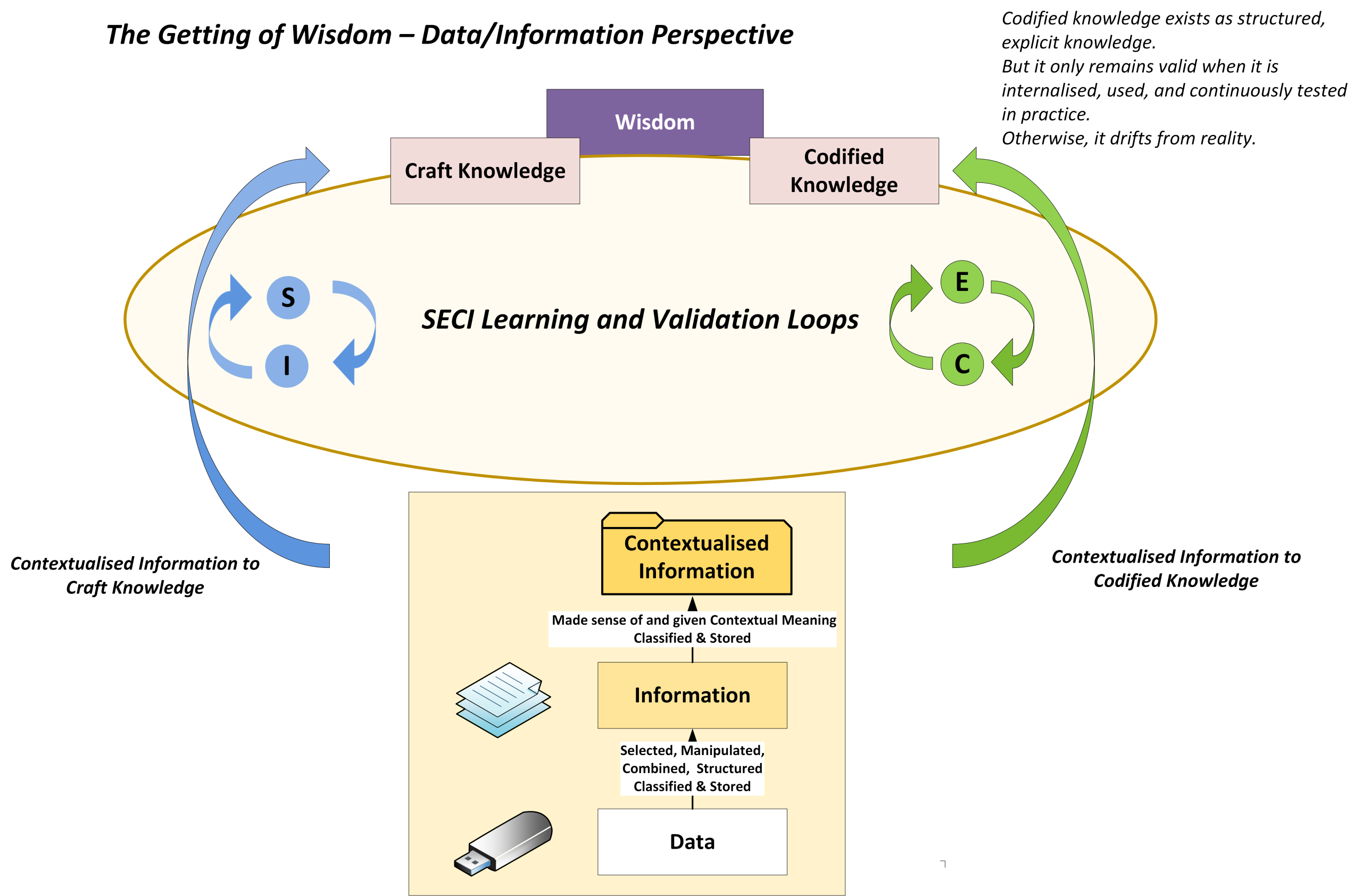
Figure 2: The transformation of data to knowledge.
In the bottom half of the picture, data is transformed into contextualised information. The transformations of Craft Knowledge and Codified Knowledge can occur only within the SECI Learning and Validation Loops.
Craft Knowledge — The Outcome of Internalisation
Craft knowledge is the lived, embodied form of knowledge that develops through experience.
It includes:
- Muscle memory — how work is physically performed.
- Sensory awareness — recognising subtle cues and patterns.
- Cognitive judgement — knowing what matters and what does not.
- Observational skill — seeing what others miss.
- Know-why in practice — understanding cause, consequence, and timing.
👉 This cannot be fully taught.
👉 It must be developed through experience.
Codified Knowledge – The Knowledge Base
The Knowledge Base and its Decay (Entropy)
The Knowledge Base is not a repository.
It is a living structure of shared mental models, expressed through:
- Business Capability Models (what the business does)
- Common Data Models (what the business deals with)
- Their integration (how meaning is connected across the organisation)
👉 It is the stable foundation beneath changing processes, systems, and stakeholder perspectives
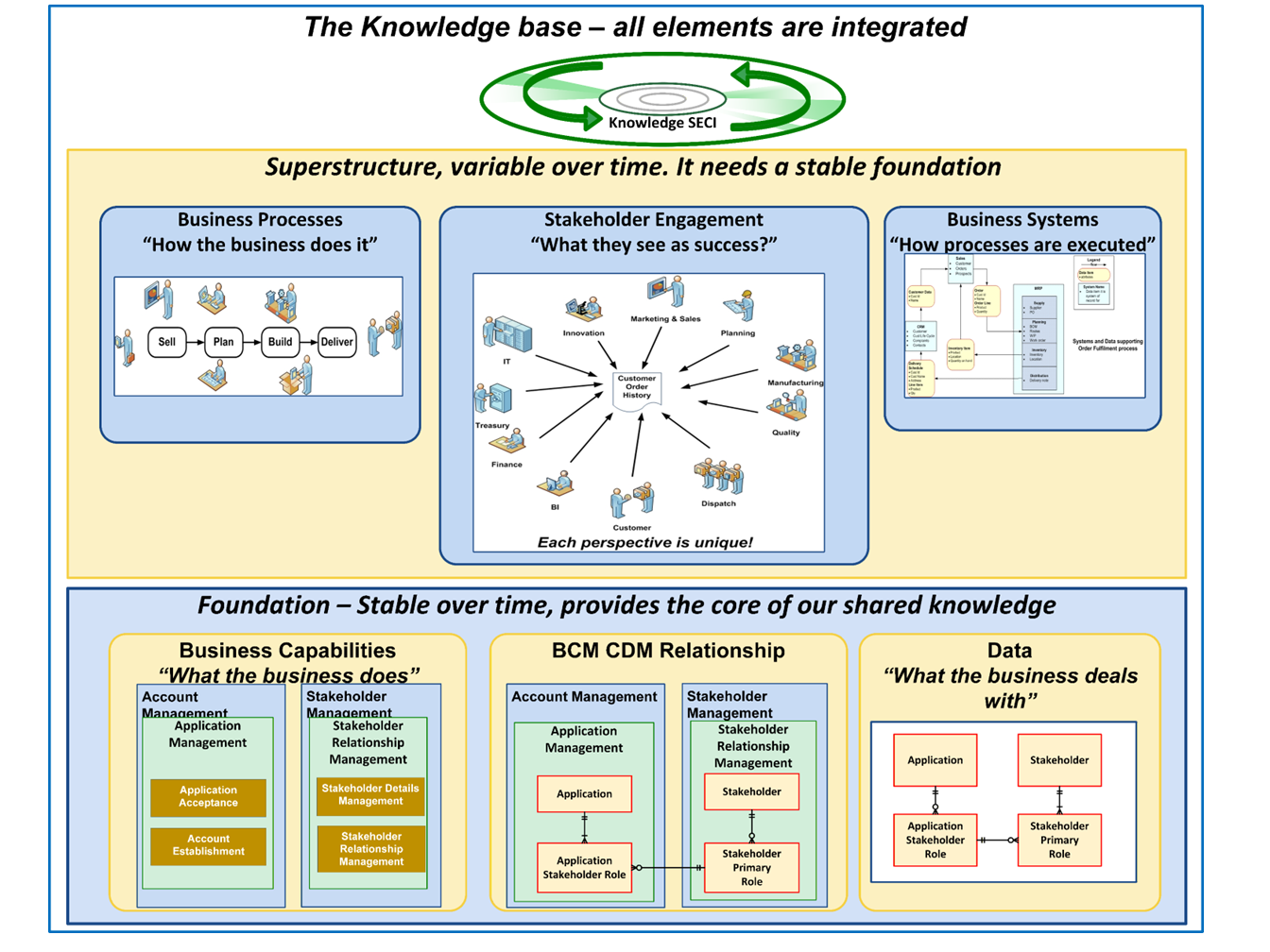
Figure 3: The Knowledge Base – built on a stable foundation.
Value Through Use (Gemba)
Explicit knowledge increases in value only when it is:
- applied in real work,
- tested against reality,
- used to inform decisions and action.
👉 Use creates:
- potential for growth,
- continued refinement,
- may increase insight and provide deeper alignment,
- ongoing testing of relevance and assumptions,
- and a broader base of people who understand and use it.
Without use:
- Knowledge becomes abstract as meaning is slowly lost.
- Assumptions remain untested, so their relevance may be lost, and their truth diminished as a result.
- Coherence degrades as people’s memories fade.
Entropy — The Silent Decay
All explicit knowledge is subject to entropy.
Without continual use and renewal:
- Definitions and shared understanding drift.
- Models lose alignment with reality as new factors come into play.
- Multiple versions of truth may emerge as group coherence begins to fade, and people begin to develop their own solutions in isolation to meet their own immediate needs.
- As a direct result of group fragmentation, siloed thinking becomes more prevalent, and systems become complex with an increasing loss of group coherence.
Knowledge does not remain valid by being stored. It becomes real only through use.
👉 It is not self-sustaining. It requires continuous engagement across the organisation.
Craft Knowledge
How Craft Knowledge Forms in the SECI Learning Cycle
Internalisation does not stand alone.
It is fed by Socialisation and completed through practice:
- Through Socialisation
→ individuals observe, experience, and absorb tacit knowledge from others. - Through Externalisation & Combination
→ aspects of that knowledge are structured and made explicit - Through Internalisation (at Gemba)
→ individuals apply that knowledge in real work
And through repetition:
- practice → feedback → refinement.
- action → consequence → adjustment.
👉 Tacit knowledge deepens
👉 Craft knowledge emerges
Critical Insight
Internalisation is where:
- knowledge becomes capability,
- capability becomes judgement,
- and judgement becomes adaptation.
Without internalisation:
- knowledge remains abstract,
- capability remains superficial,
- and learning is incomplete.
🧭 See Adapt, Survive and Flourish (KM Guideline) for the full SECI definition.
Key Insight
Culture is the emergent outcome of repeated SECI cycles across the organisation.
Where Social Capital Sits in SECI
Social capital is not a side concept.
It is a core enabling condition for SECI — but it exists in degrees.
SECI does not simply function or fail.
It operates at varying levels of effectiveness depending on the quality of the social field.
As social capital weakens, SECI does not stop —
it becomes distorted, constrained, or degraded.
How degradation shows up
- With low trust or psychological safety
→ Socialisation becomes selective, guarded, or superficial.
→ Experience is not fully shared, knowledge may be withheld or filtered. - With weak relationships
→ Externalisation becomes partial or performative.
→ Knowledge is expressed incompletely, shaped by context, capability, and perceived risk. - With fragile or misaligned norms
→ Internalisation becomes inconsistent
→ knowledge is applied unevenly, or not at all.
What this means in practice
Organisations rarely have:
- zero social capital,
- or zero learning.
Instead, they operate with:
- Fragmented trust.
- Localised knowledge sharing.
- Uneven capability development.
- Higher levels of key person risk.
👉 This is why many organisations appear to function while gradually accumulating fragility.
Critical Insight
SECI is always operating.
The question is not whether learning occurs, but:
- what is being learned,
- how accurately reality is being interpreted,
- and how widely that learning is shared and applied?
As social capital degrades:
- Learning becomes local rather than shared.
- Knowledge becomes fragmented rather than broadly coherent.
- Behaviour shifts from adaptive → compliant.
👉 The system continues to operate — but with increasing reliance on:
- workarounds,
- key individuals, where knowledge is held by a few.
Mapping to the Knowledge Operating System and Organisational Ecology
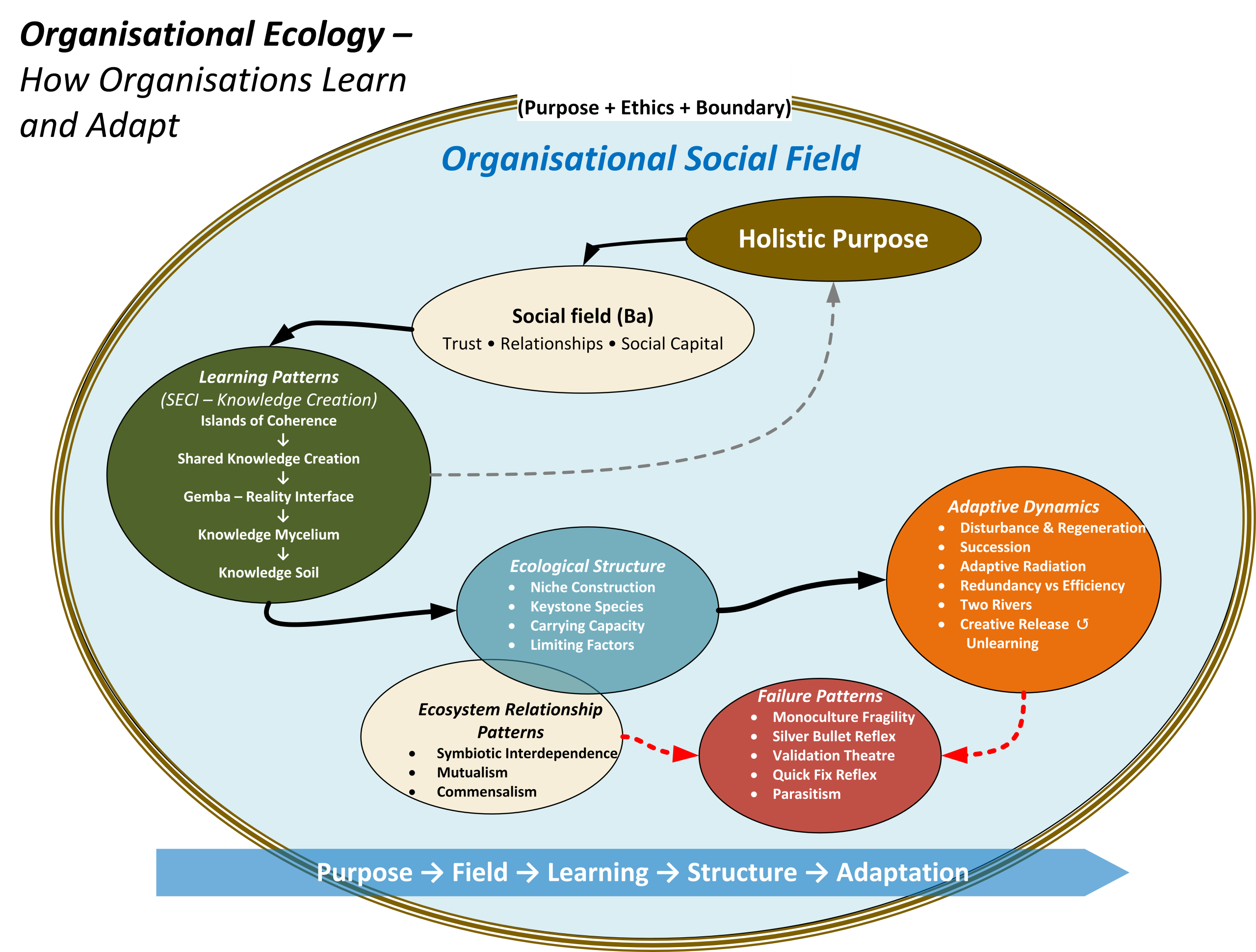
Figure 4: Organisational Ecosystem
Purpose Layer
- Purpose defines direction.
- Ethics defines constraints.
- Capabilities define what the organisation is able to do in practice.
The Purpose Layer provides direction, constraint, and scope for the Knowledge Operating System.
It determines what is learned, how it is applied, and within what boundaries.
Ba / Social Field
- The relational space in which people interact.
- Trust, respect and open communication.
- Where people speak, listen, and engage with one another.
👉 This is where knowledge flows between people in practice. It is where social capital is formed, maintained, and tested.
SECI Layer
- Knowledge creation, sharing, and operational use.
- Continuous learning loops between tacit and explicit knowledge, see figure 2.
- Understanding is formed individually and refined collectively through interaction.
Knowledge is not created in a single step.
It emerges through repeated cycles of:
- Sharing experience (Socialisation).
- Articulation and sensemaking (Externalisation).
- Structuring and integration (Combination).
- Application in practice (Internalisation).
👉 These cycles operate continuously, not sequentially
The quality of these cycles depends on:
- The strength of the social field (Ba).
- The levels of trust and mutual respect.
- The ability to test knowledge in practice (Gemba).
👉 This is how knowledge evolves, becomes capability, and is sustained over time
Gemba
- Where work is actually done.
- Where people learn by doing.
- Where reality pushes back on assumptions.
- Where consequences are experienced.
- Where feedback cannot be ignored.
Models, plans, and beliefs are formed elsewhere. At Gemba, they are tested against reality.
👉 This is where assumptions live or die.
Culture (Emergent)
- Behaviour patterns.
- Decision norms.
- Ways of working.
Culture is not:
- Values statements.
- Leadership slogans.
- Training programs.
Culture isn’t what we say we believe.
It’s what we repeatedly do—based on what we’ve learned together.
👉 Culture is not designed—it emerges from the conditions created by the system above, and reinforces them over time.
The Integrated Model
- Purpose and ethics shape the field (Ba).
- The field enables SECI.
- SECI builds shared mental models.
- Shared mental models drive behaviour.
- Behaviour patterns become culture.
What Happens When the System Breaks
Weak Social Capital
- Reduced trust.
- Limited knowledge sharing.
- Fragmentation.
Loss of Tacit Knowledge
- Experience disappears.
- Judgement declines.
- Learning slows.
- Key person risk increases.
Over-Dominance of Combination (systems/platforms)
- Explicit knowledge dominates.
- Tacit layer atrophies.
Result
- Culture shifts from adaptive → compliant
- From learning → execution
- From resilient → fragile
The Critical Pattern
When organisations remove people, over-standardise, or rely excessively on platforms:
- Social capital weakens.
- Tacit knowledge flow reduces.
- SECI slows or breaks.
- Culture becomes static.
Final Pattern Statement
As social capital weakens:
- Tacit knowledge flows less freely.
- SECI becomes constrained.
- Culture loses its capacity to adapt.
- The organisation becomes increasingly fragile.
Knowledge becomes capability through use.
It remains valid through renewal.
It survives through shared practice.
Nonaka, I., Toyama, R., & Konno, N. (2000). SECI, Ba and leadership: a unified model of dynamic knowledge creation. Long range planning, 33(1), 5–34.
Explore further
This article connects to the broader framework:
- Ethical Domain — how constraints shape decisions and define the boundaries of action
- Sensemaking Domain — how organisations interpret reality and form shared understanding
- Relational Domain — how the social field (Ba) enables trust, communication, and coordination
- Learning Domain — how SECI cycles create, share, and test knowledge in practice
- Action Domain — how knowledge is applied at Gemba and expressed as coordinated capability
👉 Explore the full Knowledge Operating System: Source Notes
Reminds me of Margaret Wheatley’s six/seven circles model – https://www.nationalequityproject.org/frameworks/seven-circle-model
Peter, my sincere apologies for the delayed response. A problem with the website’s comment notifications meant I did not see your comment when it arrived. Thank you for drawing my attention to Margaret Wheatley’s six/seven circles model. There is a clear resonance with the organisational learning ecology described here, and I will explore the connection more closely. Much appreciated.