SECI is not just a flow of knowledge
Most explanations of SECI stop too early.
They describe a neat spiral.
That’s accurate.
But it misses the point.
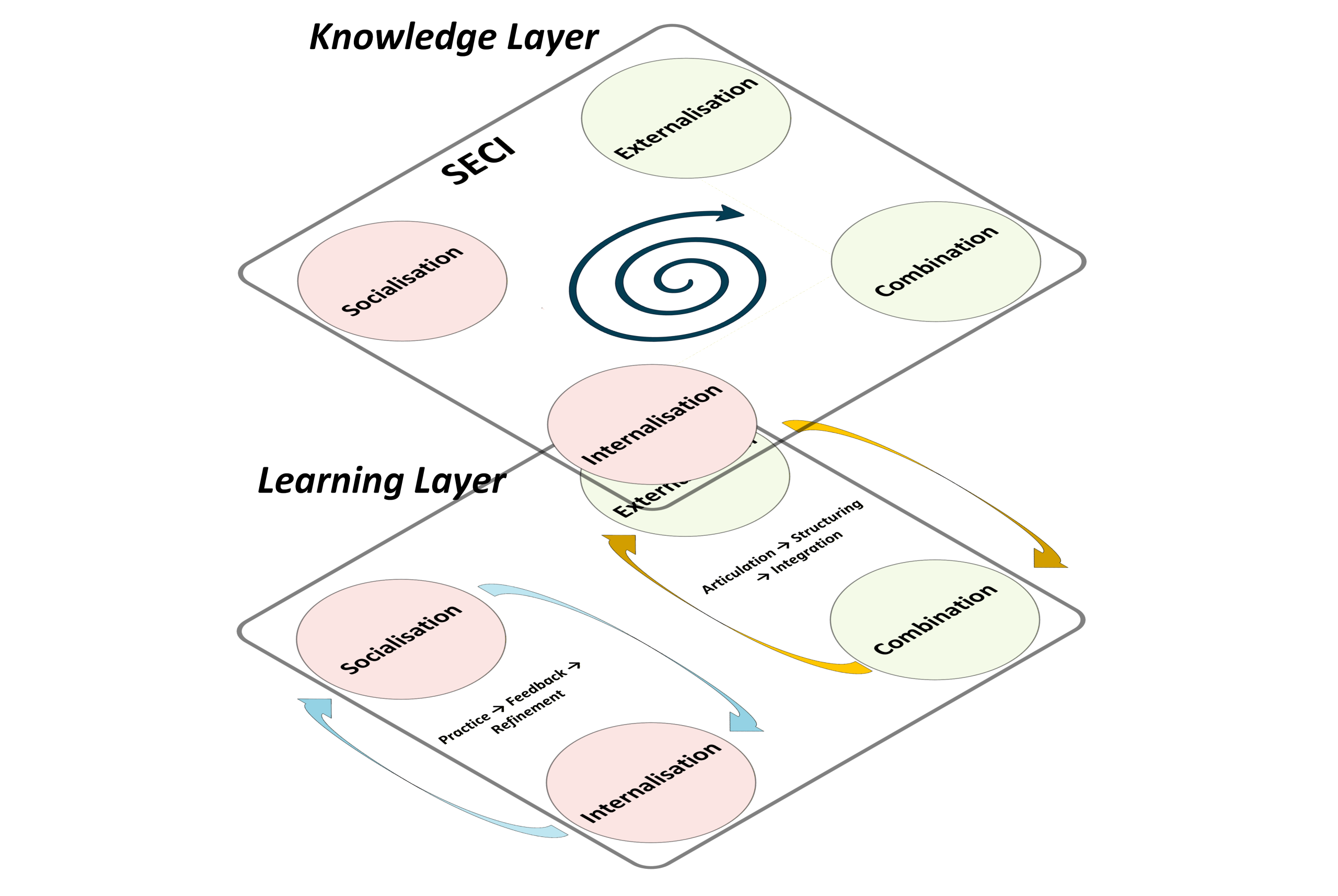
Figure 1: SECI Layers
In Figure 1, the top layer is the traditional SECI Knowledge Spiral, comprising:
- Socialisation
- Externalisation
- Combination
- Internalisation
But the learning processes occur in the learning layers as a system of interacting learning loops.
At its core, SECI is driven by two distinct but coupled learning processes:
1. The Tacit Learning Loop
Practice → Feedback → Refinement
- Skills are developed through experience
- Judgement is shaped through feedback
- Capability emerges through repeated use
This is where:
- craft is formed
- intuition develops
- relationships and trust are built
This is the foundation of Social Capital
2. The Explicit Learning Loop
Articulation → Structuring → Integration
- Insight is expressed
- Knowledge is formalised
- Artefacts are created and connected
This is where:
- models are built
- frameworks are defined
- knowledge bases are formed
This builds Human Capital
The critical insight
SECI is not a sequence.
It is a system.
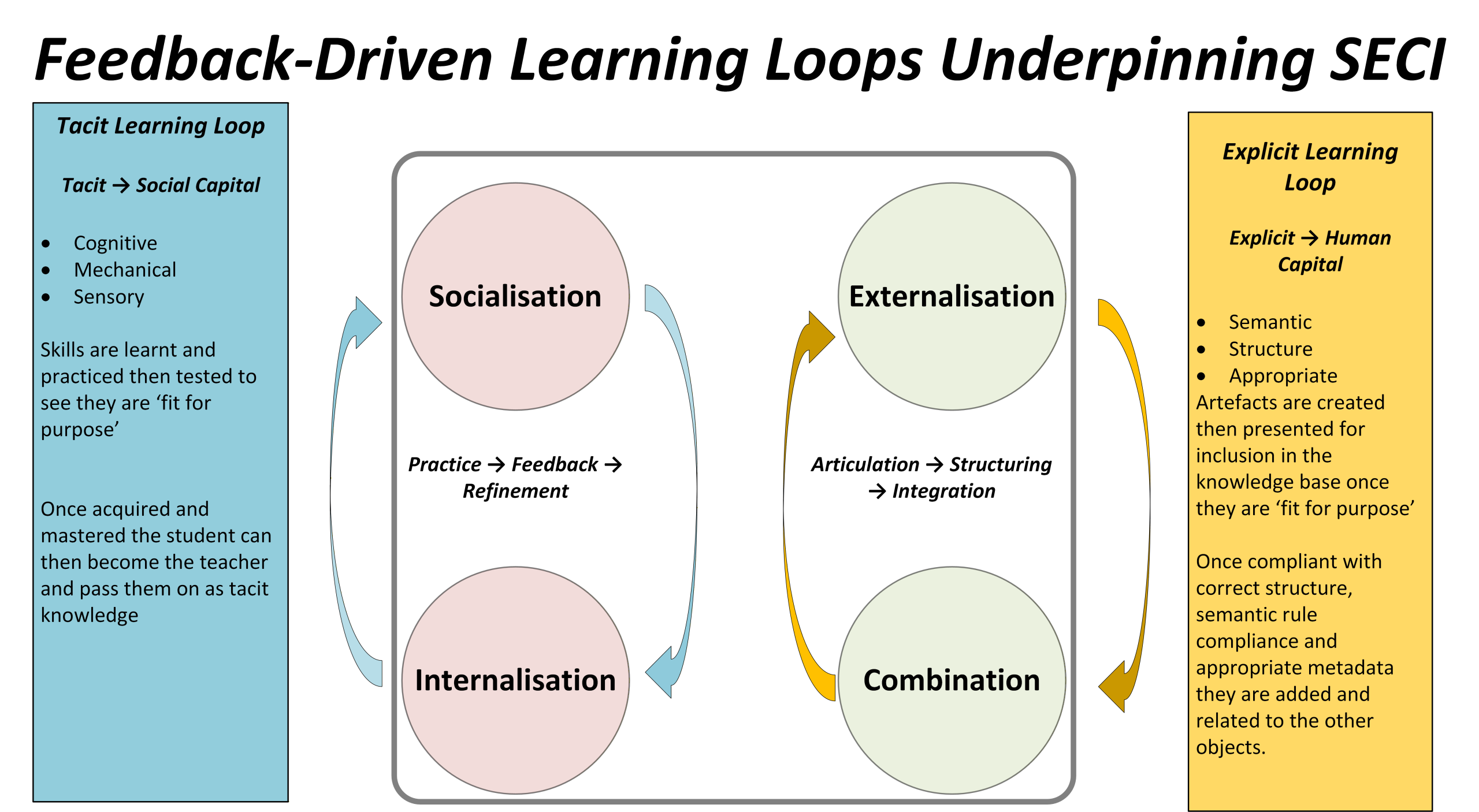
👉 It is the coupling of these two loops
- Tacit learning gives depth and meaning
- Explicit learning gives structure and scale
When they reinforce each other:
👉 learning accelerates
👉 capability grows
When they separate:
👉 organisations produce artefacts without understanding
Where most organisations go wrong
They over-invest in the explicit loop:
- documents
- models
- frameworks
- repositories
…and under-invest in the tacit loop:
- practice
- apprenticeship
- feedback
- shared experience
👉 The result is predictable:
- knowledge exists.
- but nothing changes.
The role of Internalisation
Internalisation is not the final step.
👉 It is a test of learning
If people are not:
- acting differently
- making better decisions
- responding more effectively
In that case, the SECI cycle has not been completed.
📖 Narrative Example — NaturFlourish (BCM Workshop at Gemba)
The first BCM session produced a coherent model.
The language is aligned
- The structure held
- No one objected
It looked like progress.
It wasn’t.
In the second workshop, something changed.
The conversation moved out of the room and into the work.
Assumptions were tested against real decisions
- Gaps began to surface
- People started to hesitate before agreeing
Bruno paused more.
Saanvi pushed back.
Josh asked questions that didn’t quite fit the model.
The model didn’t break.
👉 But confidence in it did.
This is where learning actually started.
Not when the model was produced.
- Not when it was agreed.
👉 When it was used — and found wanting.
This is the shift:
- From coherence → to consequence
- From agreement → to challenge
- From structure → to reality
What changed was not the artefact.
👉 It was behaviour.
People began to:
question their own assumptions
- challenge each other
- test relevance, not just correctness
The conversation slowed.
But the quality increased.
This is the moment SECI completes.
👉 Internalisation is not acceptance. It is a behavioural change under pressure.
Final thought
SECI is often presented as a model of knowledge creation.
It is better understood as:
👉 a living learning system that converts experience into capability.
Most organisations are very good at producing knowledge.
Very few are good at learning from it.