Why some tools work brilliantly in Gemba—and fail everywhere else.
Overview
Simple frameworks are attractive. They promise clarity, alignment, and control.
Many organisations adopt one-page models—four-step strategies, canvases, strategy maps—believing that if something fits on a page, it must be understandable.
It often isn’t.
The effectiveness of any framework depends on the nature of the problem it is applied to.
Tools designed for bounded, operational issues do not transfer cleanly into complex, adaptive environments.
The Case Where One Page Works
The Toyota A3 is a well-known example of a one-page method that works exceptionally well.
It works because it is applied under strict conditions:
- A single, clearly defined problem.
- A specific operational context (Gemba).
- A directly accountable owner.
- A closed learning loop.
The one-page constraint does not simplify the problem—it forces the practitioner to:
- Deeply understand the issue.
- Establish cause and effect.
- Articulate a coherent response.
In this context, the A3 is not a summary tool.
It is a discipline for thinking.
Where the Problem Begins
Difficulties arise when this logic is transferred into broader organisational contexts:
- Strategy.
- Purpose.
- Stakeholder systems.
- Transformation under uncertainty.
These environments are fundamentally different:
- Problems are interconnected, not isolated.
- Stakeholders hold competing truths and agendas.
- Outcomes involve trade-offs and consequences.
- Understanding emerges through interaction, not analysis alone.
Applying a one-page structure here creates a predictable failure mode:
Premature convergence on an incomplete understanding.
The result is often:
- Superficial alignment.
- Hidden assumptions.
- Unresolved tensions.
- Details left out, either accidentally or deliberately.
This results in an incomplete model that cannot provide a shared understanding among stakeholders. The real danger is ill-conceived plans that fail under real-world conditions. Failure arises from unintended consequences that may not be recognised or understood within the planning period.
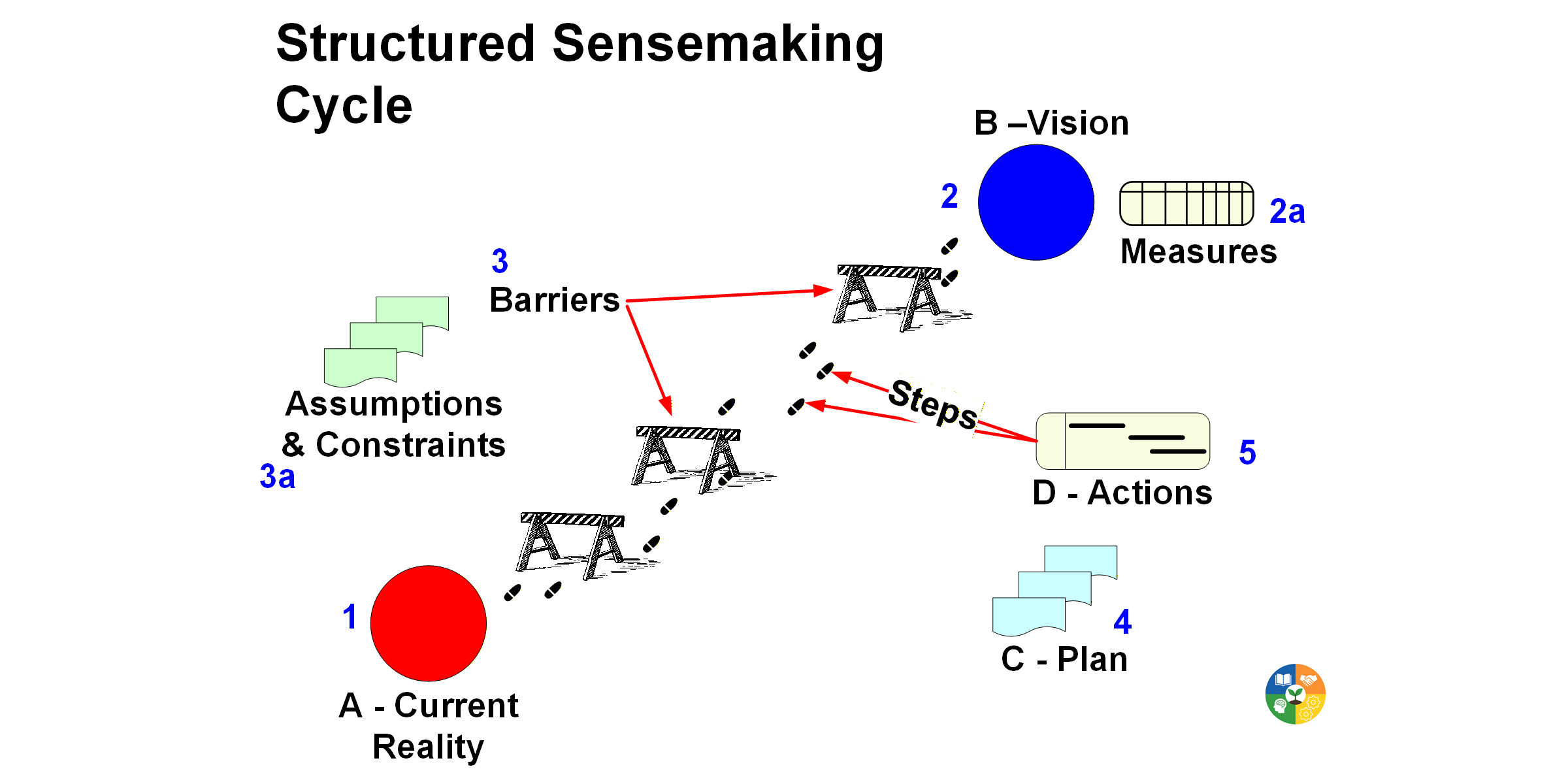
Figure 1: Structured Sense Making Cycle
Figure 1 illustrates a common approach to initiative planning:
- A — Address Current Reality
- B — Articulate Vision
- C — Identify Barriers
- D — Develop Plan and Steps
Used properly, this is not a static framework but a learning sequence:
- Reality is explored.
- Vision is negotiated.
- Barriers are surfaced (often politically and ethically)
- Assumptions are surfaced and constraints named.
- Action is taken and assessed.
- Assumptions are subject to ongoing monitoring.
- As change occurs so the steps are reviewed and updated.
Crucially, the sequence must loop:
Plans change reality.
New reality requires re-sensemaking.
This is where most simplified versions fail—they present ABCD as a linear, closed process, rather than an ongoing adaptive cycle.
On completion of the plan, D loops back to A for the next cycle.
The One-Page Trap
The One-Page Trap occurs when complex, adaptive challenges are compressed into a single, static representation, creating the illusion of clarity while concealing uncertainty, conflict, and consequence.
The core issue is not the framework itself.
It is the assumption that:
Complex organisational challenges can be reduced to a single, stable representation.
When constrained to one page in a complex domain:
- Nuance is removed.
- Conflict is hidden.
- Uncertainty is suppressed.
- Understanding and acceptance are assumed, not assessed.
- It’s a static process, it becomes the ‘truth’.
- Assumptions are not surfaced and checked.
The output appears clear—but that clarity is achieved by excluding complexity, not resolving it.
This creates a false sense of control — precisely when control is least available.
Domain Matters
A critical distinction appears:
Operational Domain (Gemba)
- Problems are bounded and observable.
- Cause and effect can be evaluated.
- One-page methods (e.g. A3) are highly effective.
Adaptive / Strategic Domain (VUCA)
- Problems are emergent and relational.
- Cause and effect is unclear or contested.
- Understanding develops through interaction and iteration.
In this domain, forcing a one-page solution leads to distortion.
Practical Implication
The question is not: “Is this framework good?”
The better question is: “Is this framework appropriate for the nature of the problem?”
Where complexity is high:
- Use structures that allow iteration and feedback.
- Expect multiple perspectives to coexist.
- Resist pressure to converge too early.
Key Takeaway
A3 works because the problem is bounded.
One-page strategy fails because the system is not.
Or more simply:
Clarity achieved by removing complexity is not understanding.
Links to Adaptive Capacity
This pattern connects directly to:
- Sensemaking → framing determines what is seen and acted upon
- Learning → understanding must be assessed and refined in practice.
- Ethics → suppressed tensions reappear as consequences.
- Action → plans must adapt as reality changes.
Closing Reflection
One-page tools are powerful when used in the right domain.
Used outside it, they do something else entirely:
They create the impression of control in systems that require learning.
🔗This source note is also relevant to:
- Sensemaking → False certainty drives fragility