Knowledge creation is not yet learning
Organisations frequently confuse the exchange, articulation, or storage of knowledge with true learning.
People may:
- share experience,
- hold workshops,
- construct models,
- agree on terminology,
- document procedures,
- and approve a common course of action,
without discovering whether their understanding is dependable.
Agreement establishes a shared mental model, but it does not validate it. Validation starts only after that understanding is put into practice, interacts with reality, results in consequences, and is then reviewed.
Knowledge creation forms understanding. Learning tests and changes it.
SECI is a learning system in motion
The SECI model describes four interacting movements of knowledge:
- Socialisation — exchanging experiences and building shared tacit understanding.
- Externalisation — expressing experiences, insights, and assumptions for review.
- Combination — linking and organising explicit knowledge into models, explanations, plans, and procedures.
- Internalisation — implementing explicit knowledge until it becomes part of judgment, skill, and practice.
These are not four boxes completed in sequence.
They form a continuing spiral through which understanding moves between people, artefacts, experience, and action.
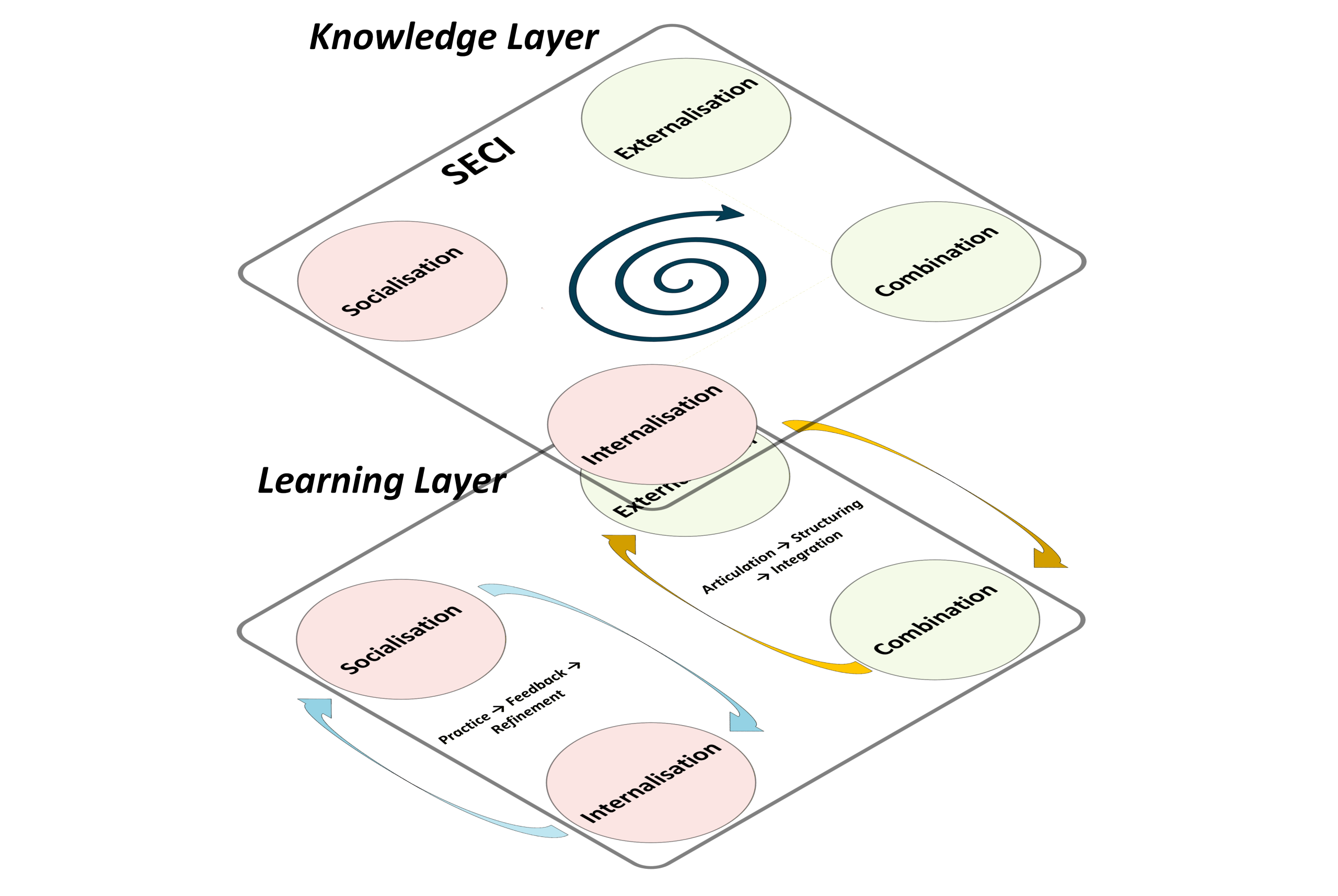
Figure 1: SECI Learning Loops
The Knowledge Layer develops, articulates, and organises understanding through a SECI cycle.
The Learning Layer subjects understanding to practice, feedback, reflection, and refinement through a further SECI cycle.
The two layers are interconnected, with organised knowledge guiding actions and experiences shaping updated understanding. The diagram does not specify which SECI process accounts for this connection.
Within the Learning Layer, Externalisation and Combination help articulate, structure, and integrate new knowledge, while Socialisation and Internalisation link practice with feedback and refinement.
Learning emerges through the continuing interaction between the two SECI layers, not through the completion of either cycle in isolation.
From data to contextualised information
Data does not become knowledge merely because it has been collected, classified, or stored.
Data may be:
- selected,
- combined,
- structured,
- manipulated,
- classified,
- and presented as information.
Information becomes useful only when people make sense of it within a particular context.
Contextualised information may then contribute to:
- craft knowledge, embodied in experience, skill, and practical judgement.
- codified knowledge, expressed through models, principles, procedures, designs, and other explicit forms.
Neither form is inherently true. Craft knowledge can become routine, localised, or outdated. Codified knowledge may become disconnected from practice while still seeming authoritative. Both types must stay linked to experience, results, and evolving circumstances.
Wisdom emerges through the judgement to use, question and revise knowledge responsibly in context.
Gemba closes the learning loop
Gemba is where understanding encounters reality.
The Gemba Learning Cycle illustrates the continuing movement through:
- experience,
- Hansei,
- understanding,
- hypothesis,
- improvement,
- and testing.
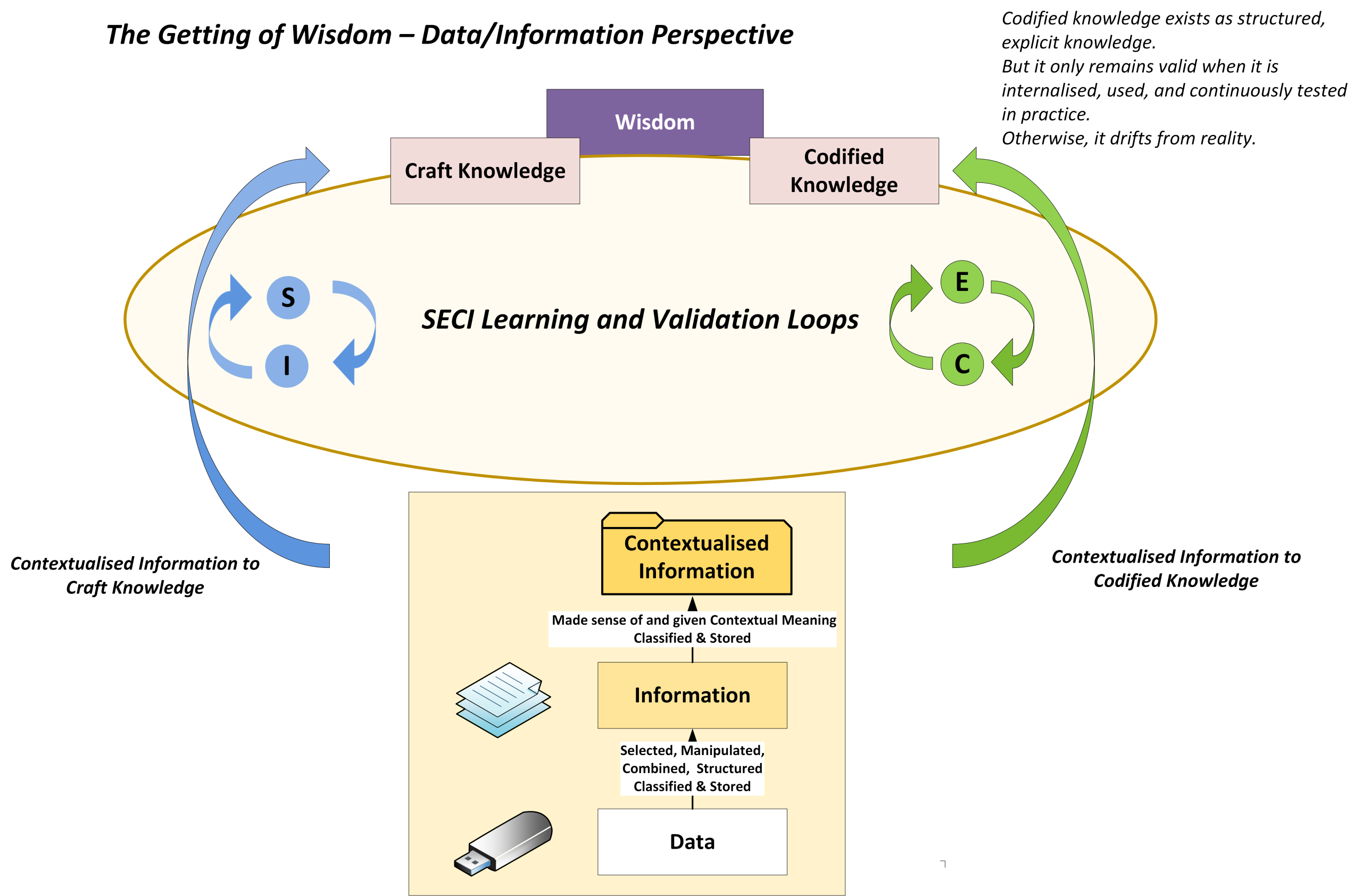
Figure 2: Gemba learning cycle
This is not a linear progression. Experience may challenge understanding at any point, reflection may reopen an earlier assumption, and testing may reveal consequences that prompt the organisation to reconsider both the proposed improvement and its original understanding of the situation.
Hansei gives the cycle its reflective discipline:
- What actually happened?
- What did we misunderstand?
- Which assumptions failed?
- What consequences did we overlook?
- What must now change?
Without this return to experience, an organisation may accumulate activity and information without genuinely learning.
SECI depends upon the learning environment
SECI does not operate in a social vacuum.
People must be sufficiently able and willing to:
- expose uncertainty,
- describe lived experience honestly,
- challenge existing explanations,
- listen to materially different perspectives,
- admit that an established model may be wrong,
- and revise shared understanding.
This depends on the quality of the relational field—the organisation’s Ba.
When trust, dialogue and psychological safety are weak, Socialisation becomes guarded, Externalisation becomes politically filtered, Combination preserves the official account, and Internalisation becomes compliance rather than learning.
The organisation may produce more knowledge artefacts while becoming less able to know what is actually happening.
What happens when the loop remains open
When action is not followed through to consequence:
- agreement is mistaken for validation,
- implementation is mistaken for Internalisation,
- training completion is mistaken for capability,
- repositories are mistaken for organisational knowledge,
- codified knowledge drifts from operational reality,
- unintended consequences remain hidden,
- and confidence increases faster than understanding.
Governance may then receive internally consistent reports that no longer reflect lived reality. This is why adaptive governance depends on Gemba, feedback, truth-telling and learning from consequences.
Learning remains alive when understanding is repeatedly evaluated through experience, consequence, reflection, and revision.
SECI supports this movement, but the deeper organisational learning system is explored elsewhere in the Guidelines.
Key principle
If it has not been tested at Gemba, it has not yet been validated.
Explore further
This article connects to the broader framework:
- Ethical Domain — how constraints shape decisions
- Sensemaking Domain — how organisations interpret reality
- Relational Domain — how trust and coordination emerge
- Learning Domain — how knowledge is created and tested
- Action Domain — how intent becomes capability
To understand more on Purpose detailed Subject Areas, visit the Deep Dive section.
📖See the Books