A Gemba-ready artefact is sufficiently coherent, credible and understandable to establish fluency and invite serious engagement, while remaining deliberately incomplete enough to be challenged.
It is not presented as organisational truth. It is a candidate representation of current understanding, prepared well enough that the people who know the work can concentrate on correcting, extending or rejecting it from lived reality rather than spending their time explaining the basics.
Gemba-ready does not mean ready for approval. It means ready to encounter reality.
Why Gemba-ready matters
Traditional discovery often begins with a blank page. Practitioners are asked to explain their work, terminology, relationships and exceptions while analysts attempt to construct a model from the conversation.
This consumes scarce human attention and frequently produces uneven results. Much of the available time is spent establishing basic fluency rather than examining what is important, unusual or wrong.
Generative AI changes that equation.
Using existing organisational knowledge, governed modelling patterns, industry research and prior validated structures, Human–AI work can prepare a credible candidate before engagement with Gemba.
The purpose is not to replace discovery. It is to make discovery more productive.
Instead of asking: “How does this work?”
the conversation can begin with: “This is our current understanding of how it works. What have we misunderstood, omitted or oversimplified?”
The 80% idea
Gemba-ready is sometimes described informally as 80% ready.
This does not mean 80% correct.
It means approximately:
80% fluent enough that knowledgeable practitioners can spend their time challenging the remaining 20% rather than teaching us the first 80%.
The distinction is critical.
A beautifully constructed model may still be wrong. A plausible AI-generated model may reproduce industry convention while completely missing local reality.
Gemba-readiness is therefore a measure of readiness for meaningful inquiry, not truth.
Characteristics of a Gemba-ready artefact
A Gemba-ready model should normally be:
Coherent
Its concepts, relationships and terminology fit together sufficiently well to support a serious conversation.
Credible
It reflects available evidence, established knowledge and relevant patterns rather than arbitrary invention.
Understandable
People familiar with the work can recognise what the model is attempting to represent.
Explicit
Important assumptions, definitions, relationships, lifecycle states and uncertainties are visible rather than hidden in prose or analyst interpretation.
Challengeable
It is deliberately presented as candidate knowledge. People must be able to say yes, but…, no, or you have missed something important.
Proportionate
It contains enough detail for the decision or validation need, but avoids unnecessary modelling depth.
Gemba-ready is not polished certainty
There is a danger in making candidate artefacts look too complete.
A highly polished model can unintentionally encourage passive approval:
“That looks comprehensive. Yes, that seems right.”
This creates validation theatre.
The purpose of a Gemba-ready artefact is almost the opposite. It should be good enough to engage people seriously but open enough to provoke resistance.
Useful responses include:
- “That state never occurs here.”
- “You have combined two different concepts.”
- “One order can actually be fulfilled from several batches.”
- “That person does not approve the work; they only perform it.”
- “That process looks right on paper, but that is not what happens on night shift.”
Those responses are not modelling failures. They are the point of going to Gemba.
Candidate knowledge
Within HAK, a Gemba-ready artefact remains candidate knowledge.
AI may draw upon:
- existing organisational artefacts;
- reusable architectural patterns;
- reference models;
- standards;
- research;
- previous validated knowledge;
- and structural inference.
These sources can establish fluency, but none automatically establishes organisational truth.
The model therefore remains a proposition until reality has had an opportunity to resist it.
AI may generate at machine scale; humans validate at human scale, but only through engagement with reality.
What Gemba adds
Gemba contributes what a model repository, document collection or language model cannot reliably provide:
- current operating reality;
- tacit knowledge;
- exceptions;
- workarounds;
- consequences;
- local terminology;
- practical constraints;
- conflicting interpretations;
- and evidence that an apparently sensible proposition is wrong.
Human review alone is not sufficient. Humans can carry outdated assumptions just as easily as documents and AI can.
The important event is the encounter between the candidate model and reality.
The learning cycle
Gemba-ready modelling therefore forms part of a continuous learning loop:
AI proposes → Humans inquire → Reality resists → Humans learn → AI regenerates
The model entering Gemba and the model leaving Gemba should not necessarily be the same.
Where reality contradicts the candidate, the candidate changes.
Where a local correction has consequences elsewhere, those consequences can be traced and appropriate parts of the knowledge base regenerated.
Examples
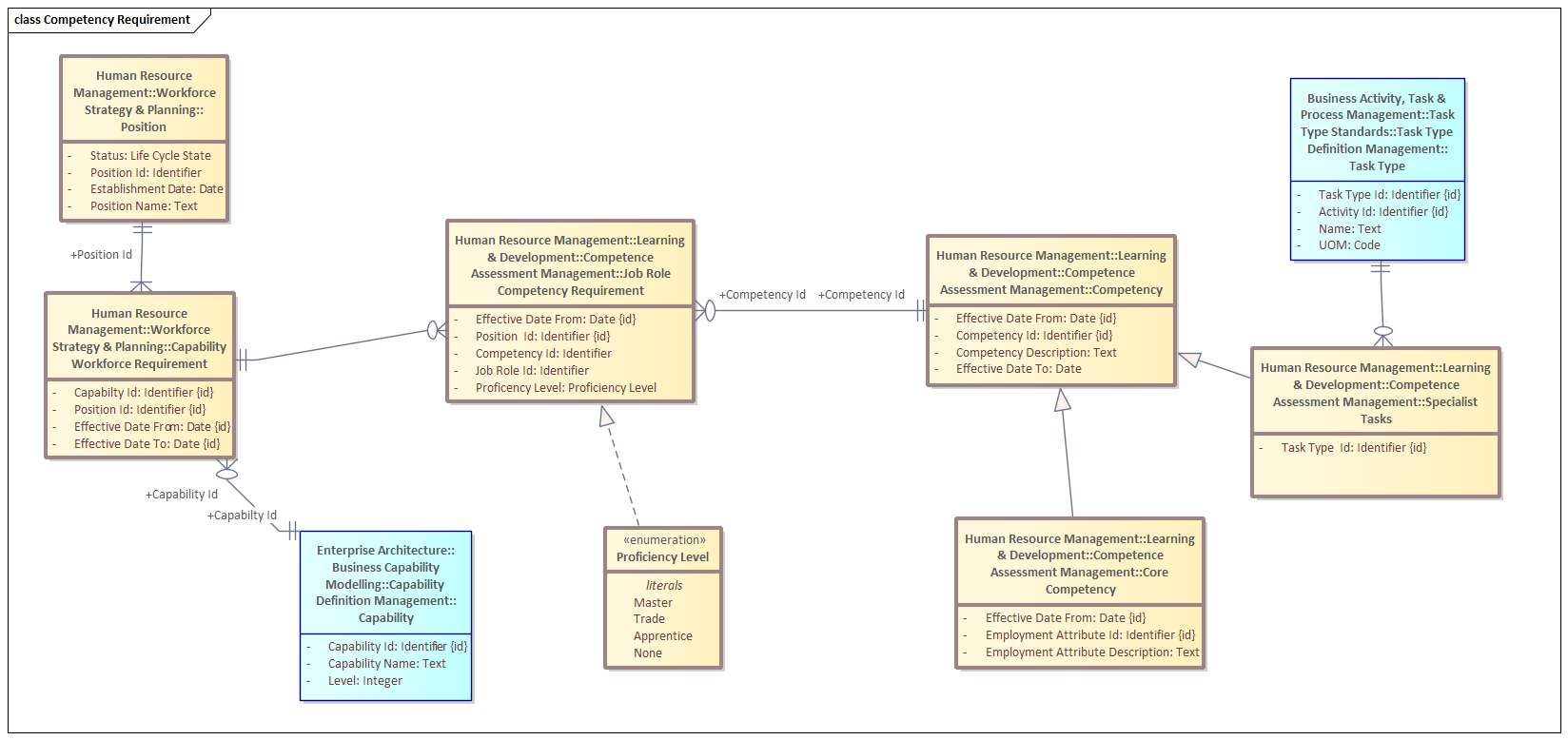
A Gemba-ready competency model might identify:
- Positions;
- required Competencies;
- Proficiency Levels;
- Task Types;
- workforce requirements;
- and assessment relationships.
It does not claim that the proposed proficiency levels or competency requirements are correct. It gives HR practitioners, supervisors and experienced workers something sufficiently concrete to challenge.
A Gemba-ready Customer Order model might distinguish:
- Product;
- Catalogue Product;
- Customer Order;
- Order Line;
- Manufactured Product;
- Batch;
- and fulfilment.
The value is not that AI has designed an order database. The value is that someone at Gemba can immediately say:
“Customers order the Catalogue Product, but what we deliver is a specific Manufactured Product from a particular Batch.”
That single correction may expose important consequences for inventory, traceability, recalls, expiry management and customer service.
Gemba-ready and Kanban Architecture
Not every part of an enterprise model needs to be validated simultaneously.
Large candidate knowledge bases can be generated and maintained holistically while mind-sized areas are pulled into validation as required.
This leads naturally to Kanban Architecture:
Generate holistically. Validate by pull. Learn continuously.
Subject Areas, capability slices, value-stream segments or other manageable views can enter a validation backlog and be pulled when appropriate practitioners, evidence and decision needs are available.
This reduces cognitive overload and respects scarce organisational attention.
A test for readiness
Before taking an artefact to Gemba, three questions are useful:
- Is it credible enough that knowledgeable people will engage with it seriously?
- Is it incomplete and explicit enough that they will feel able to challenge it?
- Is it simple enough to support conversation rather than overwhelm it?
If the answer to all three is yes, the artefact is probably Gemba-ready.
The underlying principle
Architecture should not attempt to arrive at Gemba carrying the answer.
Its role is to arrive with a sufficiently good proposition that reality can improve it.
A Gemba-ready model earns the right to ask better questions; it does not claim the right to provide the final answers.