Purpose
HASP is a structured Human–AI learning method for exploring plausible futures, understanding consequences, and continuously regenerating organisational knowledge. It does not seek to predict a single future. Instead, it enables organisations to explore plausible futures, test candidate decisions, expose assumptions, uncertainties, and unintended consequences, and regenerate trusted organisational knowledge through learning.
HASP within the Human–AI Knowledge Operating System
The Human–AI Knowledge Base (HAK) serves as the governed repository of organisational knowledge. It contains purpose, ethics, governance, stewardship, stakeholders, stakeholder outcomes, capabilities, value streams, principal entities, relationships, business rules, assumptions, risks, and organisational knowledge. HASP operates over this repository, continually testing and regenerating these knowledge objects rather than producing disconnected scenario documents.
The HASP Cycle
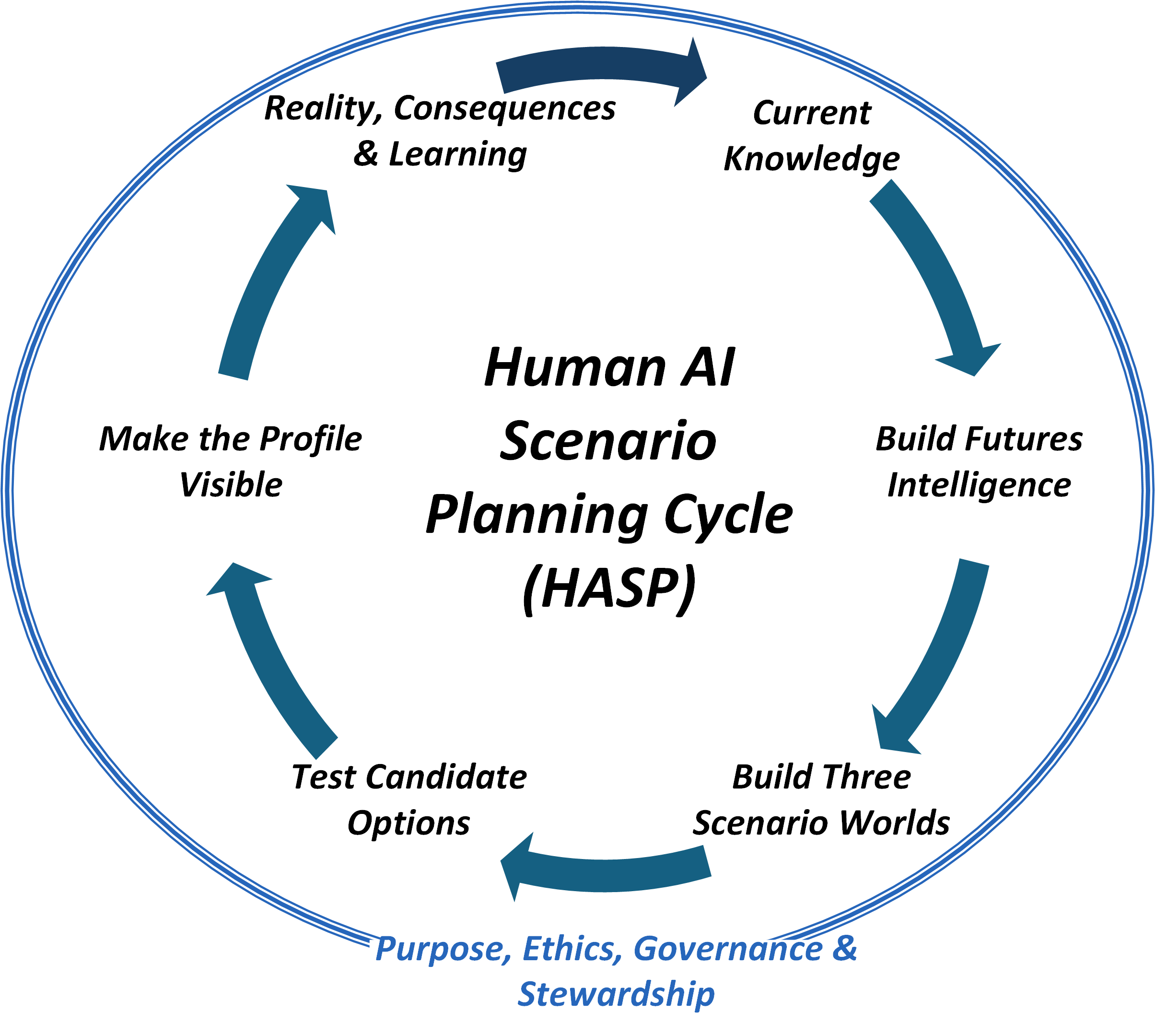
Figure 1: Human AI Scenario Planning Cycle
Knowledge Representation
HAK is technology independent. Its knowledge may be represented using Business Capability Models, Data Subject Areas, Stakeholder Models, Value Streams, Business Process Models, and ArchiMate viewpoints. These representations can be exchanged via XMI with repositories such as Sparx Enterprise Architect. These representations are multiple views of the same governed organisational knowledge. They are regenerated from the repository rather than maintained independently. People in stewardship roles validate all generated representations before they become trusted organisational knowledge.
Reality, Consequences & Learning
Reality is tested through Gemba, stakeholder experience, operational evidence, customer feedback, ecological evidence, and observed consequences. Learning regenerates the knowledge base, scenarios, enterprise models, and organisational understanding.
Learning updates stakeholder understanding, capabilities, Data Subject Areas, business rules, enterprise architecture views, scenarios and organisational awareness. Human stewards validate these changes before they become trusted organisational knowledge.
Human and AI Responsibilities
AI synthesises information, develops scenarios, identifies assumptions, uncovers relationships, tests coherence, and regenerates knowledge representations. Humans remain responsible for purpose, ethics, governance, stewardship, semantic integrity, Gemba validation, and the interpretation and approval of trusted organisational knowledge.
Primary Decision Output
The primary decision output of HASP is a series of mind-sized scenario profiles that make the consequences of alternative futures and candidate options visible.
Each profile is presented as a simple radar diagram comparing the impact of a candidate option across the three dimensions of Prosperity, Planet and People within a particular scenario world.
Figure 1 illustrates a typical HASP Scenario Diagram. Candidate options are shown vertically and scenario worlds horizontally. Each radar profile summarises Prosperity, Planet and People for one option under one scenario. This is as generated by the HASP Guideline used with ChatGPT 5.5.
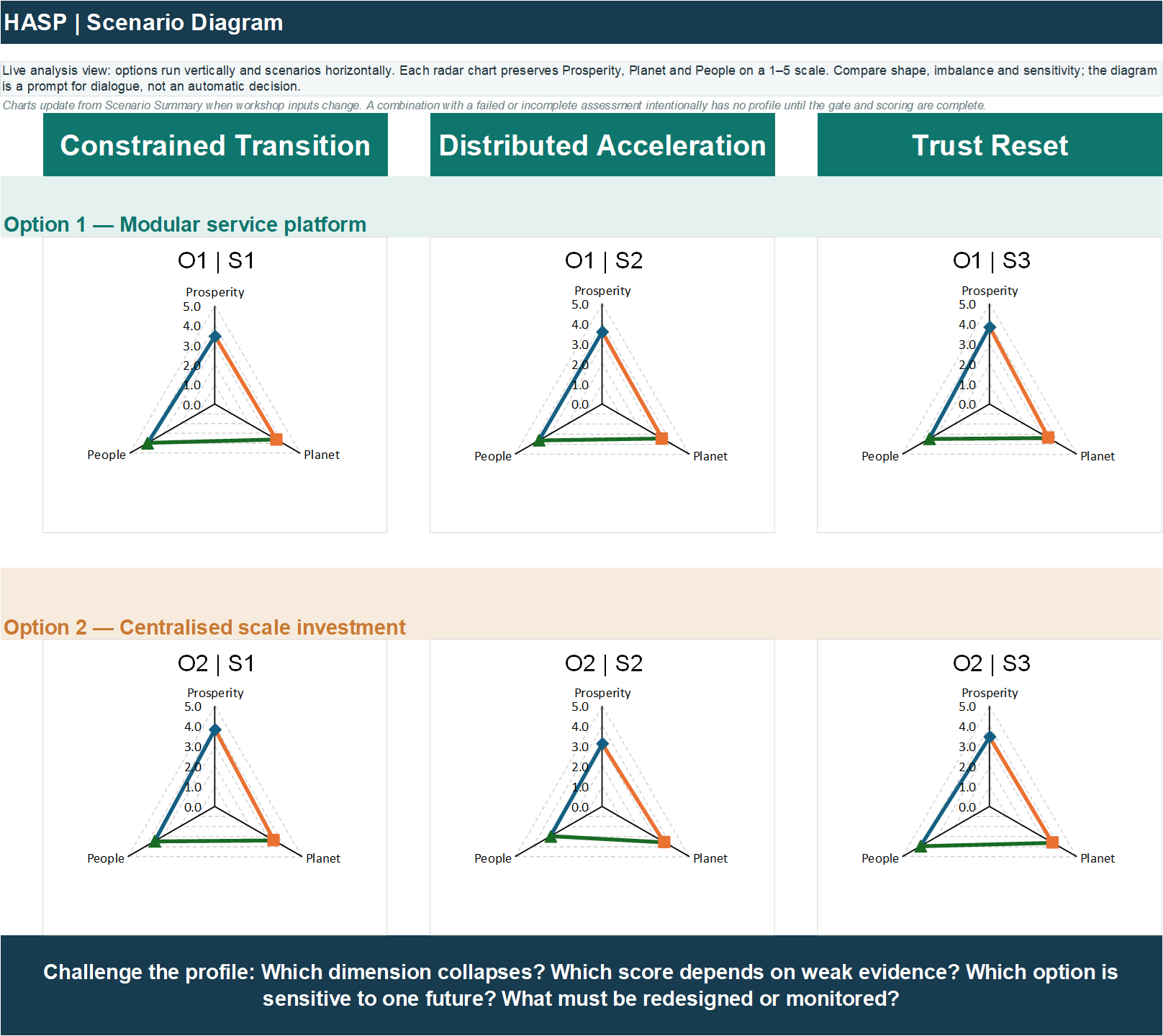
Figure 2: Example Scenario Diagrams
In addition to these challenges, there are many other questions to pose such as:
- What assumptions caused it?
- Which stakeholders are affected?
- Which capability failed?
- Which Data Subject Areas change, and how? What is the impact?
- What should be redesigned?
- What evidence would increase confidence?
The power of the diagram lies not in the individual radar charts but in comparing their shapes. A robust option maintains a balanced profile across multiple scenario worlds. A fragile option reveals collapse, imbalance or strong dependence on a particular future. The purpose is not to identify a single “winner”, but to stimulate informed Human–AI dialogue and organisational learning.
Collectively, these profiles allow decision makers to see:
- the robustness of an option across multiple futures;
- significant strengths and weaknesses;
- stakeholder consequences;
- dependencies and trade-offs;
- areas of uncertainty;
- and the assumptions requiring further investigation.
Rather than seeking a single “best” option, HASP makes differences visible so that informed Human–AI dialogue, judgement and learning can occur.
HASP incorporates insights from this dialogue into the Human–AI Knowledge Base, continually improving organisational understanding.
For more information see:
- Subject Area – Scenario Planning
- Subject Area – Support note for the Human AI Knowledge Base Guideline
- Subject Area: Human–AI Knowledge Base Development