Organisations do not fail merely because they lack information.
They fail because they cannot correctly sense, interpret, internalise, and respond to feedback from reality.
From an organisational ecology perspective, feedback is not merely reporting, communication, or process correction. It is one of the primary adaptive sensing mechanisms through which organisations stay connected to changing reality.
What feedback is
Feedback is often treated as a minor process step:
- a status update,
- a lesson learned,
- a retrospective,
- or a reporting mechanism.
From an organisational ecology perspective, feedback is one of the primary mechanisms through which organisations sense changes in their environment, interpret emerging signals, integrate learning into shared understanding, and adapt as conditions evolve.
Feedback Exists at Multiple Levels
Feedback operates simultaneously across multiple domains.
Operational Feedback
Signals related to:
- performance,
- quality,
- safety,
- defects,
- delays,
- and process variation.
Strategic Feedback
Signals related to:
- changing markets,
- disruption,
- stakeholder expectations,
- environmental shifts,
- and long-term viability.
Behavioural Feedback
Signals emerging through:
- trust,
- morale,
- disengagement,
- conflict,
- collaboration,
- and psychological safety.
Ethical Feedback
Signals that reveal:
- harm,
- exclusion,
- unintended consequences,
- power imbalance,
- and erosion of legitimacy.
Tacit Feedback
Weak signals often sensed before they are formally articulated:
- discomfort,
- hesitation,
- tension,
- confusion,
- unease,
- and loss of coherence.
Framing Feedback
Signals that suggest the organisation may be:
- solving the wrong problem,
- operating within the wrong assumptions,
- or interpreting the situation through the wrong Cynefin domain.
Feedback is more than the exchange of information.
Feedback is more than just data passing through reporting tools, dashboards, or communication channels. An organisation can hold vast amounts of information yet still be out of touch with reality.
Feedback only becomes valuable when people notice it, interpret its significance, respond positively, and change their actions accordingly. Without proper attention, signals can remain present but go unnoticed.
Although the information might be available within the organisation, learning doesn’t necessarily happen. Therefore, feedback is inherently relational, influenced by the quality of relationships, especially the level of trust among individuals, teams, and leadership.
Trust influences:
- whether people feel safe to speak openly,
- whether disagreement is tolerated,
- whether concerns can move across hierarchy,
- whether uncertainty can be acknowledged honestly,
- and whether uncomfortable information is welcomed or suppressed.
In low-trust environments, feedback is often filtered, softened, delayed, or withheld entirely. People quickly learn that exposing reality carries personal, political, or career risk.
Over time, organisations may continue to generate increasing amounts of information while losing their ability to accurately sense reality.
In this way, trust is not merely a cultural attribute.
It is a critical condition for organisational learning, feedback quality, and adaptive capacity.
Feedback is interpretive.
The same signal may be understood very differently depending on:
- assumptions,
- incentives,
- organisational culture,
- mental models,
- the cultural background of both the giver and receiver,
- relational context,
- and the framing through which the situation is viewed.
Meaning does not arise from information alone. One of the deepest forms of feedback occurs when organisations realise the framing itself may be wrong.
People interpret signals through their relationships with others, their role within the organisation, prior experience, cultural expectations, and their understanding of the broader situation in which the interaction occurs.
As Fujii et al. (Fujii et al., 2025) observe through Ba theory, meaning is situated relationally and emerges through interaction within a shared social context, rather than being transmitted mechanically between individuals.
This means feedback cannot be separated from social context.
The same message may be interpreted as:
- support,
- criticism,
- threat,
- learning,
- resistance,
- or invitation,
depending on the quality of the relational environment in which it is exchanged.
Adaptive organisations, therefore, require more than communication mechanisms.
They require relational environments that support shared interpretation, reflective inquiry, and constructive sensemaking under uncertainty.
This means feedback does not speak for itself.
Organisations must continuously develop their capacity to collectively interpret emerging signals.
Feedback is behavioural.
Feedback only influences organisational adaptation when it changes how people act:
- how decisions are made,
- how priorities are set,
- how tensions are handled,
- how learning occurs,
- and how relationships evolve over time.
Without behavioural change, feedback becomes informational residue rather than adaptive learning.
This is why adaptive organisations require more than reporting systems and performance metrics.
They require cultures and relational environments capable of sensing reality, interpreting signals constructively, and responding coherently under changing conditions.
The critical challenge is not simply receiving information.
It is whether the organisation can:
- hear it,
- understand it,
- tolerate it,
- learn from it,
- and respond constructively.
Feedback and Learning
Feedback is central to organisational learning.
It underpins:
- Hansei,
- reflective inquiry,
- double-loop learning,
- Gemba,
- Design Thinking,
- Strategic Thinking,
- Scenario Planning,
- Theory U,
- and Shared Mental Models.
Without feedback:
- assumptions remain unchallenged,
- defensive routines strengthen,
- and learning loops collapse.
Ego vs Eco Responses to Feedback
Egocentric systems often treat feedback as:
- criticism,
- threat,
- loss of control,
- or resistance.
This produces:
- defensiveness,
- blame,
- information filtering,
- and “shoot the messenger” dynamics.
Ecocentric systems treat feedback as:
- environmental sensing,
- learning opportunity,
- relational information,
- and adaptive guidance.
This allows organisations to:
- respond earlier,
- adapt more effectively,
- and maintain coherence under uncertainty.
Feedback in Complex Adaptive Systems
Feedback plays a central role in organisational resilience because resilience itself depends upon the organisation’s capacity to learn, adapt, and respond appropriately as conditions change.
Recent organisational learning research increasingly recognises that resilience is not simply the ability to “bounce back” after disruption (Evenseth, Sydnes, & Gausdal, 2022). It also involves:
- anticipation,
- sensing,
- interpretation,
- coping,
- adaptation,
- and ongoing learning.
From this perspective, feedback becomes far more than operational reporting or performance measurement. It becomes one of the organisation’s primary adaptive sensing mechanisms.
Research into organisational resilience and learning suggests that resilient organisations depend heavily upon:
- experiential learning,
- systemic learning,
- reflection,
- unlearning obsolete assumptions,
- and environments that support ongoing learning and adaptation.
This aligns closely with the broader Adaptive Capacity and Knowledge Operating System perspectives presented throughout this work.
Within complex and uncertain environments, organisations must continuously:
- detect emerging signals,
- interpret changing conditions,
- surface tensions and consequences,
- test assumptions,
- and adjust behaviour as understanding evolves.
Feedback therefore functions as a living connection between:
- reality,
- learning,
- decision-making,
- and adaptation.
This means feedback is inherently social and interpretive. The same signal may be understood very differently depending upon:
- assumptions,
- incentives,
- organisational culture,
- mental models,
- social cohesion,
- emotional safety,
- and the quality of dialogue occurring within the organisational environment.
As a result, the quality of the organisational social field significantly influences the quality of feedback interpretation.
In fragmented or low-trust environments:
- signals may be ignored,
- filtered,
- politicised,
- suppressed,
- or misinterpreted.
In healthier and more coherent learning environments:
- weak signals are surfaced earlier,
- difficult conversations occur more openly,
- assumptions can be challenged safely,
- and organisations become better able to adapt before problems escalate.
From a Knowledge Operating System perspective, feedback is therefore not merely a process step or management mechanism. It is a foundational adaptive capability that supports:
- SECI learning cycles,
- shared mental model development,
- Hansei and reflection,
- Scenario Planning,
- Design Thinking,
- Strategic Thinking,
- sensemaking,
- Theory U presencing,
- and adaptive capacity more broadly.
Feedback also plays a critical role in unlearning.
As conditions change, organisations often need to let go of:
- outdated assumptions,
- obsolete routines,
- inappropriate mental models,
- and legacy interpretations of reality.
Without effective feedback processes, organisations may continue reinforcing patterns that are no longer fit for purpose.
From an organisational ecology perspective, feedback serves as a primary sensing mechanism by which the organisational ecosystem maintains adaptive alignment with its environment.
The issue is therefore not simply whether feedback exists.
Most organisations are saturated with data, metrics, reports, dashboards, and communication channels.
The deeper issue is whether the organisation possesses the relational, cognitive, ethical, and structural capacity to:
- correctly sense,
- interpret,
- internalise,
- and respond appropriately to what reality is signalling.
Organisations often fail not because information is absent, but because meaningful feedback is not successfully transformed into learning and adaptive change.
Linear Processes vs Recursive Feedback Loops
Simple and stable processes often operate effectively through relatively linear sequences, like the original Waterfall Methodology:
- define,
- analyse,
- decide,
- implement,
- review.
In simple and stable environments, this can work well because:
- cause and effect remain relatively visible,
- variation is limited,
- and future conditions remain reasonably predictable.
However, adaptive systems rarely operate in this way in complex environments
Living systems continuously:
- sense changes,
- interpret signals,
- modify behaviour,
- generate consequences,
- and re-adjust in response to emerging conditions.
Nature itself operates through recursive feedback loops rather than fixed linear progression.
Examples include:
- ecological balancing,
- predator–prey relationships,
- immune responses,
- climate systems,
- nervous systems,
- learning processes,
- and social adaptation.
The same applies within organisations operating under uncertainty.
As complexity increases:
- actions reshape the environment,
- feedback alters understanding,
- understanding changes decisions,
- decisions create new consequences,
- and new signals continuously emerge.
This means adaptive organisational processes increasingly resemble interconnected feedback networks rather than linear workflows.
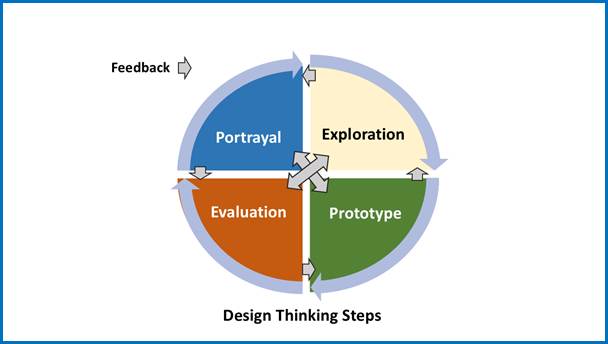
Design Thinking – based on He and Ortiz
This work draws particularly on He and Ortiz’s sustainability-oriented interpretation of Design Thinking, which explicitly frames design activity as a recursive network of interacting feedback loops rather than a linear sequence of steps (He & Ortiz, 2021). Design Thinking provides a useful example. Although often presented visually as sequential stages:
- exploration,
- portrayal,
- prototyping,
- and evaluation.
As the model depicts, the process operates through continual feedback between stages.
New information emerging during evaluation may completely reshape:
- the original framing,
- assumptions,
- stakeholder understanding,
- or even the nature of the problem itself.
Similarly:
- prototypes generate behavioural feedback,
- stakeholder interactions surface tacit feedback,
- environmental signals create strategic feedback,
- and weak signals may reveal emerging opportunities or risks not previously visible.
The process, therefore, functions less like a production line and more like a dynamic learning ecology.
The quality of adaptation depends not merely upon process execution, but upon:
- the quality of feedback sensing,
- the ability of people to interpret and respond appropriately
- the social environment through which signals flow,
- and the willingness of the organisation to revise assumptions and change as understanding evolves.
This is why adaptive learning environments increasingly depend upon:
- recursive sensemaking,
- reflective inquiry,
- dialogue,
- Hansei,
- Scenario Planning,
- Gemba,
- and shared mental model development.
Without effective feedback loops, organisations often continue to optimise based on outdated assumptions long after environmental conditions have changed.
Shallow vs Deep Feedback
Not all feedback produces learning.
Shallow Feedback
Often focuses on:
- compliance,
- metrics,
- reporting,
- or surface correction.
It may improve efficiency while leaving underlying assumptions untouched.
Deep Feedback
Surfaces:
- structural tensions,
- hidden assumptions,
- unwanted behaviours,
- personal and organisational discomfort,
- unintended consequences,
- conflicting mental models,
- and emerging patterns.
Deep feedback may initially create discomfort, but that may be essential for adaptive learning.
Feedback Failure Patterns
Feedback systems don’t fail just because information is missing. More often, they fail because signals get distorted, delayed, suppressed, politicized, or disconnected from reality as they pass through the organisation. Over time, organisations might produce more reports, dashboards, and performance data but lose their ability to genuinely sense what is happening in their environment.
- Metric theatre
Organisations focus on producing impressive metrics and reporting appearances rather than genuinely improving underlying capability, learning, or system health.
- Dashboard blindness
Leaders rely too much on abstract dashboards and summary indicators, which causes them to lose touch with the actual operational reality, frontline insights, and early warning signs.
- Political filtering
Information is selectively softened, reshaped, delayed, or withheld as it moves through the hierarchy to protect reputation, avoid conflict, or manage political exposure.
- “Shoot the messenger”
Whistleblowers and others who reveal uncomfortable truths, risks, or contradictions tend to be blamed, marginalised, or ignored, which discourages future honest feedback.
- Delayed escalation
Early warning signals remain unresolved or trapped within organizational layers until issues become much harder, more expensive, or riskier to handle.
- False green status
Reporting systems continue to indicate that projects, programs, or operations are “on track” even as significant structural, behavioural, or operational problems emerge beneath the surface. The classic here is the ‘project is 95% complete’.
- Compliance masquerading as learning
Organisations complete reviews, workshops, audits, or retrospectives as procedural obligations without genuinely challenging assumptions, changing behaviour, or deepening understanding.
- Overreliance on quantitative signals
Organizations focus on measurable indicators but often overlook tacit knowledge, lived experience, emotional tension, intuition, relational issues, and qualitative feedback.
- Ignoring tacit discomfort
Subtle feelings of confusion, unease, tension, or loss of coherence are dismissed as difficult to measure or articulate, even though they often represent early indicators of emerging problems.
- Executive framing lock
Senior leaders become trapped in existing assumptions, strategic narratives, or mental models, preventing the organisation from recognising that the framing of the problem itself may be flawed.
Core Insight
Feedback is not merely information flowing through a system.
It is one of the primary mechanisms through which organisations remain connected to reality.
Evenseth, L. L., Sydnes, M., & Gausdal, A. H. (2022). Building Organizational Resilience Through Organizational Learning: A Systematic Review. Frontiers in Communication, Volume 7 – 2022. doi:10.3389/fcomm.2022.837386
Fujii, Y., Kim, M.-H., Panpothong, N., Phakdeephasook, S., Mochizuki, Y., & Kurogo, Y. (2025). Situating self and others in task-based interaction: A cross-linguistic study through ba theory. In Emancipatory Pragmatics: Innovative approaches to pragmatics incorporating the concept of “ba” (pp. 347-380): John Benjamins Publishing Company.
He, J., & Ortiz, J. (2021). Sustainable business modeling: The need for innovative design thinking. Journal of Cleaner Production, 298, 126751.