Why Trust Matters
Trust is a fundamental to effective leadership. It is not a soft skill that a strong leader can consider as mere niceness and ignore. Authority alone will not inspire commitment, elicit discretionary effort, or encourage people to share their knowledge and skills.
When people trust their leaders, they are more likely to communicate openly, share their knowledge, and give discretionary effort to help others and the organisation.
The most important role of a leader is to “Position people for success”. The following table illustrates why trust is important in that context:
| Low Trust | High Trust |
| I will comply because you have authority. | I contribute because it is worthwhile and important to me and others. |
| I will only do what I am obliged to do, which is what I need to get paid. Nothing more. | I put discretionary effort in because it’s important and I am appreciated. |
| I participate defensively to avoid problems and protect myself. | I participate to help us succeed and improve outcomes. |
| I will only share the information that is requested, nothing more. I will withhold my knowledge to protect my position. | I actively share knowledge and help others succeed. |
| I just do my job. | I take full responsibility for the role I am in and the work I do. |
Linked SN:
- Converting Compliance into Contribution.
Trust and Complexity
In complex environments:
- uncertainty is unavoidable,
- change is often unpredictable,
- information is incomplete and not always reliable,
- perspectives differ and may become increasingly polarised,
- relationships with stakeholders may become more volatile as consequences are experienced differently,
- and cause-and-effect relationships are often unclear or only visible in hindsight.
Under these conditions, organisations cannot rely solely on formal authority, rigid procedures, or centralised control to coordinate action.
Niklas Luhmann (Luhmann, 2000) described trust as “a solution for specific problems of risk.”
In essence, trust enables action despite uncertainty by reducing the complexity that would otherwise need to be managed. Trust allows people to cooperate, share knowledge, and act despite uncertainty, vulnerability, and incomplete information.
As complexity increases, the importance of trust also increases.
Without trust:
- Interactions grow increasingly defensive as individuals seek to protect themselves from uncertainty, blame, or exposure.
- Knowledge sharing declines as psychological safety erodes, leading to more knowledge hoarding and hiding, and a reduced willingness to ask for help or admit mistakes.
- Coordination weakens as people become less willing to take initiative, challenge assumptions, surface concerns, or communicate proactively.
- Organisational energy is increasingly consumed by verification, surveillance, politics, and self-protection, while additional rules, controls, and communication protocols are introduced to compensate for declining trust.
- Learning throughput slows as weak signals are ignored, uncomfortable realities remain hidden, and opportunities for collective learning are lost.
- Adaptive capacity declines as the organisation becomes less able to sense, interpret, and respond effectively to changing conditions and emerging consequences.
You can see trust is collapsing:
| High Trust Environment | Low Trust Environment |
| communicate to solve problems | communicate to protect yourself |
| discuss issues directly | create documentary evidence for protection |
| seek understanding | seek defensibility |
| surface uncertainty | minimise exposure |
| learn | cover arse |
| trust intent | anticipate blame |
This directly hampers people’s ability to communicate openly, leading to a decline in the free exchange of knowledge, ideas, and experience. It also reduces the willingness to surface weak signals, challenge assumptions, expose uncomfortable realities, and learn from consequences. Over time, this weakens Social Capital, diminishes Human Capital, slows Learning Throughput, and ultimately reduces Adaptive Capacity.
Trust, therefore, plays a critical role in organisational learning, resilience, and long-term sustainability.
📖 Narrative Example – In Adapt Survive and Flourish
This was discussed in Adapt, Survive and Flourish, where the group discusses the gradual erosion of trust, customer service, and relational interaction within modern organisations and institutions.
As Judy observes:
“What once took minutes can now take hours or days.”
The concern was not merely operational inefficiency.
It reflected a broader shift away from:
- relational interaction,
- local judgement,
- tacit coordination,
- and human support
toward:
- procedural control,
- automated mediation,
- and increasingly transactional systems.
A contemporary example:
Modern supermarkets provide a useful illustration of this broader pattern.
For decades, supermarkets relied heavily on human cashiers. These interactions were not merely transactional. They also provided:
- relational accountability,
- ambiguity resolution,
- emotional smoothing,
- and low-friction adaptive coordination.
The widespread introduction of self-checkout systems fundamentally altered this trust architecture.
Research by criminologist Emmeline Taylor (Taylor, 2016)
identified the emergence of “SWIPERS”:
“Seemingly Well-Intentioned Patrons Engaging in Regular Shoplifting.”
Her work suggests that otherwise law-abiding customers increasingly engaged in low-level theft within self-checkout environments, particularly where human interaction and social accountability had been reduced.
As retail losses increased, supermarkets responded with escalating procedural verification and surveillance:
- overhead cameras,
- AI-assisted scanning,
- smart exit gates,
- receipt verification,
- and behavioural monitoring systems.
This illustrates a broader organisational pattern:
When relational trust declines, systems often compensate through:
- surveillance,
- procedural control,
- verification,
- and increased friction.
However, these responses may unintentionally reinforce distrust further.
Customers increasingly experience:
- suspicion,
- cognitive burden,
- transactional relationships,
- and reduced relational attachment to the organisation.
The result can become a self-reinforcing distrust loop:
- reduced trust increases verification,
- verification increases friction and alienation,
- alienation weakens goodwill and commitment,
- and weakened goodwill increases opportunistic behaviour.
The infrastructure of distrust becomes self-reinforcing.
From an organisational ecology perspective, the deeper lesson is not about supermarkets alone.
It is about what happens when relational infrastructure is removed and replaced primarily by procedural control systems.
Complexity does not disappear.
It is redistributed.
A lived experience – The Email Wars
During my time at one organisation, I noticed a colleague sending a one-line email to someone sitting approximately twenty metres away on the same side of the building.
When I asked why he didn’t simply walk over and speak to the person, he replied:
“You must do this as well with this guy; it’s evidence.”
My response was:
“When’s the court case?”
Looking back, the issue wasn’t email.
The issue was trust
Trust and Cynefin
From a Cynefin (Snowden 2007) perspective, trust plays an important role in organisational sensemaking.
Without trust:
- sensing is impaired,
- communication is reduced,
- weak signals remain hidden,
- and knowledge is hoarded or withheld.
As a result, leaders may develop an incomplete or distorted understanding of the situation they are facing.
This creates a significant risk in complex environments.
When weak signals are suppressed, and alternative perspectives remain unheard, leaders may incorrectly assume that a situation is:
- more predictable,
- more controllable,
- and more certain
than it actually is.
In effect, low trust can cause organisations to misdiagnose complex situations as merely complicated or even simple.
This can lead to premature decisions, overconfidence, excessive reliance on planning and control, and a reduced capacity to adapt as conditions change.
Trust, therefore, contributes not only to coordination and learning but also to the quality of organisational sensemaking itself.
The bigger picture
The deeper significance of trust becomes apparent as complexity increases.
In highly complex environments, people cannot verify every assumption, monitor every interaction, or centrally control every decision. Organisations therefore depend heavily upon distributed judgement, local adaptation, and coordinated action under uncertainty.
As these control mechanisms increase, organisational learning often slows and adaptive responsiveness declines.
In practice, organisations with low trust frequently become slower, more fragmented, and less capable of responding effectively to changing conditions and emerging consequences.
Beyond Familiarity and Confidence
Luhmann differentiates between familiarity, confidence, and trust.
Familiarity offers interpretive context — an understanding of how an environment functions.
Confidence allows engagement with systems like payroll, ERP, governance, and reporting.
However, trust goes beyond this; it involves a willingness to be vulnerable and act despite uncertainty. While familiarity and confidence help navigate stable environments and dependable systems, trust is increasingly vital as complexity rises. Organisations may be very familiar with their surroundings and confident in their systems, yet still lack the trust needed for open communication, knowledge sharing, learning, and adaptive coordination. Ultimately, while familiarity and confidence support organisational operations, trust is essential for learning, adapting, and responding effectively amid uncertainty.
If an organisation wishes to build Social Capital, familiarity and confidence remain important. Familiarity helps people interpret their environment, while confidence enables participation in organisational systems. However, neither is sufficient on its own. Trust is what enables people to move beyond participation and compliance toward contribution, collaboration, learning, and adaptive action.
👉 Trust converts compliance into contribution and is thus the key enabler of Adaptive Capacity.
Psychological Safety and Learning
Trust and psychological safety are closely related, but they are not the same thing.
Rousseau et al. (Rousseau, Sitkin, Burt, & Camerer, 1998) define trust as a psychological state involving a willingness to accept vulnerability based upon positive expectations of another’s intentions or behaviour.
In practical terms, trust involves accepting a degree of vulnerability because we expect others to act ethically, competently, honestly, and in good faith.
Trust involves accepting a degree of vulnerability because we expect others to act ethically, competently, honestly, and in good faith.
Psychological safety concerns whether speaking openly is perceived as safe, specifically, asking questions, admitting mistakes, and challenging assumptions.
The two reinforce one another. When trust is scarce, people tend to be more hesitant to reveal uncertainties, share incomplete ideas, admit mistakes, or express dissenting opinions. This reluctance leads to valuable tacit knowledge remaining unarticulated and missed learning opportunities. This is especially significant in the context of the SECI model.
Socialisation relies on individuals freely and openly sharing experiences, observations, intuitions, concerns, and judgments. Since these forms of tacit knowledge are often uncertain, incomplete, and hard to describe, sharing them requires vulnerability. Trust creates the environment that makes this vulnerability acceptable.
In this way, trust acts as a prerequisite for the flow of tacit knowledge.
Without trust:
- judgement is withheld, so people do not challenge ideas, decisions, or assumptions they do not understand or agree with,
- weak signals remain hidden. As a result, the person in the ‘master’ role may never realise that the ‘apprentice’ does not understand,
- difficult conversations are avoided, causing important information, valuable insights, and critical misunderstandings to remain unaddressed,
- and, consequently, learning becomes increasingly constrained.
Over time, this impairs learning ability, diminishes shared understanding, and lowers adaptive capacity. Consequently, trust not only promotes cooperation and coordination but also boosts the organisation’s ability to learn from experience and adjust to evolving conditions.
Trust and Shared Mental Models
Trust influences far more than communication and cooperation. It also shapes how people interpret information, attribute intent, construct meaning, and develop shared understanding.
A Shared Mental Model is a sufficiently aligned understanding of the task, environment, relationships, and consequences that allows coordinated action.
Shared Mental Models are not collections of facts, nor do they require perfect agreement.
For more information, see: Shared Mental Models
Rather, they represent a sufficiently aligned interpretation of reality that enables people to anticipate one another’s actions, coordinate decisions, respond coherently under changing conditions, and adapt together when circumstances shift.
Trust plays a critical role in this process.
When trust is high, people are more willing to:
When trust is high, people are more willing to:
- explain their reasoning and make their thinking visible to others,
- expose assumptions that might otherwise remain hidden,
- challenge interpretations and test understanding,
- admit uncertainty and acknowledge what they do not know,
- and engage in constructive disagreement in pursuit of better understanding.
These behaviours help surface differences in understanding before they become problems.
When trust is low, the opposite occurs. People become more likely to:
- question motives rather than ideas,
- withhold concerns,
- avoid difficult conversations,
- interpret ambiguity defensively,
- and protect position rather than pursue understanding.
As a result, assumptions remain hidden, misunderstandings persist, and alternative interpretations are left unexplored.
Over time, Shared Mental Models begin to fragment. This fragmentation often appears as:
- competing, inconsistent, and sometimes contradictory versions of reality,
- inconsistent decision-making, prioritisation, planning, and action as different groups operate from different assumptions about reality,
- inconsistent decision-making, prioritisation, planning, and action as different groups operate from different assumptions about reality,
- duplication of effort, rework, and wasted resources as teams pursue incompatible interpretations of objectives, requirements, and priorities,
- increasing risk to complex programmes and organisational initiatives as fragmented understanding undermines coordination and coherent execution,
- semantic drift as meaning and understanding become increasingly fragmented,
- escalating coordination overhead as organisations attempt to reconcile competing interpretations,
- and, ultimately, growing organisational incoherence and siloed thinking.
From a Knowledge Operating System perspective, trust is an essential enabler of the development, evolution, and maintenance of Shared Mental Models.
It does not directly generate agreement. Instead, trust establishes a safe environment for exploring disagreements, openly testing assumptions, and gradually building understanding through dialogue, feedback, experience, and consequences.
In this context, trust is more than just a relational attribute; it is a fundamental part of the infrastructure that enables organisations to create shared meaning. Without trust, information may still circulate, but the shared understanding tends to break apart.
👉The result is not merely poor communication but reduced organisational coherence.
Trust and Organisational Ecology
Trust is often viewed as an individual’s trait or a matter of interpersonal relationships.
However, from an organisational ecology standpoint, it is much broader. Trust serves as a key part of the relational infrastructure that facilitates the flow of information, knowledge, meaning, feedback, and coordination.
For a deeper dive, look at: Subject Area: Organisational Ecology
Similar to the flow of nutrients in an ecosystem, trust enables signals, learning, and adaptive responses to pass between individuals, teams, and organisational units. When trust is robust, these flows stay active. Conversely, when trust becomes fragmented, distorted, or withdrawn, organisational learning and adaptability start to decline.
Trust Islands
Trust rarely develops uniformly across an organisation. Instead, it tends to emerge within small groups where people share purpose, communicate openly, and have learned through repeated interaction that vulnerability is safe.
These groups may be:
- project teams,
- operational units,
- communities of practice,
- leadership teams,
- incident response teams,
- and informal networks.
Within these Trust Islands:
- mutual respect is the norm,
- knowledge flows more freely,
- assumptions are surfaced,
- learning accelerates,
- and coordination requires less effort.
The presence of Trust Islands is therefore often a positive sign. However, Trust Islands alone are not sufficient for organisational learning.
Bridging Trust
Many organisations contain highly functional teams that trust one another internally but remain disconnected from the rest of the organisation. Project teams can sometimes be like this.
In siloed organisations that have been built over time with poor integration this is prevalent. As the research shows (Cilliers & Greyvenstein, 2012):
nce the silo becomes a mental model, each group starts developing:
- its own language,
- its own priorities,
- its own assumptions,
- its own interpretation of reality.
Which is exactly the fragmentation you were describing.
As a result:
- local learning remains local,
- insights fail to propagate,
- misunderstandings accumulate between groups,
- and organisational coherence gradually fragments.
The challenge is therefore not simply building trust within groups. It is creating trust between groups.
For more information, see: Source Note – Preventing Silo Culture after a Merger
This is where the organisation starts acting less like separate silos and more like a cohesive ecosystem. The exchange of knowledge, judgment, and learning relies not just on the strength of individual Trust Islands, but also heavily on the quality of their connections.
Trust and the Movement of Knowledge
The ecological question is not: “Do we trust each other?”
The ecological question is: “Not whether people are communicating. It is whether important information, knowledge, and learning can move to where they are needed?”
If relationships are:
- fragmented,
- disrespectful,
- politicised,
- defensive,
- or overly transactional.
Then, the knowledge movement slows regardless of how much information is available.
Trust, therefore, acts as a form of relational infrastructure that enables:
- weak signals to travel,
- tacit knowledge to move,
- learning to propagate,
- and adaptive responses to emerge.
Trust Entropy
Trust does not remain static.
Like many ecological conditions, and like any relationship, it requires ongoing reinforcement and renewal.
When opportunities for:
- dialogue,
- reflection,
- learning,
- shared problem solving,
- and ethical challenge decline, trust gradually, but unintentionally, erodes.
Like other unintended consequences, this erosion may not be immediately visible:
- People still attend meetings.
- Reports continue to circulate.
- Projects continue to operate.
Yet over time:
- knowledge sharing decreases,
- communication becomes increasingly defensive,
- learning throughput slows,
- and adaptive capacity declines.
Trust fragmentation is therefore often an early warning signal of broader organisational fragility.
This aligns with other work on Fragility Conditions, where learning depends upon sustained relational conditions rather than artefacts alone.
For more information, see: The Great Inertia
Trust and Adaptive Leadership
Leadership in Complexity
In stable environments, leadership can often rely on authority, expertise, processes, and control.
In complex environments, however:
- information is incomplete,
- uncertainty is unavoidable,
- expertise is distributed,
- consequences are difficult to predict,
- and adaptation requires learning.
Under these conditions, leadership shifts from controlling to fostering an environment where people can contribute, learn, coordinate, and adapt collectively. Consequently, trust evolves into a fundamental leadership skill.
Trust Enables Adaptive Leadership
Adaptive leadership depends on people being willing to:
- surface weak signals,
- challenge assumptions,
- admit uncertainty,
- share concerns,
- expose risks,
- and contribute ideas.
Without trust, these behaviours become increasingly unlikely.
People begin to:
- protect themselves,
- withhold judgement,
- avoid difficult conversations,
- minimise exposure,
- and focus on compliance rather than contribution.
As a result, leaders receive less reliable information and may unwittingly and unknowingly make decisions based on incomplete or distorted understanding.
Trust Enables Distributed Leadership
Many organisational challenges cannot be solved by a single leader. The knowledge required is often dispersed throughout the organisation. In many cases, it may be tacit, and leadership may be unaware it exists.
Adaptive organisations therefore rely on distributed leadership, where individuals contribute leadership through:
- the trusted relationships they have developed and maintained,
- expertise in specific domains, skills, and practices,
- knowledge of local conditions, constraints, and stakeholder realities,
- personal initiative and the passion to pursue opportunities others may not recognise,
- the ability to exercise judgement within a local context,
- specialised problem-solving capabilities,
- and the capacity to learn, connect, and seek advice from appropriate sources.
Trust enables people to step forward when needed and contribute these capabilities to the broader organisation.
Without trust, leadership becomes concentrated at the top, while knowledge, judgement, initiative, and learning remain trapped elsewhere.
Followership Matters Too
Trust is not solely a leadership responsibility. Adaptive organisations require active followership.
People must be willing to:
- contribute honestly,
- raise concerns,
- challenge assumptions respectfully,
- support collective decisions,
- and take personal responsibility for learning.
Trust enables this participation.
Without trust, people often disengage, comply, or withdraw.
Walking the Talk
Trust is built less through statements and more through repeated experience.
People observe:
- whether leaders listen,
- whether concerns are acknowledged,
- whether mistakes are treated as learning opportunities,
- whether difficult conversations are encouraged,
- and whether actions align with stated values.
When words and actions diverge, trust erodes. Trust is influenced less by an organisation’s espoused values than by its theory-in-use (Argyris, 1976).
People learn what is truly expected through repeated experience of how concerns, mistakes, disagreements, and uncertainty are treated in practice.
When leaders consistently model the behaviours they seek from others, trust strengthens.
Ecocentric and Egocentric Leadership
Trust is influenced not only by what leaders do but also by how people interpret the motivations behind those actions.
From an adaptive perspective, leadership exists on a spectrum between egocentric and ecocentric orientations.
An egocentric orientation focuses primarily on:
- personal success,
- status,
- control,
- certainty,
- self-protection,
- and short-term outcomes.
An ecocentric orientation focuses more on:
- collective wellbeing,
- long-term sustainability,
- learning,
- relationships,
- stewardship,
- and the health of the broader system.
People rarely expect leaders to be perfect.
However, people’s trust is often strongly influenced by whether decisions seem to serve their own interests or align with the organisation’s and its stakeholders’ needs.
Trust tends to grow when individuals see leaders acting for a greater purpose rather than personal gain.
This is especially crucial during times of uncertainty, change, conflicting interests, and tough choices.
In such cases, trust is less about the specific decision and more about whether people believe it was made honestly and with sincere regard for wider consequences.
For more information see: Source Note — Ecocentric vs Egocentric Thinking
Compassion and Consequence
Adaptive leadership doesn’t mean avoiding tough decisions. Instead, it emphasises recognising that such choices impact real people, relationships, and communities. Compassionate leadership merges empathy, accountability, honesty, and responsibility for the outcomes. Trust is built when individuals see that decisions are made thoughtfully, ethically, and sincerely—even if they disagree with the results.
Reflection and Learning
Trust significantly impacts an organisation’s ability to reflect.
When people trust that their learning won’t be weaponised against them, they are more inclined to:
- admit mistakes,
- scrutinise assumptions,
- engage in Hansei,
- participate in diagnosis,
- and back adaptive changes.
Thus, trust underpins the ongoing learning cycles essential for adaptive organisations.
For more information, see: Hansei — Reflection That Forces Correction
Closing Insight
Adaptive leadership is frequently seen as guiding organisations through uncertainty and change.
In reality, it relies greatly on trust. Trust allows information to flow, promotes learning, enables distributed leadership, and fosters adaptation.
Without trust, organisations might still operate, but their capacity to learn, coordinate, and adapt diminishes over time.
Adaptive leadership requires more than technical competence.
It requires the willingness to place the long-term health of the organisation, its people, and its stakeholders above narrow self-interest.
In this sense, trust is not merely a leadership outcome. It often reflects whether leadership is perceived as primarily egocentric or ecocentric.
Building Mutual Trust and Respect
Trust and respect are seldom built with slogans, team activities, or stated values. They also don’t develop through monitoring, compliance measures, reporting lines, or extra controls. Instead, they gradually form through consistent interactions in which individuals encounter competence, honesty, reciprocity, fairness, dependability, and authentic concern for others.
Rousseau et al.(Rousseau et al., 1998) define trust as:
“a psychological state comprising the intention to accept vulnerability based upon positive expectations of the intentions or behaviour of another.”
This definition emphasises that trust entails vulnerability, as it matters only when there is uncertainty, risk, or the possibility of disappointment.
Similarly, Luhmann (Luhmann, 2000) argues that:
“Trust is a solution for specific problems of risk.”
Trust, therefore, emerges when people repeatedly discover that:
- commitments are honoured,
- concerns are listened to,
- contributions are valued,
- mistakes become opportunities for learning,
- and vulnerability is not punished.
Respect develops through a similar process. People gain respect for others when they consistently observe:
- capability,
- integrity,
- accountability,
- sound judgement,
- and willingness to contribute.
Trust and respect, therefore, tend to develop together.
Repeated experiences of trustworthy behaviour generate respect.
Repeated experiences of respectful behaviour generate trust.
Why Gemba Matters
Most trust literature focuses on interpersonal relationships, psychological safety, or leadership behaviours.
However, trust does not develop in abstract concepts. It forms through real experiences. This highlights the significance of Gemba. Gemba provides opportunities for people to:
- solve problems together,
- support one another,
- learn from mistakes,
- make commitments,
- fulfil obligations,
- and experience the consequences of decisions.
These interactions create opportunities for reciprocity.
Rousseau et al. (Rousseau et al., 1998) observe that trust develops through:
“repeated cycles of exchange, risk taking, and successful fulfilment of expectations.”
They further note that relational trust emerges through:
“repeated interactions over time” and “(Frei & Morriss, 2020).”
This is essentially a description of reciprocity in practice.
Over time, people learn that:
- help is returned,
- effort is recognised,
- information is shared,
- commitments are honoured,
- and support flows in both directions.
These ongoing reciprocal interactions steadily develop mutual trust and respect. In this context, Gemba is not just the place where work happens; it is where trust is challenged, strengthened, and demonstrated.
Beyond Kumbaya
Many organisations attempt to build trust through symbolic activities:
- trust workshops,
- values statements,
- motivational speeches,
- team-building exercises,
- and various forms of organisational theatre.
While these activities may occasionally strengthen relationships, they cannot substitute for lived experience.
People ultimately trust what happens repeatedly, not what is said repeatedly.
Trust grows when:
- people are listened to,
- concerns are acted upon,
- promises are kept,
- learning is supported,
- and contributions matter.
Conversely, no amount of team building can compensate for environments where:
- mistakes are punished,
- politics dominates,
- commitments are routinely broken,
- credit is appropriate,
- or concerns are ignored.
As Frances Frei and Anne Morriss (Frei & Morriss, 2020) point out, trust is built when people perceive they are engaging with an authentic individual, trust in their competence and judgment, and feel that they truly care about others.
These qualities are not demonstrated through slogans. They are demonstrated through repeated behaviour.
The Reinforcing Loop
Trust and respect form a reinforcing cycle:
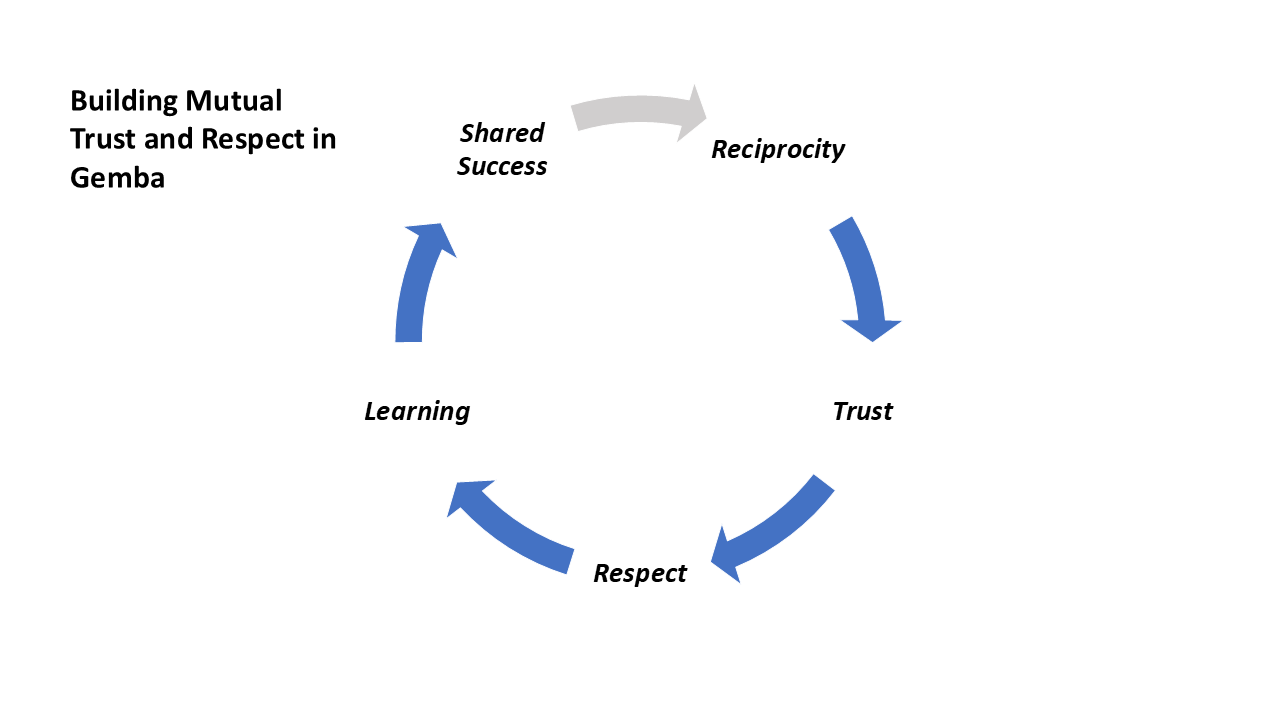
Reciprocity reinforcing feedback loop
As trust increases:
- communication becomes more open,
- knowledge sharing improves,
- learning accelerates,
- coordination becomes easier,
- and outcomes improve.
Successful outcomes, in turn, strengthen trust and respect even more. This is why high-performing teams often seem to have exceptionally strong trust relationships. Trust is seldom built through a single workshop; instead, it typically develops from consistently working together to solve real problems.
Closing Insight
- Trust is not built through declarations.
- Trust is not built through surveillance.
- Trust is not built through Kumbaya.
- Trust is built through repeated experience of competence, reciprocity, fairness, respect, and shared consequence.
Gemba provides the place where these experiences occur.
Trust, therefore, grows through contribution, consequence, and shared experience.
Trust Failure Patterns
Structural
- metric theatre,
- dashboard blindness,
- hidden incentives,
- abstraction collapse.
Behavioural
- fear filtering,
- symbolic listening,
- performative transparency,
- executive framing lock.
Cultural
- validation theatre,
- compliance masquerading as learning,
- kumbaya monoculture,
- coercive urgency.
AI/Technology
- algorithmic opacity,
- trust outsourcing,
- automation overreach,
- “system says so.”
This section gives the SA practical bite.
Trust and AI
The growing use of Artificial Intelligence raises new questions about trust within organisations. Unlike trust between people, trust in AI isn’t based on intentions, character, or goodwill. Instead, it depends on perceptions of its functionality, reliability, explainability, transparency, and accountability.
This distinction is significant.
People might trust an AI system to do a specific task but remain cautious about its recommendations, limitations, or unintended effects.
Therefore, trust in AI differs from interpersonal trust, though many concerns like competence, honesty, accountability, and ethics still apply.
Ultimately, humans retain responsibility for decisions. While organisations may leverage AI for analysis, decision-making, modelling, and learning, accountability cannot be transferred to the technology. That’s why accountability, governance, ethical oversight, and human judgment are vital for responsible AI use.
Most importantly, trust in AI is shaped by the organisational environment.
In organisations with strong trust, learning, openness, accountability, and ethics, AI is seen as a helpful partner.
Conversely, in settings characterised by low trust, poor communication, weak accountability, or defensiveness, AI can exacerbate existing issues. In this way, trust in AI often reflects the trust in the organisation that employs it.
Trust Beyond the Organisation
Trust is vital beyond organisations, playing a key role in communities, institutions, industries, and broader social systems.
Elinor Ostrom (Ostrom, 1990) and others showed that groups can effectively manage shared resources when relationships are grounded in trust, reciprocity, accountability, and stewardship. In such contexts, trust reduces the need for heavy monitoring and controls, fostering cooperation and collective responsibility.
From a broader adaptive perspective, trust functions as Social Capital, enabling individuals and groups to collaborate amid uncertainty and common challenges.
This is especially crucial when tackling complex issues such as sustainability, environmental care, community resilience, and regenerative growth that extend beyond organisational boundaries.
Thus, trust is more than an organisational resource; it is fundamental to how societies, communities, and organisations learn, coordinate, and adapt together.
Trust and Adaptive Capacity
Adaptive Capacity refers to an organisation’s ability to sense, interpret, coordinate, learn, and respond effectively to changing conditions.
Throughout this Subject Area, trust has repeatedly emerged as an enabling condition for these capabilities.
Trust influences whether:
- people share tacit knowledge,
- weak signals are surfaced,
- assumptions are challenged,
- psychological safety develops,
- Shared Mental Models emerge,
- learning flows through SECI,
- knowledge moves between Trust Islands,
- distributed leadership becomes possible,
- and coordinated action occurs under uncertainty.
Trust does not create Adaptive Capacity on its own.
However, many of the mechanisms through which Adaptive Capacity develops rely upon trust.
Without trust:
- the quality and throughput rate of learning slows,
- existing silos may be reinforced, and new silos form,
- organisational coherence fragments,
- cooperation and coordination become increasingly difficult,
- and so Social Capital weakens with a consequential slowing of adaptation.
From a Knowledge Operating System perspective, trust is one of the enabling conditions that allow knowledge, learning, and coordination to move through the system.
Trust thereby facilitates the transformation of:
- knowledge into understanding,
- understanding into coordinated action,
- and coordinated action into adaptation.
Closing Insight
Trust is frequently regarded as a cultural trait or an interpersonal quality.
In adaptive organisations, however, it goes beyond that. Trust acts as a key condition that enables people to share their knowledge, learn from each other, coordinate their efforts, and respond efficiently to evolving situations.
In this context, trust is not the ultimate aim but a critical enabling factor that makes Adaptive Capacity functional.
Trust Signals
Trust is difficult to measure directly. However, its presence—or absence—often becomes visible through patterns of behaviour, communication, learning, and coordination.
In many organisations, trust is most visible through its absence.
Potential indicators include:
Communication and Dialogue
- reduced willingness to challenge assumptions,
- fewer difficult conversations,
- increasing silence in meetings,
- declining participation,
- excessive reliance on formal communication channels,
- growing use of email and documentation for self-protection rather than collaboration.
Learning and Knowledge Sharing
- knowledge hoarding,
- reluctance to share lessons learned,
- reduced participation in reflective activities,
- fewer weak signals being surfaced,
- declining psychological safety,
- increasing reluctance to admit mistakes or uncertainty.
Coordination and Decision-Making
- escalating coordination overhead,
- repeated misunderstandings,
- duplicated effort,
- increasing use of workarounds,
- delayed escalation of issues,
- reporting distortion or selective reporting,
- growing gaps between espoused values and actual behaviour.
People and Culture
- increasing cynicism,
- burnout and disengagement,
- declining discretionary effort,
- rising turnover among trusted contributors,
- reduced cross-functional collaboration,
- growing silo behaviour,
- declining trust in leadership.
These indicators should not be viewed in isolation. Trust erosion often appears as a pattern of reinforcing signals rather than a single measurable event.
For leaders, the challenge is not simply to monitor these indicators, but to understand what they may be revealing about the underlying relational ecology of the organisation.
Trust is often most visible through its absence.
When trust is strong, organisations are generally able to learn, coordinate, adapt, and respond with relatively little friction. When trust erodes, communication becomes defensive, learning slows, coordination becomes more difficult, and adaptive capacity begins to decline.
Trust is therefore more than a cultural attribute. It is one of the enabling conditions that allows organisations to learn, adapt, and flourish in an increasingly uncertain world.
Argyris, C. (1976). Theories of action that inhibit individual learning. American psychologist, 31(9), 638.
Cilliers, F., & Greyvenstein, H. (2012). The impact of silo mentality on team identity: An organisational case study. SA Journal of Industrial Psychology, 38(2), 1-9.
Luhmann, N. (2000). Familiarity, confidence, trust: Problems and alternatives. Trust: Making and breaking cooperative relations, 6(1), 94-107.
Ostrom, E. (1990). Governing the commons: The evolution of institutions for collective action: Cambridge university press.
Rousseau, D. M., Sitkin, S. B., Burt, R. S., & Camerer, C. (1998). Not so different after all: A cross-discipline view of trust. Academy of Management Review, 23(3), 393-404.
Snowden, D. J., & Boone, M. E. (2007). A leader’s framework for decision making. Harvard business review, 85(11), 68.
Taylor, E. (2016). Supermarket self-checkouts and retail theft: The curious case of the SWIPERS. Criminology & criminal justice, 16(5), 552-567.