The Pattern
In complex environments, there is a strong pressure to create clarity early.
This shows up as:
- Premature classification of problems.
- Early convergence on a single explanation.
- Reliance on planning when understanding is incomplete.
- Forcing agreement when perspectives differ.
👉 Understanding narrows at the point it should expand
What Sits Beneath This
This behaviour is not accidental.
It reflects a structural mismatch:
- uncertain environments
- approached with certainty-based thinking
In practice:
- methods designed for stable, predictable situations are applied to complex, dynamic one,
- planning replaces inquiry,
- and control is attempted where adaptation is required.
👉 The system relies on familiar logic even outside its valid domain.
Collapse into False Certainty
When this happens, a pattern emerges:
- uncertainty is suppressed rather than explored,
- disagreement is avoided or overridden,
- confidence replaces understanding.
👉 Decisions are made inside a bubble of certainty — not in response to reality
Structural Reinforcement
This pattern is often reinforced through artefacts:
- dashboards and metrics
- early modelling and classification
- “quality scores” and reporting cycles
These create:
visibility without integrity
👉 Certainty is simulated before it is earned.
Why This Fails in Complex Domains
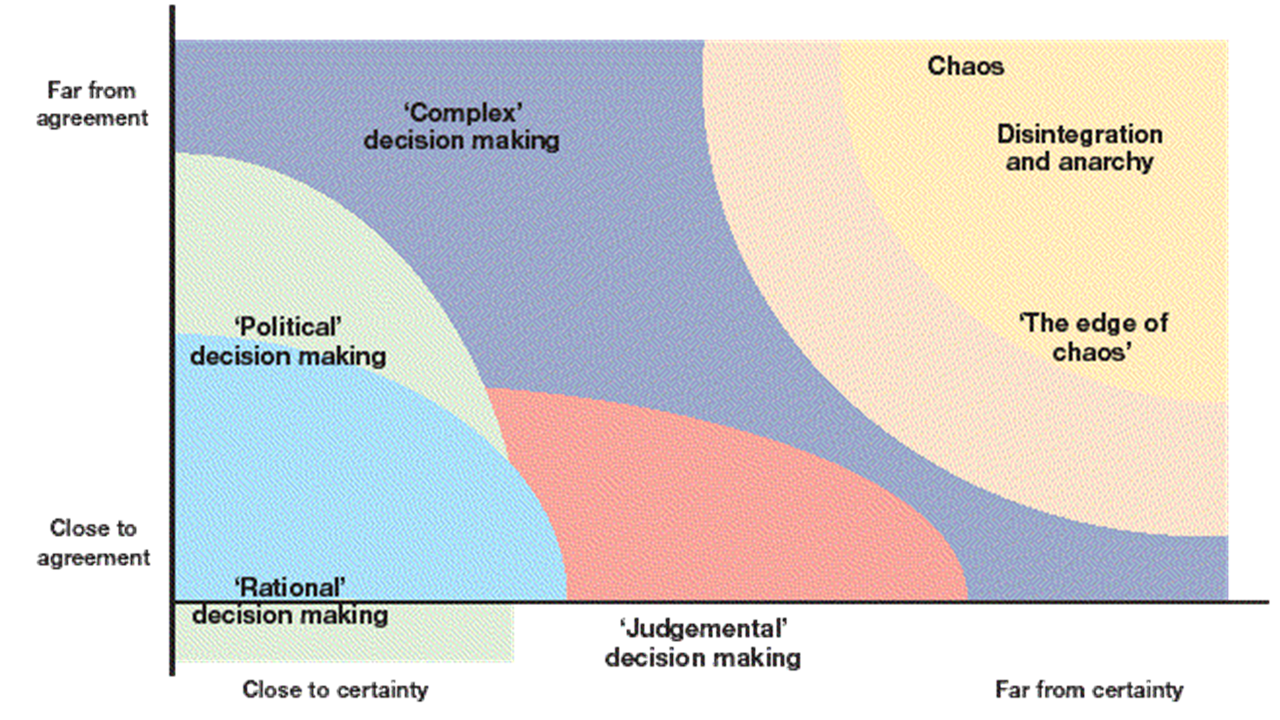
Decisions far from certainty require judgement and exploration — not premature convergence.(Zimmerman, 2001)
In complex environments:
- cause and effect are not clear,
- outcomes cannot be predicted in advance,
- perspectives are incomplete and evolving.
👉 Action must precede certainty
This aligns directly with the Stacey matrix:
- close to certainty → planning works
- far from certainty → judgement and exploration are required
👉 Forcing certainty in this zone collapses the very conditions required for learning.
The Consequence
When certainty is forced too early:
- Weak signals are ignored.
- Alternative interpretations are not explored.
- Flawed assumptions become embedded.
- Learning is reduced.
👉 The organisation becomes confidently wrong
The Required Shift
Sensemaking in complex environments requires:
- holding multiple interpretations simultaneously,
- delaying closure long enough for patterns to emerge,
- surfacing and testing assumptions,
- and allowing disagreement to inform understanding
👉 Clarity must emerge through interaction — not be imposed to reduce discomfort
Governing Insight
Forcing certainty too early does not reduce uncertainty — it hides it.
Where This Connects
- Information Quality is Not Binary — It Is Interpreted
→ why uncertainty exists - The Data Quality Theatre Trap
→ how false certainty is constructed - Hansei — Reflection That Forces Correction
→ how false certainty is exposed and corrected
In complex environments, certainty is not achieved by deciding early — it is earned through disciplined sensemaking
Explore further
This article connects to the broader framework:
- Ethical Domain — how constraints shape decisions
- Sensemaking Domain — how organisations interpret reality
- Relational Domain — how trust and coordination emerge
- Learning Domain — how knowledge is created and tested
- Action Domain — how intent becomes capability
To understand more on Purpose detailed Subject Areas, visit the Deep Dive section.
📖See the Books
Zimmerman, B. (2001). Ralph Stacey’s agreement & certainty matrix. Schulich School of Business, York University, Toronto, Canada, available on http://www. plexusinstitute. org/edgeware/archive/think/main_aides3. html.