A Knowledge Base is a structured repository of organisational knowledge that provides a shared understanding of how an organisation operates. It contains the models, definitions, relationships and metadata required to support decision-making, analysis, reporting and organisational learning.
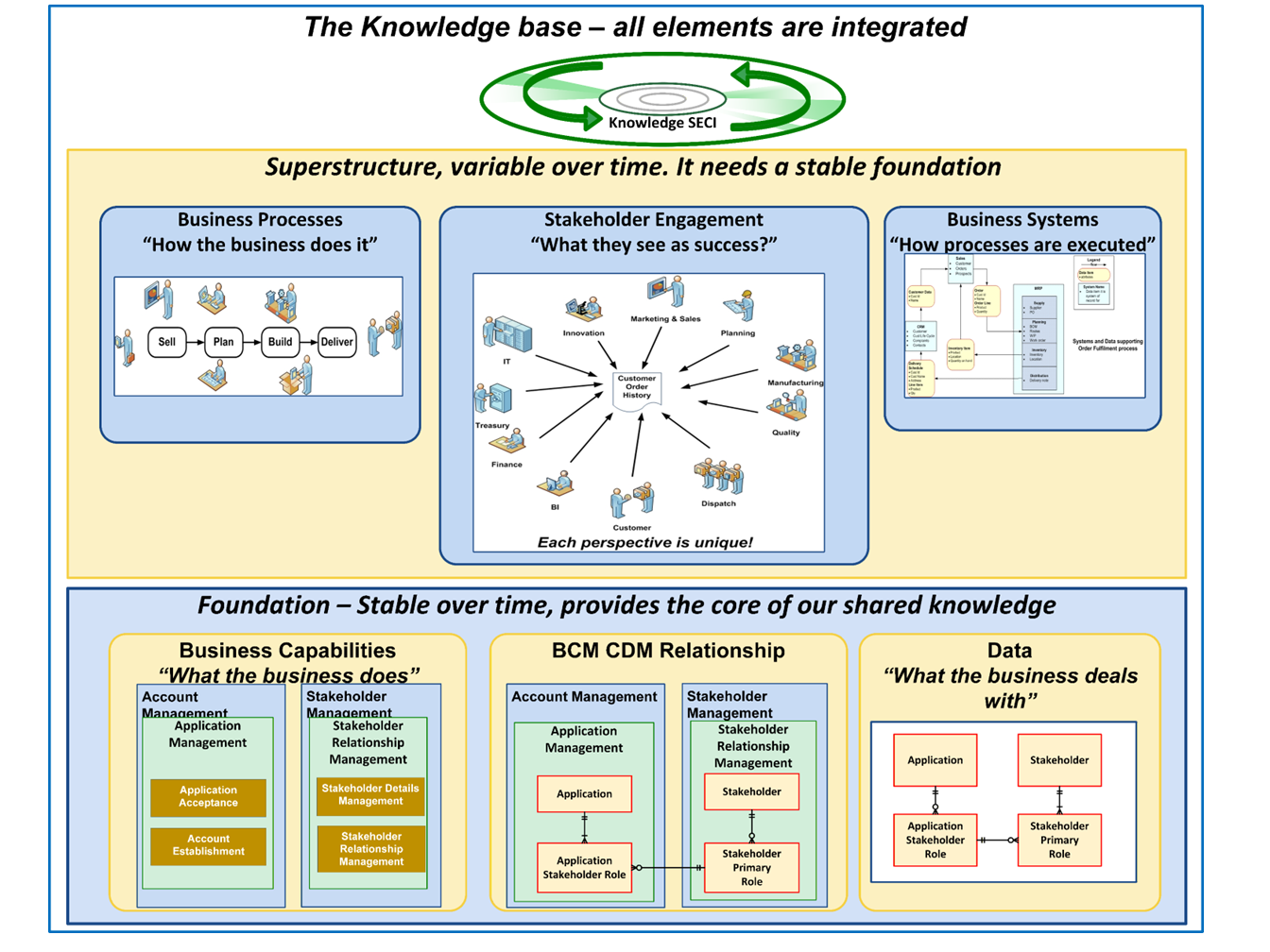
Figure 1: Knowledge Base
Within the ASF framework, the Knowledge Base integrates business capabilities, processes, activities, information, stakeholders, measures and other architectural artefacts into a coherent system of shared knowledge.
At the foundation level sit the Business Capability Model, the Common Data Model, and the relationships that connect them. Together, they provide a stable representation of what the organisation does, what it deals with, and how these elements interact.
Just as a reinforced concrete foundation provides a stable, long-lasting base for a house, this foundation undergirds the constantly evolving Superstructure, which adapts to business challenges and opportunities.
It provides the foundation for Design Thinking, Strategic Thinking, Activity-Based Costing, reporting, strategy execution and adaptive learning.
The Knowledge Base also provides the structural foundation for Activity-Based Costing by linking capabilities, processes, activities, task types, and tasks into a coherent model of work and resource consumption.
Business Process Management builds upon the Knowledge Base by describing how workflows are created through capabilities and activities that deliver value to stakeholders.
Stakeholder Perspectives provides insight into who the stakeholders are and what matters to them in a specific context.
Systems Maps are a holistic view for IT planners, developers, builders, and testers.
Related Glossary Items:
Related Source Notes
- Source Note: Activity Based Costing
- Business Capability Model
- Source Note: Enterprise Architecture – The Language of Business Design
- Source Note – Triple Bottom Line: From Profit to Prosperity
- Source Note: Knowledge Operating System
Subject Areas
- Subject Area: Enterprise Architecture — Foundation of Shared Knowledge
- Source Note: Knowledge Operating System
- Subject Area: Triple Bottom Line and the Balanced Scorecard
- Source Note: Enterprise Architecture – The Language of Business Design
- Subject Area — Adaptive Thinking Systems, Design Thinking and Strategic Thinking
- Subject Area – The Learning Environment