Framing Insight
The SECI spiral explains how knowledge is created, but does not explain where that process becomes effective.
Ba and Basho describe the field conditions that enable SECI to function in practice.
The Missing Layer
Most organisations invest heavily in:
- knowledge artefacts,
- system to store, organise and share content,
- and models to capture shared meaning about the organisation’s architecture, structures and processes.
They assume that once knowledge exists, it will be used.
It isn’t. Knowledge only becomes actionable when it is interpreted by people within a shared context.
Without this:
- meaning diverges
- assumptions remain hidden
- coordination becomes fragile
Ba and Basho — The Distinction
- Ba → the relational field where knowledge is created, shared, and interpreted
- Basho → the broader ecology within which multiple Ba emerge, interact, and dissolve
Ba is local and active.
Basho is systemic and enabling.
Ba as the Integration Layer
Organisations typically attempt integration through:
- data models
- process alignment
- shared terminology
This operates at the level of explicit knowledge.
But explicit knowledge is downstream.
Integration does not occur through artefacts.
It occurs through shared meaning.
Ba provides this.
It is the layer through which:
- tacit knowledge flows
- assumptions are surfaced
- meaning is aligned
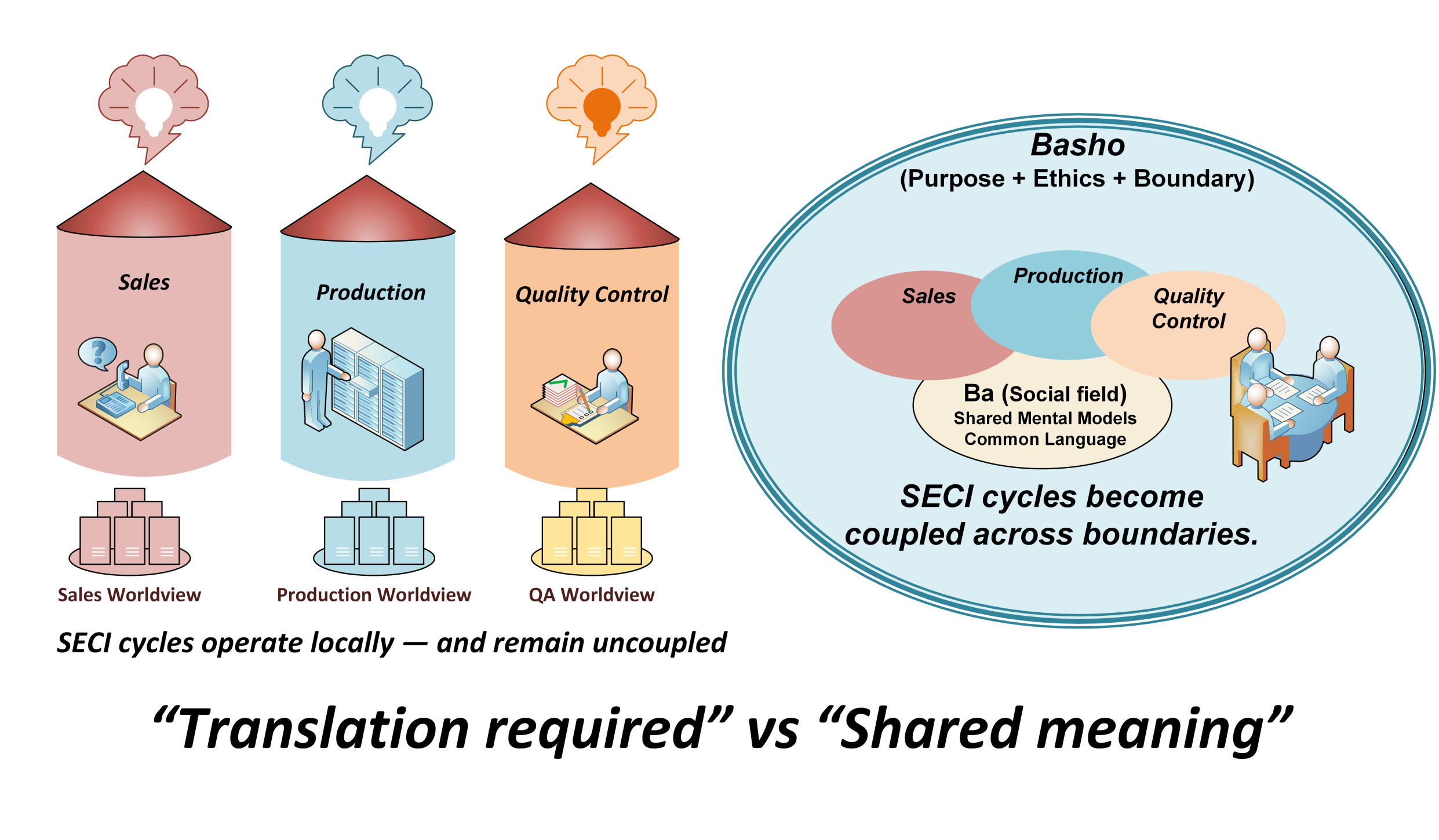
1. Without Basho & Ba – uncoupled learning and fractured knowledge
Each organisational silo maintains its own knowledge base.
SECI cycles operate locally.
Attempts at alignment rely on:
- common language
- negotiated understanding
Learning remains local and must be translated before action.
2. With Ba – coupled learning and integrated knowledge
A shared field is established.
Organisations interact within a common context.
SECI becomes coupled across boundaries.
Meaning is formed before action is taken.
Core Observation
When Ba is absent, learning does not translate into coordinated action — it fragments into local understanding.
Each organisation continues to learn.
But without a shared field:
- knowledge must be translated
- alignment must be negotiated
- decisions become slow and fragile
Under pressure, this fails.
Ba at Gemba
Ba is not created in abstraction.
It forms where reality pushes back.
At Gemba:
- knowledge is tested
- assumptions are exposed
- consequences are visible
Without this:
- Ba becomes performative
- dialogue loses consequence
- learning does not transfer
Conditions for Ba
Ba does not emerge by default.
It requires:
- Attention → focus on a shared problem
- Motivation → willingness to engage
- Schema failure → recognition that current understanding is insufficient
Without these:
- participation becomes ritual
- learning remains superficial
Sanctuary
Ba must be protected.
Not from disagreement — but from:
- ego domination
- premature judgement
- performative consensus
Without sanctuary:
- people withhold contribution
- tacit knowledge remains hidden
- learning collapses
- risk accumulates unseen
Islands of Coherence
Ba is observable.
It appears where:
- contribution is voluntary
- alignment emerges naturally
- people act with shared understanding under pressure
Examples include:
- emergency response teams
- operational crews
- tightly coupled project environments
These are islands of coherence within a broader system.
📖 Narrative Example — Lead, Transform and Navigate
In the final BCM workshops in the workplace (Gemba):
- The BCM model provided a focal point.
- People gathered and participated without invitation.
- Assumptions were challenged openly.
- Meaning emerged through interaction.
The artefact did not create alignment.
The Ba formed around it did.
Implication
SECI is necessary but not sufficient.
Learning requires both:
- a mechanism (SECI)
- a field (Ba/Basho)
Without Ba:
- knowledge accumulates
- learning appears to occur
- action remains fragmented
With Ba:
- meaning aligns
- learning transfers
- coordinated action becomes possible
Systems don’t integrate. Meaning does.
You cannot integrate systems without first integrating meaning.