NaturFlourish BCM was redeveloped after regeneration, using the AI/Human Business Modelling Guideline and more detailed work on the AI query. The model was then socialised (in the SECI sense) across the business.
Backstory:
📖 Narrative Example from Lead, Transform and Navigate
Following its initial presentation, the Business Capability Model was adopted as a working reference within NaturFlourish.
During walkthroughs, the model appeared complete and coherent. Participants treated it as something to be explained rather than challenged.
Questions focused on understanding the structure, not on testing its assumptions.
Bruno was seen as the Enterprise Architecture expert, and the model carried additional weight through Sam’s visible support.
As a result, the model was accepted and used operationally without significant challenge.
Over time, it began to shape conversations, decisions, and interpretations of how the business operated.
It was only when Mallory questioned specific elements of the model that its underlying assumptions were exposed.
Under scrutiny, inconsistencies and gaps became visible, and the model’s apparent coherence began to break down.
This led to a broader realisation:
The model had not been socialised in the SECI sense.
While it had been presented, explained, and shared, it had not been collectively interrogated, challenged, or validated through interaction.
Participants had not contributed to its formation or tested it against their own experience of the business.
In contemporary consulting practice, a presentation to an executive group, followed by minor refinement, is often described as “socialisation.”
In this case, that level of engagement proved insufficient.
The model had been communicated, but a shared meaning had not been established.
Revised AI BCM Query:
Narrative Example from Lead, Transform and Navigate.
The AI Query in LTN was much more of a narrative, with AI by Josh and the senior compliance auditor (C. Mallory) next to him, driving the conversation with ‘the Robot’.
The Human–AI Business Modelling Guideline is not a set of “magic prompts” or a shortcut to automated architecture. It is a disciplined way of working in which human judgement and AI capability are deliberately combined to build shared meaning. The guideline treats modelling as a social process first and a technical artefact second. Through structured dialogue, people bring context, experience, and tacit knowledge, while AI contributes pattern recognition, structure, and speed. The result is not just a model, but a shared understanding of what the organisation does and how it works — a knowledge base that people recognise, trust, and use.
In practice, the guideline is used as a conversational workflow rather than a one-shot query. Teams move rhythmically through explore → propose → test → refine, often in workshop settings where capabilities and data are surfaced, challenged, and clarified. AI is used as an apprentice modeller — drafting, decomposing, and suggesting structures — while humans continuously test meaning, boundaries, and accountability. This keeps the sensemaking loop firmly human while accelerating the work. The outcome is a set of coherent Business Capability and Data Models that are not only technically sound, but socially embedded — enabling coordination, learning, and adaptive capacity across the organisation.
The initial query began by using the attached Human–AI Business Modelling Guideline.
- Assess the BCM for:
- missing or weak capabilities
- unclear ownership
- boundary inconsistencies
- For selected capabilities, decompose to Level 3 and:
- define each capability (“the ability to…”)
- identify the principal entity
- propose relevant KPIs
- For each L3 capability, ask:
“If this fails, who is accountable?”
- Do not optimise for elegance. Optimise for:
- auditability
- accountability
- survivability under failure
Use iterative refinement. Challenge assumptions.
For the result, see NaturFlourish BCM Notes
Josh transformed this into a Visio representation:
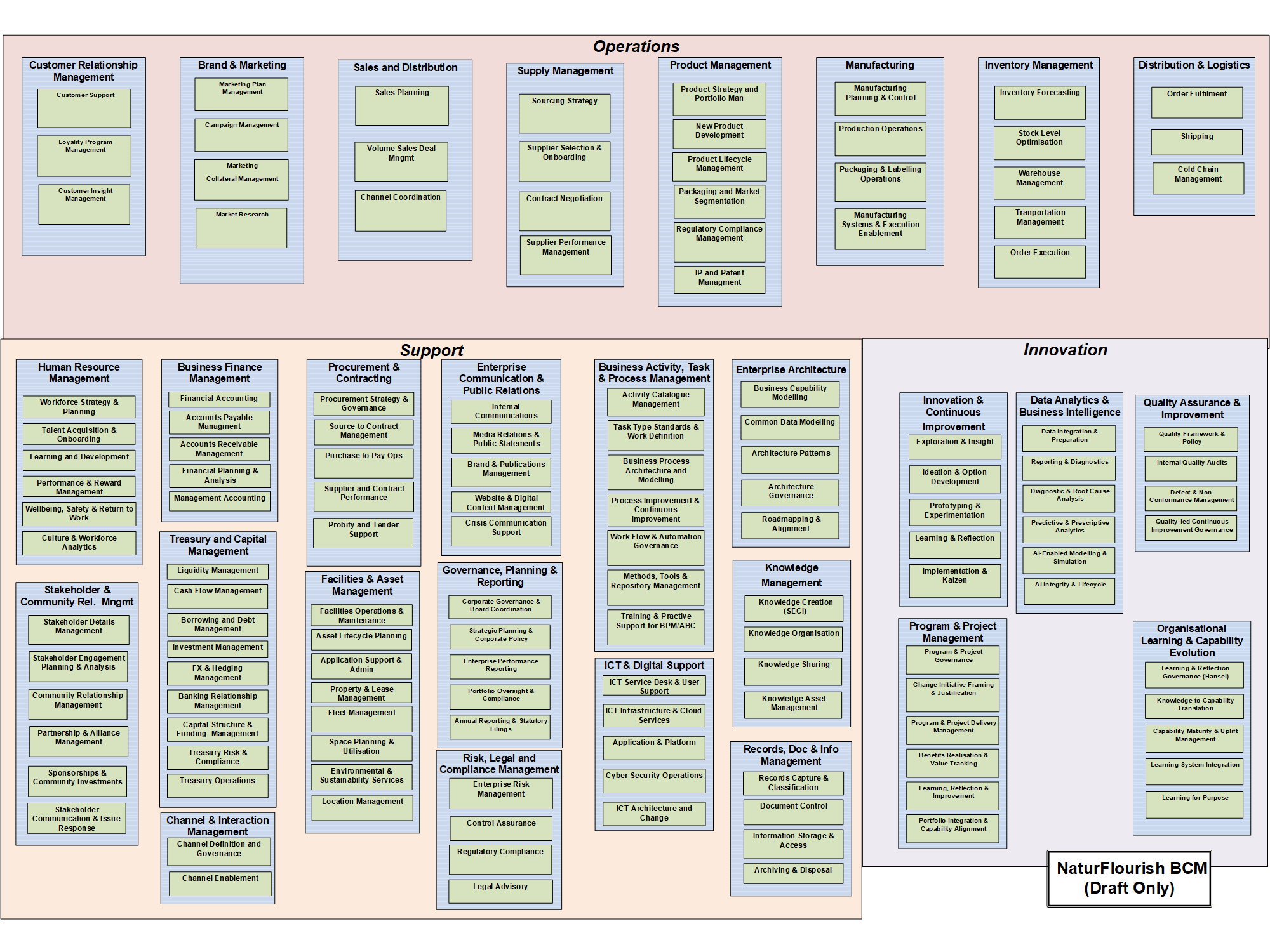
Socialisation
This was the stage omitted from the initial BCM V1 presentation. This step is missing in many cases where artefacts are generated externally, usually by consultants or as part of a ‘best practice’ package. In the Lead, Transform and Navigate, the BCM was socialised back into the business through a series of Gemba workshops.
This is ‘socialisation’ in the SECI sense of the word, not just an executive PowerPoint presentation with a quick walkthrough in which people look at it and think, ‘Well, that broadly looks like what we do’. In these cases, it had been presented but not collectively tested, challenged, or owned.
You need the L1, L2, L3 definitions, the KPIs, and the data to really appreciate what is going on.
It is working with the people doing the work to test the model’s veracity and challenge its underlying assumptions.
Explore further
This article connects to the broader framework:
- Ethical Domain — how constraints shape decisions
- Sensemaking Domain — how organisations interpret reality
- Relational Domain — how trust and coordination emerge
- Learning Domain — how knowledge is created and tested
- Action Domain — how intent becomes capability
To understand more on Purpose detailed Subject Areas, visit the Deep Dive section.
📖See the Books