Framing the Subject Area
Most organisations still approach strategy and innovation using largely sequential processes that typically follow:
- analyse,
- decide,
- implement,
- control.
Yet organisations do not operate as static machines or exist in stable and simple environments. They operate as living systems embedded within complex and volatile environments shaped by:
- uncertainty of what is happening now, or what will happen next,
- high levels of interaction in many contexts, including supply chains, stakeholder networks and the natural environment,
- constant feedback from diverse sources, including social networks, key stakeholders and regulators,
- shifting assumptions,
- and emerging consequences.
Under these conditions, thinking itself must become adaptive.
This Subject Area explores Design Thinking and Strategic Thinking not as isolated methodologies, but as recursive learning systems that help organisations:
- interpret changing conditions,
- explore possibilities,
- form, test and update assumptions,
- adapt interventions,
- and continuously refine understanding through feedback and experience.
Both approaches are fundamentally cyclic rather than linear.
They rely on:
- iterative inquiry,
- reflection,
- experimentation,
- shared sensemaking,
- and ongoing adaptation.
While Design Thinking often operates at the level of human experience, products, services, and local innovation, Strategic Thinking typically operates at organisational and ecosystem scale.
However, both share the same underlying adaptive structure:
- portrayal,
- exploration,
- intervention,
- evaluation,
- and recursive learning through feedback.
This Subject Area positions both as forms of adaptive inquiry operating within living organisational systems.
Why Linear Thinking Struggles in Complexity
Linear planning models assume:
- stable environments,
- confidence that our interpretation of reality is correct,
- predictable cause and effect,
- the ability to control and direct outcomes,
- and complete information.
In complexity, these assumptions weaken.
Conditions shift while decisions are still being formulated and implemented.
Feedback arrives late, partially, or ambiguously.
Interventions reshape the system itself.
As a result:
- plans degrade,
- assumptions drift,
- unintended consequences emerge,
- and organisations become increasingly disconnected from operational reality.
Adaptive organisations therefore require more than just a planning capability.
They require:
- sensing capability — understanding changing current conditions,
- anticipatory capability — exploring possible future states,
- reflective capability, the ability to incorporate new information and grasp its implications for individuals and groups,
- learning capability, the capacity to learn and adapt in response to emerging challenges,
- and the ability to update understanding as circumstances change.
This is why Design Thinking and Strategic Thinking are increasingly important in uncertain environments.
Shared Adaptive Structure
Both Design Thinking and Strategic Thinking rely on recursive learning cycles.
These cycles typically involve:
- understanding or portraying the current situation,
- exploring possibilities,
- testing or implementing interventions,
- evaluating outcomes,
- and revising assumptions through feedback.
The process is not sequential in a rigid sense. Actions emerge dynamically in response to changing conditions, feedback, and evolving understanding.
Movements, driven by sensing and feedback, occur continuously between:
- inquiry,
- experimentation,
- reflection,
- learning,
- and adaptation.
Feedback is therefore not an “end stage”, it is continuously present throughout the process.
Weak-signal sensing, stakeholder reactions, operational outcomes, emerging tensions, and unintended consequences all influence how understanding evolves over time.
👉 Explore:
Design Thinking as Adaptive Inquiry
Design Thinking is often misunderstood as a creativity technique or workshop method.
At deeper levels, it is better understood as a structured learning process for exploring uncertainty through interaction, experimentation, and reflection.
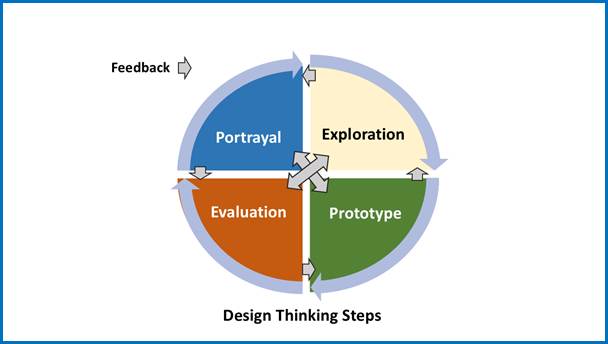
Figure 1: Design Thinking Cycle
Design Thinking is a cyclic process with feedback between stages based on the work of He and Ortiz (He & Ortiz, 2021).
Portrayal (Understanding Current Reality)
The term portrayal refers to the process of forming a working understanding of the current situation.
This involves:
- monitoring, evaluating and interpreting signals,
- surfacing and assessing assumptions,
- understanding stakeholder perspectives,
- recognising constraints, risks, opportunities, and emerging tensions,
- and identifying what may be occurring beneath surface appearances.
Portrayal is therefore not simply “describing” reality.
It is an active sensemaking process shaped by consideration of:
- Mental models influence how people interpret situations and determine what they notice, ignore, or assume to be true.
- Prior experience shapes expectations and often influences how new information and emerging situations are understood.
- Framing affects how problems, opportunities, and risks are defined, interpreted, and communicated.
- Feedback helps organisations test assumptions against reality and adjust understanding as conditions evolve.
- The quality of organisational dialogue influences whether perspectives are genuinely explored, challenged, and integrated into shared understanding.
In adaptive environments, poor portrayal leads organisations to:
- reinforce existing assumptions,
- ignore weak signals,
- misunderstand emerging conditions,
- and respond to yesterday’s reality rather than today’s.
Effective portrayal, therefore, requires:
- curiosity,
- reflection,
- diverse perspectives,
- psychological safety and trust,
- and openness to reframing.
Exploration (Possibilities and Emerging Options)
Exploration refers to the process of investigating possibilities, testing assumptions, and opening space for alternative interpretations and responses.
This involves:
- generating options,
- developing narratives about possible future scenarios to test assumptions and responses,
- reframing problems within alternative contexts,
- exploring stakeholder perspectives,
- examining emerging opportunities,
- and questioning existing assumptions.
Exploration is not merely brainstorming.
It is a structured process of adaptive inquiry shaped by:
- Curiosity motivates organisations to go beyond their current assumptions and familiar solutions.
- Dialogue fosters the sharing and examination of diverse perspectives, concerns, and insights collaboratively.
- Experimentation allows testing of ideas, exploring impacts, and learning through practical application.
- Feedback enables organisations to assess initial responses and gradually refine their understanding.
- A willingness to challenge existing mental models helps organisations re-evaluate assumptions that might no longer suit evolving circumstances.
In adaptive environments, weak exploration leads organisations to:
- defend existing ideas,
- converge too early,
- suppress dissent,
- repeat familiar patterns,
- ignore possible consequences,
- and overlook emerging risks or opportunities.
Effective exploration, therefore, requires:
- Psychological safety enables people to contribute ideas, concerns, and uncertainty without fear of ridicule or punishment.
- Reflective dialogue supports deeper inquiry, shared understanding, and reconsideration of assumptions.
- Diversity of perspective broadens interpretation and helps expose blind spots and hidden assumptions.
- Respect for stakeholder groups strengthens understanding of differing needs, impacts, and consequences across the wider system.
- Tolerance for uncertainty and ambiguity enables organisations to continue learning and adapting even when clarity is incomplete.
Prototype / Intervention (Testing Through Action)
A prototype or intervention refers to the process of introducing actions, experiments, models, or changes into the system to test understanding and generate learning.
This involves:
- testing developments in Gemba,
- trialling with real customers and stakeholders,
- implementing small-scale interventions,
- testing assumptions,
- observing responses,
- and learning through interaction with reality.
Interventions are not isolated activities.
They actively reshape the system itself by generating:
- new behaviours,
- new constraints,
- unintended consequences,
- stakeholder reactions,
- and new feedback.
In adaptive environments, weak intervention processes lead organisations to:
- pursue validation rather than learning,
- ignore emerging consequences,
- scale untested assumptions,
- and mistake activity for progress.
Effective intervention, therefore, requires:
- Humility enables organisations to recognise that current understanding may be incomplete, flawed, or no longer aligned with changing reality.
- Experimentation creates opportunities to test ideas, explore consequences, and learn through practical interaction with the system itself.
- Consequence awareness encourages organisations to consider both intended and unintended impacts arising from interventions and decisions.
- Rapid feedback allows emerging responses, tensions, and weak signals to be identified early before problems become deeply embedded.
- Willingness to revise assumptions when reality differs from expectations enables organisations to refine their understanding of reality rather than defending outdated interpretations or existing plans.
Evaluation (Reflection and Sensemaking)
Evaluation refers to the process of interpreting outcomes, reflecting on consequences, and reassessing understanding considering feedback and experience.
This involves:
- reviewing outcomes against agreed measures, expectations, and emerging conditions,
- understanding and interpreting feedback,
- identifying unintended consequences,
- examining assumptions and interpretations,
- and reassessing what has been learned through action and experience.
Evaluation is not merely performance measurement.
It is an ongoing sensemaking activity shaped by:
- interpretation,
- reflection,
- dialogue,
- and the quality of organisational learning processes.
In adaptive environments, weak evaluation leads organisations to:
- filter uncomfortable feedback,
- focus only on metrics,
- protect existing narratives,
- avoid accountability,
- and repeat ineffective patterns.
Effective evaluation, therefore, requires:
- Honest reflection enables organisations to critically examine outcomes, behaviours, decisions, and consequences without filtering uncomfortable realities or protecting existing narratives.
- Openness to challenge allows assumptions, interpretations, and strategies to be questioned constructively rather than defended automatically.
- Weak-signal sensing helps organisations recognise emerging changes, tensions, risks, and opportunities before they become fully visible or deeply embedded.
- Double-loop learning encourages organisations not only to improve actions and processes, but also to reconsider the underlying assumptions, beliefs, and mental models driving those actions.
- Willingness to reconsider existing assumptions and strategies enables organisations to adapt understanding and direction as reality changes rather than remaining locked into outdated plans or interpretations.
Learning (Continuous Adaptation)
Recursive learning refers to the ongoing process through which organisations continuously revise understanding, update assumptions, and adapt behaviour in response to changing conditions and feedback.
This involves:
- integrating learning into future action,
- updating shared mental models,
- adapting practices and strategies,
- revising assumptions,
- and continuously refining understanding through experience.
Recursive learning is not a final stage.
It operates continuously throughout the adaptive cycle as learning, feedback, reflection, and action influence one another over time.
In adaptive environments, weak recursive learning leads organisations to:
- repeat mistakes,
- reinforce outdated assumptions,
- become trapped in rigid routines,
- lose adaptive capacity,
- and drift away from operational reality.
Effective recursive learning therefore requires:
- Reflective capability enables organisations to critically examine outcomes, assumptions, behaviours, and consequences rather than reacting automatically or defensively.
- Openness to emergence allows organisations to recognise new patterns, possibilities, and interpretations that may not have been visible at the outset.
- Continuous feedback helps organisations remain connected to operational reality as conditions, stakeholder responses, and environmental signals evolve.
- Adaptive mindsets support curiosity, flexibility, and willingness to revise understanding when circumstances change.
- Strong relational and learning environments enable ongoing dialogue, inquiry, feedback, and collaborative learning across the organisation.
Design Thinking is therefore far more than a creativity technique or workshop methodology.
At deeper levels, it functions as a recursive learning system that enables organisations to:
- explore uncertainty,
- test assumptions,
- learn through intervention and feedback,
- and progressively refine understanding through interaction with reality.
Its effectiveness depends heavily upon:
- feedback quality,
- reflective capability,
- shared sensemaking,
- adaptive mindsets,
- and the strength of the broader learning environment.
Without these conditions, Design Thinking can easily deteriorate into:
- validation theatre,
- symbolic participation,
- or superficial innovation activity disconnected from operational reality.
Strategic Thinking as Organisational Learning
Strategic Thinking is often misunderstood as:
- forecasting,
- annual planning,
- or static strategic plans.
At deeper levels, Strategic Thinking is better understood as a continuous adaptive learning process operating within living systems shaped by uncertainty, feedback, and consequence.
Rather than predicting a single future, adaptive strategic thinking helps organisations:
- explore possibilities,
- recognise uncertainty,
- monitor environmental shifts,
- evaluate emerging consequences,
- and adapt understanding over time.
This requires:
- shared vision and intent,
- systems awareness,
- reflective inquiry,
- recursive learning,
- weak-signal sensing,
- and adaptive intervention.
Strategic Thinking therefore becomes less about rigid prediction and more about adaptive navigation.
The underlying process is best understood as a form of organisational learning operating recursively through:
- exploration,
- intervention,
- evaluation,
- feedback,
- and continuous adaptation.

Figure 2: Strategic Thinking cycle based on Jeanne Liedkta’s concept
This adaptive interpretation extends earlier strategic thinking concepts proposed by Jeanne Liedtka (Liedtka, 1998), particularly:
- systems perspective,
- intent focus,
- thinking in time,
- intelligent opportunism,
- and hypothesis-driven inquiry.
However, in adaptive environments, these capabilities do not operate sequentially or independently.
They operate recursively through continuous interaction with:
- feedback, which provides information about how the system is responding to actions and changing conditions,
- stakeholder responses, which reveal differing perspectives, expectations, concerns, priorities, and emerging tensions,
- operational reality, where strategic assumptions are tested against agreed criteria against practical implementation and consequence,
- emerging constraints, including resource limitations, regulatory requirements both existing and emerging, capability gaps, and changing environmental pressures,
- unintended consequences, which often reshape both the organisation and the broader system in unexpected ways,
- and changing environmental conditions, where markets, technologies, social expectations, geopolitical conditions, and ecosystems continue to evolve over time.
Strategic Thinking therefore becomes:
- less about optimisation toward a single predicted future,
- less about certainty and control,
- less about rigid long-range planning based on assumed stability,
and increasingly about:
- adaptive sensemaking,
- recursive learning,
- coordinated inquiry,
- scenario exploration,
- weak-signal sensing,
- and continuous adjustment as conditions evolve.
Traditional strategic approaches often assume an ideal or preferred future state toward which the organisation should progress.
However, scholars such as Mintzberg argued that strategy frequently emerges through learning, adaptation, negotiation, and interaction with changing conditions rather than through purely linear planning processes (Mintzberg, Ahlstrand, & Lampel, 2020).
More recent work by Nonaka and Takeuchi extends this perspective further by positioning strategy as a dynamic, human-centred, future-making process grounded in practical wisdom, learning, and adaptive response within complex environments (Nonaka & Takeuchi, 2021).
Adaptive strategic thinking, therefore, recognises that multiple possible futures may emerge, and that strategic capability depends less on prediction accuracy and more on the organisation’s capacity to sense, learn, adapt, and respond coherently as conditions change.
Shared Vision and Intent
Shared Vision and Intent refer to the process of establishing collective direction, purpose, and strategic orientation within conditions of uncertainty.
This involves:
- clarifying purpose,
- understanding organisational aspirations,
- identifying strategic priorities,
- understanding and aligning stakeholder expectations,
- and establishing boundaries and constraints that shape decision-making.
Shared vision is not merely a slogan or communication exercise. It functions as an orienting mechanism that helps organisations:
- coordinate action,
- interpret uncertainty,
- prioritise effort,
- and maintain coherence during change.
In adaptive environments, weak shared vision leads organisations to:
- fragment priorities,
- pursue conflicting objectives,
- drift toward short-term optimisation,
- reinforce silos,
- and lose strategic coherence.
Effective shared vision, therefore, requires:
- dialogue across stakeholder groups, which enables differing experiences, priorities, concerns, and aspirations to be surfaced and understood collectively,
- reflective inquiry into assumptions and purpose, which helps organisations examine why particular directions are being pursued and whether underlying beliefs remain valid,
- openness to differing perspectives, which allows alternative interpretations, emerging risks, and overlooked opportunities to be explored rather than suppressed,
- clarity regarding constraints and trade-offs, which supports more realistic decision-making by recognising limitations, tensions, consequences, and competing priorities,
- and willingness to revise direction as circumstances evolve, which enables organisations to adapt understanding and strategic intent in response to changing conditions, feedback, and emerging reality.
Shared vision must also remain connected to:
- operational reality,
- organisational capability,
- environmental feedback,
- and emerging consequences.
Without this connection:
- vision becomes symbolic rhetoric,
- strategy becomes detached from reality,
- and alignment deteriorates over time.
Exploration and Strategic Options
Exploration and Strategic Options refer to the process of investigating possible futures, alternative responses, and emerging strategic opportunities under uncertainty.
This involves:
- exploring strategic alternatives, which enables organisations to investigate multiple possible pathways, responses, and courses of action rather than prematurely converging on a single preferred solution,
- developing and testing scenarios, which helps organisations examine how different future conditions, disruptions, uncertainties, and environmental shifts may influence strategic choices and organisational resilience,
- identifying emerging opportunities and risks, which supports earlier recognition of changing market conditions, stakeholder expectations, technological developments, competitive dynamics, regulatory pressures, and weak signals that may influence future outcomes,
- examining stakeholder perspectives, which enables organisations to better understand differing aspirations, concerns, priorities, constraints, values, and interpretations across internal and external stakeholder groups,
- questioning assumptions, which helps expose hidden beliefs, inherited mental models, outdated interpretations, and taken-for-granted expectations that may no longer align with changing operational reality,
- and reframing strategic challenges in new ways, which enables organisations to reinterpret problems, reconsider boundaries, explore alternative meanings, and identify possibilities that may remain invisible within existing frames of reference.
Exploration is not simply brainstorming or idea generation.
It is a disciplined process of adaptive inquiry shaped by:
- systems thinking,
- dialogue,
- curiosity,
- experimentation,
- weak-signal sensing,
- and reflective challenge.
In adaptive environments, weak exploration leads organisations to:
- converge too early,
- defend existing strategies,
- suppress dissent,
- repeat historical assumptions,
- overlook emerging disruptions,
- and narrow strategic options prematurely.
Effective exploration, therefore, requires:
- psychological safety,
- diversity of perspective,
- tolerance for ambiguity,
- reflective dialogue,
- stakeholder trust and engagement,
- and openness to emergence and uncertainty.
Strong exploration expands adaptive capacity by increasing the organisation’s ability to:
- recognise change early,
- interpret complexity,
- and respond coherently under uncertain conditions.
Strategic Intervention and Action
Strategic Intervention and Action refer to the process of introducing strategic actions, initiatives, policies, or structural changes into the organisational system to influence outcomes and generate learning.
This involves:
- implementing strategic initiatives, which involves translating strategic intent into coordinated actions, programs, projects, policies, and operational activities designed to influence organisational direction and outcomes,
- allocating resources, which requires organisations to make deliberate decisions regarding investment, funding, people, time, technology, capability development, and organisational attention in support of strategic priorities,
- adjusting organisational structures or processes, which enables organisations to realign governance, roles, workflows, decision-making mechanisms, and operational practices in response to changing strategic requirements and emerging conditions,
- engaging stakeholders, which involves building understanding, participation, alignment, trust, and coordinated action across internal and external stakeholder groups affected by strategic decisions and interventions,
- testing strategic assumptions through action, which allows organisations to evaluate whether strategic beliefs, expectations, projections, and intended outcomes remain valid when exposed to operational reality and changing environmental conditions,
- and learning through interaction with operational reality, where feedback, implementation experience, stakeholder responses, emerging tensions, unintended consequences, and practical constraints continuously reshape strategic understanding over time.
Strategic interventions are not isolated actions.
They reshape the system itself by generating:
- new behaviours,
- new constraints,
- unintended consequences,
- stakeholder reactions,
- and new forms of feedback.
In adaptive environments, weak intervention processes lead organisations to:
- pursue symbolic action rather than meaningful change,
- scale untested assumptions,
- ignore emerging consequences,
- reinforce defensive routines,
- and mistake activity for progress.
Effective intervention, therefore, requires:
- humility regarding current understanding,
- experimentation and adaptive adjustment,
- consequence awareness,
- rapid feedback mechanisms,
- and willingness to revise assumptions when reality differs from expectations.
Adaptive intervention recognises that strategy is not implemented onto a passive system.
Strategy intervenes within a living system that responds, adapts, and changes as action occurs.
Evaluation and Weak-Signal Monitoring
Evaluation and Weak-Signal Monitoring refer to the process of assessing outcomes, interpreting feedback, identifying emerging tensions, and reassessing understanding in light of experience.
This involves:
- reviewing outcomes against strategic intent,
- monitoring environmental shifts,
- identifying weak signals and emerging risks,
- examining unintended consequences,
- interpreting stakeholder feedback,
- and reassessing strategic assumptions.
Evaluation is not simply a retrospective measurement.
It is an ongoing interpretive process through which organisations attempt to understand:
- what is changing,
- why is it changing,
- and what those changes may imply for future action.
In adaptive environments, weak evaluation processes lead organisations to:
- filter inconvenient feedback,
- reinforce outdated assumptions,
- rely excessively on lag indicators,
- overlook emerging disruption,
- and disconnect strategy from operational reality.
Effective evaluation, therefore, requires:
- honest reflection,
- openness to challenge,
- weak-signal sensing,
- double-loop learning,
- and willingness to reconsider existing assumptions and strategies.
Weak signals are particularly important in adaptive environments because:
- major disruptions often emerge gradually,
- early signals are frequently ambiguous,
- and organisations typically dismiss weak indicators that conflict with existing beliefs or priorities.
Adaptive organisations therefore treat evaluation not as compliance reporting, but as a critical learning capability.
Recursive Learning and Adaptation
Recursive Learning and Adaptation refers to the ongoing process through which organisations continuously revise understanding, update assumptions, and adapt behaviour in response to changing conditions and feedback.
This involves:
- integrating learning into future action, which enables organisations to incorporate insights, experience, feedback, and emerging understanding into subsequent decisions, interventions, and strategic responses rather than treating learning as isolated reflection,
- updating shared mental models, which involves revising collective assumptions, interpretations, expectations, and ways of understanding reality as new information, experiences, and perspectives emerge over time,
- adapting practices and strategies, which allows organisations to modify behaviours, operational approaches, structures, priorities, and strategic direction in response to changing conditions and evolving understanding,
- revising assumptions, which helps organisations recognise when previously accepted beliefs, forecasts, interpretations, or strategic expectations no longer align with operational reality or emerging environmental conditions,
- and continuously refining understanding through experience, where learning develops progressively through reflection, experimentation, feedback, stakeholder interaction, operational consequence, and ongoing engagement with changing reality.
Recursive learning is not a final stage. It operates continuously throughout the adaptive cycle as:
- feedback influences interpretation,
- interpretation shapes action,
- action generates consequences,
- and consequences reshape future understanding.
In adaptive environments, weak recursive learning leads organisations to:
- repeat mistakes,
- reinforce rigid routines,
- defend outdated assumptions,
- lose adaptive capacity,
- and drift away from operational reality.
Effective recursive learning therefore requires:
- reflective capability,
adaptive mindsets,
continuous feedback,
- openness to emergence,
- and strong relational and learning environments that support ongoing inquiry and adjustment.
This recursive process is central to adaptive organisational learning because:
- environments continue to evolve,
- strategic assumptions continuously degrade over time,
- and no strategic understanding remains permanently valid.
Adaptive capacity, therefore, depends less on having “the right strategy” and more on sustaining the organisation’s ability to:
- learn,
- sense,
- reflect,
- adapt,
- and respond coherently as conditions change.
Feedback, Assumptions and Living Systems
Both Design Thinking and Strategic Thinking involve intervention into living systems.
Every intervention:
- changes relationships,
- reshapes behaviour,
- influences expectations,
- and generates intended and unintended consequences.
For this reason, assumptions must be continuously monitored and revisited.
Adaptive organisations actively monitor:
- operational feedback,
- stakeholder response,
- weak signals,
- unintended outcomes,
- shifting constraints,
- and emerging opportunities.
Without effective feedback:
- organisations drift,
- assumptions harden,
- learning slows,
- and adaptive capacity weakens.
Shared Mental Models and Framing
People do not respond directly to objective reality. They respond to their interpretation of reality through existing mental models, experiences, assumptions, beliefs, values, and organisational context.
Shared Mental Models therefore play a critical role in shaping how organisations:
- interpret situations,
- recognise problems and opportunities,
- evaluate possible responses,
- and make decisions under uncertainty.
These shared interpretations influence:
- what people notice,
- what they ignore,
- what they consider possible,
- how risks are understood,
- and how strategic challenges are framed and discussed.
This is why portrayal and framing are foundational stages within both Design Thinking and Strategic Thinking.
If the initial framing of a situation is narrow, incomplete, or distorted, the quality of subsequent exploration and decision-making also becomes constrained.
Poor framing can:
- reinforce existing assumptions,
- narrow the range of perceived options,
- suppress alternative perspectives,
- and reduce the organisation’s capacity to adapt effectively to changing conditions.
Under these circumstances, organisations often respond to uncertainty by defending familiar interpretations rather than exploring emerging realities.
Effective adaptive inquiry, therefore, requires more than analytical capability alone.
It also depends upon:
- reflective dialogue,
- exposure to diverse perspectives,
- constructive challenge,
- continuous feedback,
- and willingness to reframe understanding as new information and experiences emerge.
Through this process, organisations gradually refine shared understanding, strengthen adaptive learning, and improve their capacity to respond coherently within complex and changing environments.
👉 Explore:
Mindsets and Adaptive Capacity
The effectiveness of adaptive thinking depends heavily on mindset.
Organisations rarely fail because people lack intelligence.
They fail because:
- defensiveness replaces inquiry,
- certainty overrides reflection,
- blame suppresses learning,
- and interaction patterns become rigid.
Adaptive thinking requires:
- curiosity,
- humility,
- reflective inquiry,
- openness to challenge,
- and willingness to revise assumptions.
This is why ecocentric thinking becomes increasingly important under uncertainty.
Ecocentric approaches tend to support:
- learning,
- dialogue,
- adaptation,
- and shared understanding.
Egocentric approaches tend to reinforce:
- defensiveness,
- certainty-seeking,
- political positioning,
- and learning avoidance.
Dosi et al. have done some enlightening work on identifying the key mindsets for Design Thinking (Dosi, Rosati, & Vignoli, 2018). The following table repurposes those constructs in the contexts of Design Thinking and Strategic Thinking.
|
Dosi Construct
|
Design Thinking (DT) Meaning | Strategic Thinking (ST) Meaning |
| Ambiguity tolerance | Remaining open during exploration and ideation | Remaining functional under strategic uncertainty and incomplete information |
| Embracing risk | Trying unconventional ideas and experimental approaches | Accepting uncertainty and strategic exposure in decision-making |
| Human centredness | Deep understanding of people’s needs and lived experience | Understanding stakeholder interests, systemic impacts, and long-term consequences |
| Empathy | Seeing the initiative through the eyes of all stakeholders. | Understanding motivations, perspectives, constraints, and political realities |
| Mindfulness of process | Awareness of divergent and convergent design phases | Awareness of strategic positioning, decision framing, and adaptive movement |
| Holistic view | Viewing problems as interconnected human experiences | Understanding systemic interdependencies, constraints, and environmental dynamics |
| Problem reframing | Challenging assumptions to redefine the problem creatively | Reframing strategic situations to uncover new options and implications |
| Team working | Collaborative ideation and co-creation | Shared strategic understanding and coordinated direction-setting |
| Multidisciplinary collaboration | Engaging and combining diverse perspectives to stimulate creativity | Integrating expertise to improve strategic judgement and adaptability |
| Openness to perspectives | Seeking and welcoming alternative viewpoints and unexpected ideas | Remaining receptive to challenge, dissent, and emerging signals |
| Learning orientation | Learning through experimentation, iteration, and feedback | Learning through reflection, consequence, sensing, and strategic adjustment |
| Experimentation | Prototyping and iterative exploration | Safe-to-fail strategic probing and adaptive testing |
| Learning from mistakes | Harnessing failure as a source of innovation and insight | Using unintended consequences and failure to refine strategic understanding |
| Bias toward action | Making ideas tangible through rapid experimentation and testing in Gemba | Acting to test assumptions at Gemba and learn from consequences |
| Critical questioning | Challenging alternatives and conventional thinking, while treating conflict between ideas as a powerful source of creativity and new insight.
|
Challenging inherited frames, strategic narratives, and hidden assumptions |
| Abductive thinking | Generating creative possibilities and future ideas | Exploring plausible future states, scenarios, and strategic pathways |
| Envisioning | Imagining innovative products, services, or experiences | Imagining different possible environmental scenarios, future organisational states and strategic possibilities |
| Creative confidence | Confidence in generating novel ideas and solutions | Confidence in navigating uncertainty and making strategic judgements |
| Desire to make a difference | Motivation to improve human experience and create value in line with our purpose | Motivation to influence organisational direction and long-term outcomes in line with our purpose |
| Optimism | Belief that creative exploration can produce better outcomes aligned to our mission and ethics | Belief that adaptation and strategic learning can improve future resilience aligned to our purpose, shared vision and ethics. |
👉 Explore:
- Source Note — Ecocentric vs Egocentric Thinking
- Subject Area — The Learning Environment
- Source Note — Dialogue vs Debate
- Subject Area — Mindsets
Adaptive Thinking within the Knowledge Operating System
Within the Knowledge Operating System (KOS), Design Thinking and Strategic Thinking function as adaptive learning mechanisms connecting:
- purpose,
- social interaction,
- learning,
- feedback,
- capability,
- and operational reality.
They help organisations:
- sense change,
- interpret emerging conditions,
- coordinate adaptive response,
- and refine shared understanding over time.
Their effectiveness depends not only on process structure, but on:
- social capital,
- learning quality,
- interaction patterns,
- trust,
- and the organisation’s broader learning environment.
This is why adaptive capacity cannot be separated from:
- mindset,
- relationships,
- dialogue,
- and organisational culture.
Final Thought
Design Thinking and Strategic Thinking are not simply planning or innovation techniques.
They are adaptive learning systems operating within living organisational environments.
When functioning well, they help organisations:
- sense reality more clearly,
- learn more effectively,
- adapt more coherently,
- and navigate uncertainty with greater resilience.
When functioning poorly, they easily collapse into:
- performative consultation,
- validation theatre,
- political positioning,
- or symbolic planning disconnected from reality.
The difference is rarely the process alone.
The difference is usually:
- the quality of interaction,
- the quality of reflection,
- the openness to learning,
- and the organisation’s willingness to engage honestly with uncertainty and consequence.
Adaptive Enquiry Cycle
The Adaptive Enquiry Cycle brings together much of the learning and concepts that have emerged in the development of this body of work.
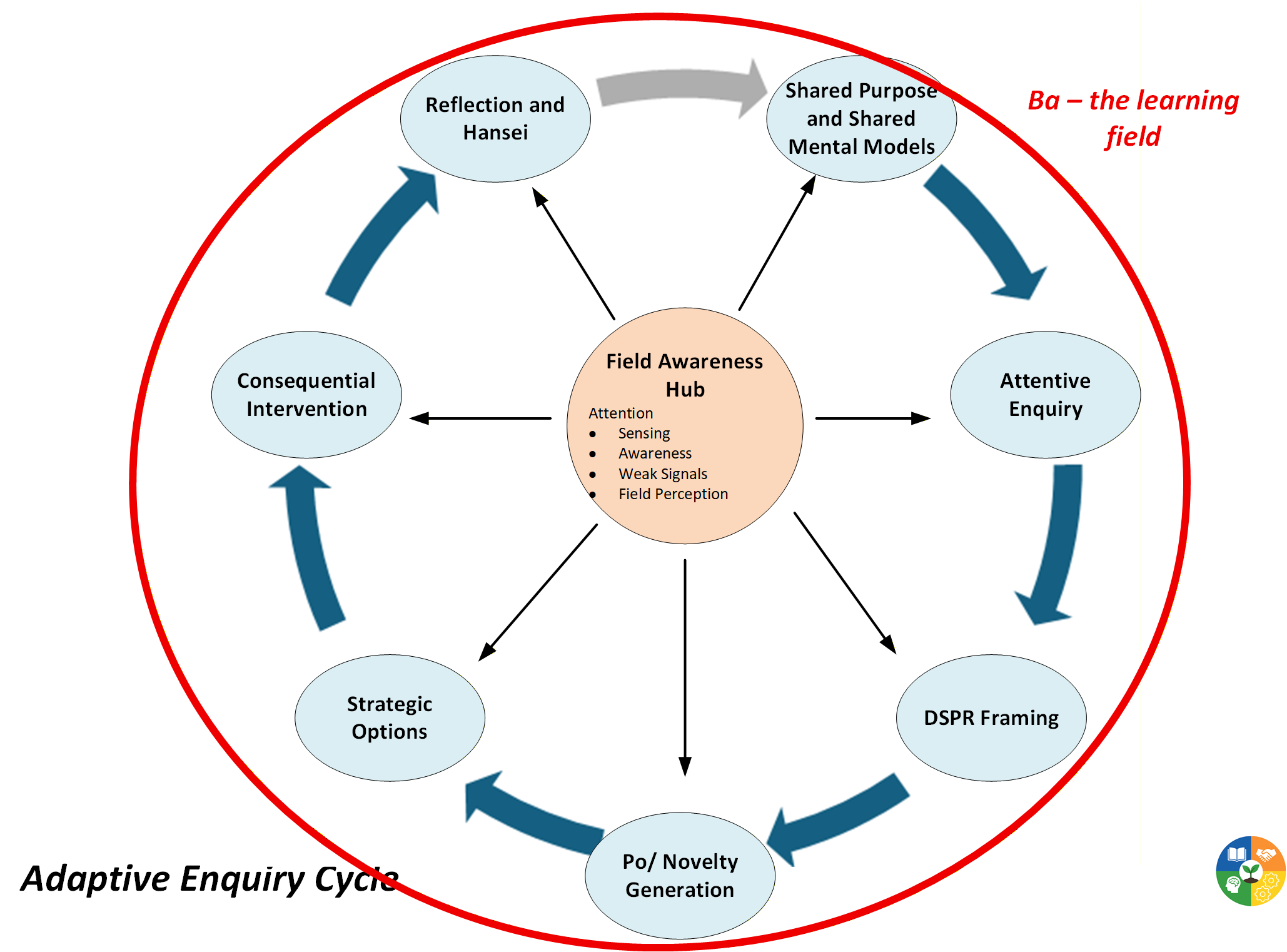
Adaptive Enquiry Cycle in Ba
Ba – The Learning Field
Ba is the social field within which the cycle takes place. It is characterised by an overall sense of purpose, shared ethical values and a boundary that reflects intent.
Around the cycle:
Shared Purpose and Shared Mental Models
This provides alignment and direction. It is to establish Purpose, which is the foundation of ba. It’s the starting point, where we are now:
- Clarify intent, values and current understanding.
- Creates the context for inquiry and learning.
Attentive Enquiry
Asks the question: “Why is it so?”
- Observe, listen, engage the real situation in Gemba,
- Notice what is happening,
- Looking for patterns,
- Sensing tensions,
- And encouraging emerging questions.
DSPR Framing
Framing the enquiry to provide a clear boundary for Ba means we know why we are here.
- Distinctions – what it is, and is not.
- Systems – where does this fit in the bigger picture, what does it contain?
- Relationships – between our system and other systems,
- Perspective – what do our stakeholders consider as success?
Novelty Generation
Using creative thinking to find new novel ways by expanding the possibility space.
- What was this aspect not so?
- What happens if we break the mould?
- How do we reform it differently?
- What if this assumption were wrong?
- Generate new ideas, combine, subtract.
Strategic Options
- These are hypotheses we can test. Plausible alternatives.
- Each hypothesis is a value proposition in its own right.
Consequential Intervention
- Test a hypothesis by conducting small experiments or purposeful actions in Gemba.
- Apply ethics to understand the consequences.
Monitoring
- Observe outcomes and unintended consequences.
- Seek weak signals and evaluate.
Hansei and Reflection
“What have we learned?”
- Individual and group deep reflection,
- Surface insights,
- Challenge biases,
- Integrate learning.
Revised Shared Mental Models
- Update understanding,
- Adjust models and intent,
- Socialise learning back to the broader group.
Field Awareness Hub
At the centre is the Field Awareness Hub, which continuously monitors activities across the Ba field. The black arrows represent feedback loops where sensed data triggers a response.
This is the place where Gemba can push back.
Gemba is the reality interface where abstraction encounters consequence and lived reality pushes back.
Strategy sets direction. Design tests it. Reality reshapes both.
Dosi, C., Rosati, F., & Vignoli, M. (2018). Measuring design thinking mindset. Paper presented at the DS 92: Proceedings of the DESIGN 2018 15th international design conference.
He, J., & Ortiz, J. (2021). Sustainable business modeling: The need for innovative design thinking. Journal of Cleaner Production, 298, 126751.
Liedtka, J. M. (1998). Strategic thinking: can it be taught? Long range planning, 31(1), 120-129.
Mintzberg, H., Ahlstrand, B., & Lampel, J. B. (2020). Strategy safari: The complete guide through the wilds of strategic management: Pearson UK.
Nonaka, I., & Takeuchi, H. (2021). Humanizing strategy. Long range planning, 54(4), 102070.