How shared organisational knowledge becomes everyday work
Organisations often don’t fail solely due to lack of strategy, technology, talent, or effort. More commonly, failure occurs because the links among purpose, capability, value, work, information, decision-making, cost, accountability, and consequences are weak.
Enterprise Architecture and Operating Model design serve as the coherence disciplines that help organisations understand how they operate, decide how they should operate, and keep that design aligned with reality as conditions evolve.
Enterprise Architecture offers a shared map of capabilities, value, information, stakeholders, work, systems, ownership, and relationships. Meanwhile, the Operating Model translates this map into daily organisational actions.
Enterprise Architecture provides the map. The Operating Model provides the wiring.
Neither is a static diagram. They collectively constitute a dynamic Knowledge Operating System guided by purpose and ethics, shaped by Organisational Awareness, validated at Gemba, and continually renewed through consequences, reflection, and learning.
Working Definitions
Enterprise Architecture is the discipline of developing and maintaining shared organisational knowledge about what the organisation must be able to do, how value is created, which information matters, how work and decisions flow, who is affected, and how the parts relate.
The Operating Model is the practical configuration of capabilities, work, roles, decisions, information, systems, governance, measures, costs, partners and learning routines through which the organisation turns purpose and strategy into action and consequences.
The Knowledge Base is the relatively stable structural core of shared organisational knowledge used to understand, coordinate and redesign the organisation.
The Knowledge Operating System is the wider living system through which organisational knowledge is created, interpreted, shared, applied, tested, governed and renewed.
Why This Subject Area Matters
Purpose, ethics, and strategy gain their significance not merely from being outlined in a plan, but through their embodiment in capabilities, value propositions, processes, roles, decision rights, measures, incentives, information, systems, relationships, and daily operations.
The Operating Model exists at the intersection of aspiration and reality, demonstrating whether the organisation’s declared purpose aligns with its actual operations or is undermined by the practical mechanisms that govern decision-making and resource allocation.
- Mindsets shape what people notice, ignore and interpret.
- Governance sets purpose, principles, ethical boundaries, ownership and accountability.
- Enterprise Architecture provides a shared map of capabilities, value, information, stakeholders and relationships.
- The Operating Model configures those elements into a practical arrangement.
- The Knowledge Base preserves the shared structure needed to compare the present with possible futures.
- Organisational Awareness monitors assumptions, weak signals, friction and consequences.
- Gemba reveals whether the model actually works.
- Hansei turns experience and consequences into learning.
- Adaptive Capacity shows whether the organisation has become more capable of sensing, coordinating, learning and changing.
A coherent organisation does not require perfect agreement or a single central view. It requires sufficient shared understanding for people to coordinate action, while preserving the different perspectives needed to discover where the map is incomplete or wrong.
Enterprise Architecture Is Shared Organisational Knowledge
Enterprise Architecture is often reduced to specialist diagrams, repositories and frameworks. That misses its organisational purpose. Its real value lies in the shared language and relationships that enable people to understand the organisation as a connected system.
It helps people ask:
- What purpose and stakeholder outcomes must the organisation serve?
- What capabilities must it possess and protect?
- How does value move across organisational boundaries?
- How does work actually happen?
- What information does the organisation depend upon, and what do key terms mean?
- Which systems support, distort or constrain the work?
- Who owns the capability, data, decisions, risks and consequences?
- Where are cost, performance, trust and capital being created or consumed?
- How will changes in one part affect the whole?
Architectural models serve as cognitive anchors and boundary objects. They reveal assumptions, boundaries, dependencies, competing interpretations, and potential consequences, making these aspects visible enough for individuals from various communities to compare perspectives and build a shared understanding for coordinated action.
The artefacts matter, but the dialogue through which they are created, interpreted and tested is far more important.
A technically sophisticated model created in isolation may remain the architect’s, consultant’s, or vendor’s model. However, a model built collaboratively with those who understand and perform the work—challenged by relevant stakeholders, used in practice, and tested at Gemba against real-world conditions and consequences—will evolve into the organisation’s shared model.
The Knowledge Base: Stable Foundation and Adaptive Superstructure
A useful Enterprise Architecture distinguishes between organisational knowledge that changes relatively slowly and arrangements that must adapt more frequently.
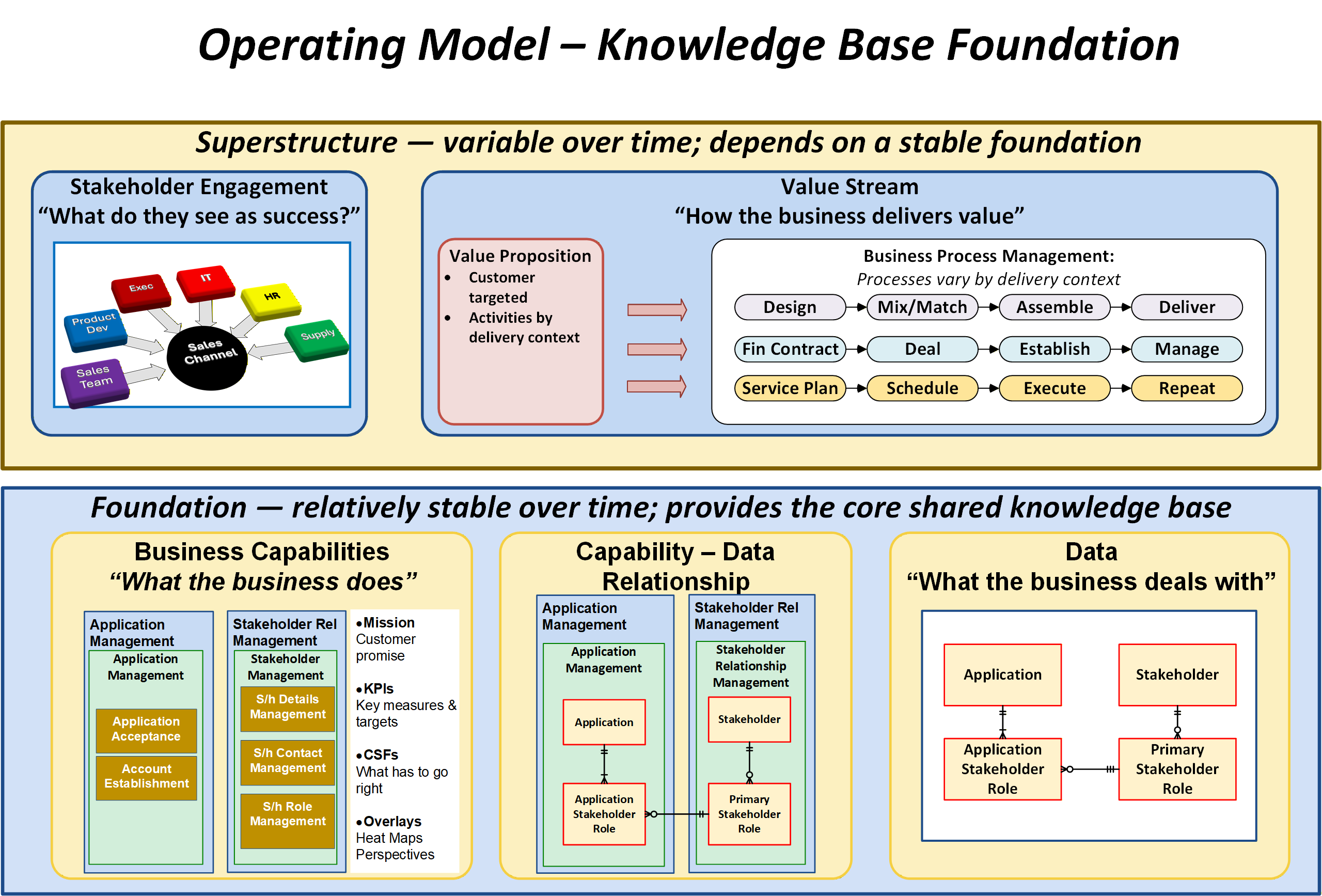
Figure 1: The Operating Model Knowledge Base – a relatively stable capability and data foundation supporting a more variable operating superstructure.
The relatively stable foundation
At the foundation are:
- the Business Capability Model – what the organisation does,
- the Common Data Model – what the organisation deals with,
- and, critically, the relationships between capability and data.
The capability-data relationship links organisational actions with their underlying meaning. It identifies which capabilities generate, utilise, and depend on specific information, clarifies ownership and stewardship, and highlights where information needs to cross capability boundaries. It also indicates where system integration, shared definitions, and business rules are necessary.
The Business Capability Model and the Common Data Model should validate each other; developing the data model can uncover gaps, overlaps, and unclear ownership in the capability model. Conversely, analysing capabilities can reveal missing information, ambiguous definitions, or relationships in the data model. These two models develop concurrently rather than separately.
The adaptive superstructure
Above that foundation sits a more variable superstructure shaped by the organisation’s current purpose, strategy, stakeholders and operating context.
- stakeholder perspectives and definitions of success,
- value propositions,
- value streams,
- business processes and delivery arrangements,
- roles, decisions and organisational structures,
- systems, channels and partnerships,
- measures, incentives, cost structures and controls,
- and the other features of the Current Operating Model.
The superstructure is the primary means through which the organisation adapts. Customer expectations, technology, regulation, ecological conditions, stakeholder needs and competitive pressures may require changes to how value is delivered, and work is performed without immediately changing the organisation’s foundational capabilities or core business concepts.
The foundation provides continuity. The superstructure is how the organisation adapts. Learning determines when the foundation itself must evolve.
Data and Information Integrity
The organisation cannot maintain coherence if its information lacks stable meaning, ownership or provenance. Data may exist in systems, spreadsheets, reports, extracts and local databases, with each copy updated differently and trusted for different purposes.
Data Quality concerns the intrinsic condition of the underlying data: its accuracy, completeness, consistency, validity, timeliness and reliability.
Information Quality is broader. It also asks whether the information is credible, relevant, current, important, usable, accessible, understandable and consistently represented for the decision or action at hand.
| Intrinsic integrity | Accuracy, believability or credibility, and consistency. |
| Context of use | Relevance, currency, importance and usability. |
| User access | Convenience of access, ease of understanding, and concise and consistent representation. |
High-quality data does not automatically create high-quality information. A report can be technically accurate but still mislead because the definition is ambiguous, the context is missing, the information is no longer current, the representation is difficult to understand, or the user cannot see the assumptions and provenance behind it.
The integrity of a decision is only as good as the integrity of the data it is based on.
Data and information integrity therefore require more than cleansing. They require clear business ownership, shared definitions, authoritative sources, traceable provenance, access appropriate to use, and line of sight to the consequences of misunderstanding or misuse.
Ownership Begins with Capability
A capability describes what the organisation must be able to do, independent of its current structure, systems or projects. Capabilities frequently span functions, processes, value streams, information domains and technologies. Without explicit ownership, each part can be managed locally, while the capability as a whole becomes fragmented.
Capability Ownership is the accountability for the coherence, performance, development and consequences of a capability across functions, processes, systems, information, roles and organisational boundaries.
Capability Owners are responsible for:
- maintaining the coherence and fitness of the capability,
- understanding its dependencies across people, process, information, technology, governance and relationships,
- making gaps, risks, fragility and local optimisation visible,
- supporting investment, prioritisation and change decisions,
- ensuring that change strengthens rather than fragments the capability,
- and linking capability performance to purpose, stakeholder value and consequence.
Data ownership is an inherent part of capability ownership. Ownership typically resides at the Level 1 capability, which has whole-of-business accountability for the relevant subject area. At the same time, Data Stewards operate within the subordinate Level 3 capabilities, where data is created, maintained and used in practice.
This arrangement makes integrity structural rather than reactive. It links business meaning, operational use, data quality, system integration and downstream consequences to the capability that depends on them.
The Operating Model Is the Working Configuration
The Operating Model is not merely an organisation chart, a process map, a technology platform or a consultant’s target-state deck. It is the working configuration through which the organisation turns purpose and strategy into capability, work, decisions, information, accountability, learning and consequences.
A useful Operating Model connects:
- purpose and strategy,
- stakeholder expectations and value propositions,
- capabilities and value streams,
- business processes, activities and delivery arrangements,
- people, roles, skills and relationships,
- decision rights, ownership and accountability,
- data, information and systems,
- governance, risk and controls,
- costs, measures and incentives,
- partners, suppliers and organisational boundaries,
- and learning, reflection and adaptation.
The Operating Model is therefore also a design of attention, power, knowledge and consequence. It determines what becomes visible, what becomes urgent, who can decide, who carries the workload, what information is trusted, and what the organisation repeatedly rewards.
The Operating Model as an Architecture of Attention
Attention is a finite psychic energy resource (Csikszentmihalyi et al., 2014). Every meeting, dashboard, target, workflow, alert, escalation, incentive and governance forum directs attention towards some matters and away from others.
- What is repeatedly measured becomes visible.
- What is rewarded becomes urgent.
- What is excluded from the model gradually becomes unreal.
- What consumes attention leaves less capacity for reflection, learning and adaptation.
A growth-dependent model may focus attention on sales, volume, utilisation, productivity, cost reduction and short-term financial return. A learning-oriented and ecocentric model widens attention to include trust, capability, stakeholder experience, ecological limits, knowledge loss, long-term viability and unintended consequences.
The organisation does not need everyone to attend to everything. Attention must be distributed across Gemba, capabilities, roles, stakeholders, data, technology and governance forums, then reconnected through Organisational Awareness without stripping observations of their context.
The danger is attention capture. A failing Current Operating Model may consume almost all available attention through crisis response, repeated reporting, compliance activity, meeting proliferation, rework and remediation. The organisation becomes so busy maintaining the present model that it loses the capacity to notice the model itself is failing.
A well-designed Operating Model protects attention from avoidable fragmentation and allows matters of consequence to reach the people able to interpret and act upon them.
The Dominant Value Logic
Every Operating Model contains a dominant value logic: a set of practical assumptions about why the organisation exists, what counts as value, who receives it, which capitals may be consumed, what time horizon matters, and how success is judged.
This logic is embedded in:
- investment criteria and pricing models,
- cost allocation and procurement rules,
- performance measures and incentives,
- decision rights and risk appetite,
- reporting requirements,
- customer and stakeholder definitions,
- and the treatment of consequences beyond the organisational boundary.
An organisation may declare a regenerative or stakeholder-oriented purpose while its Operating Model continues to reward extraction, volume growth, labour reduction and the externalisation of harm. In practice, the Operating Model reveals the organisation’s true governing logic, regardless of what its stated purpose claims.
Capital Consequences, Sufficiency and Regeneration
Organisations do not create value from nothing. They draw upon, transform and affect financial, human, social, intellectual, natural, manufactured, cultural and relational capitals.
An Operating Model can create apparent financial value by exhausting people, degrading ecosystems, consuming trust, weakening knowledge, transferring risk to suppliers or communities, and using future resilience as if it were spare capacity.
Capital liquidation disguised as performance is not value creation.
Every significant Operating Model decision should ask:
- Which capitals are being created, preserved, depleted or regenerated?
- Which capitals are critical, finite, slow to recover or non-substitutable?
- Is one capital merely being converted into financial return?
- Who carries the loss and when will it become visible?
- What capability, trust, knowledge or resilience is being consumed?
- What would be required to repair or regenerate what has been damaged?
Sufficiency asks what is enough to meet genuine need without unnecessary production, replacement, scale or throughput. It favours maintenance, durability, repair, reuse, adaptation and extension of useful life.
Regeneration asks what has been depleted or damaged and how organisational activity can restore human, social and ecological capability.
Sufficiency reduces avoidable depletion. Regeneration restores capability.
The Adaptive Operating Model Cycle
The Operating Model should be understood as a living cycle rather than a fixed target-state diagram. Current reality, possible future configurations, Organisational Awareness, the Knowledge Operating System and Adaptive Capacity remain in ongoing relationship.
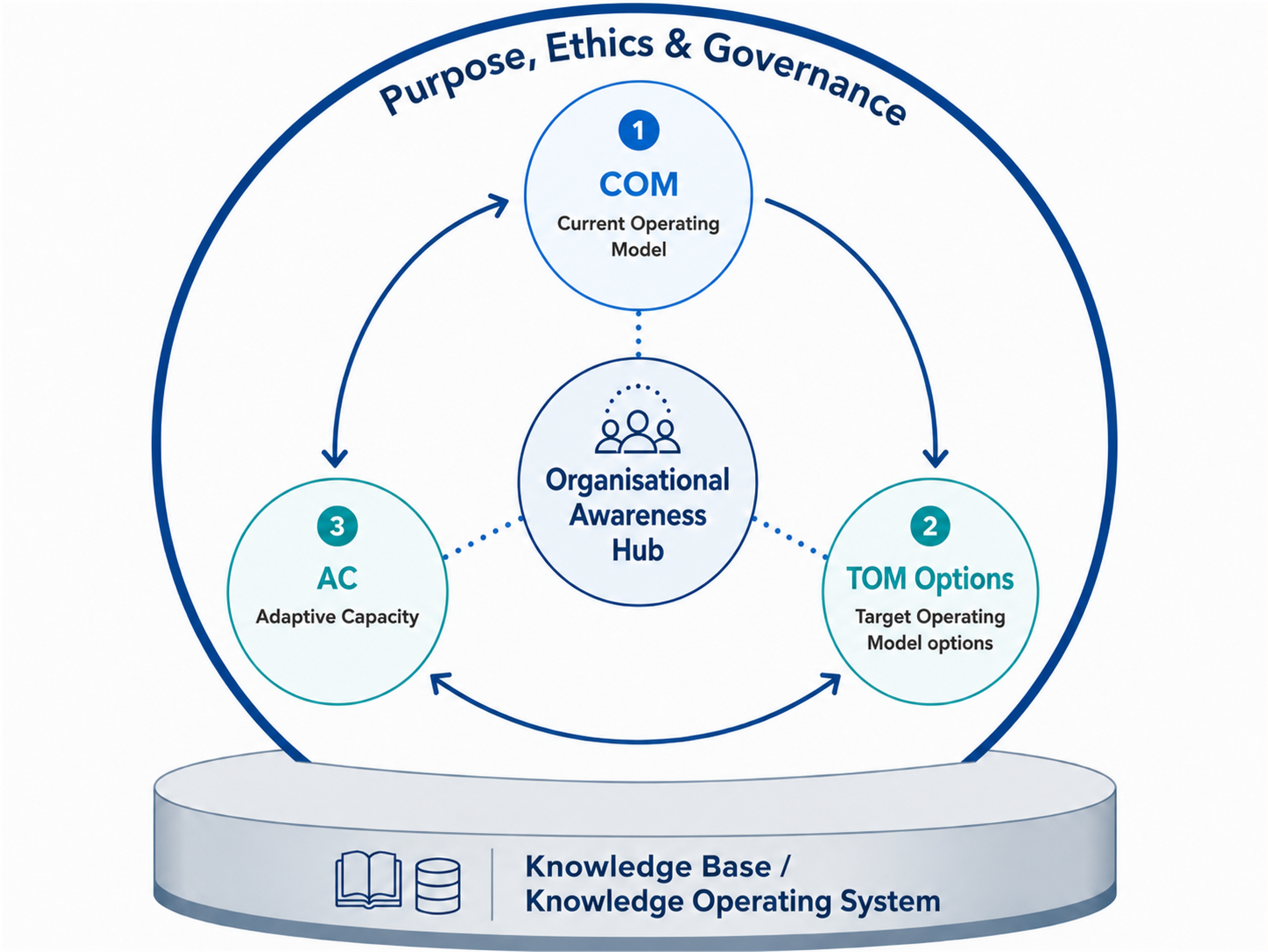
Figure 2: The Adaptive Operating Model Cycle – COM, TOM options and Adaptive Capacity held within Purpose, Ethics and Governance, supported by the Knowledge Base and Knowledge Operating System.
Current Operating Model – where we actually are
The Current Operating Model is not where the policy manual, transformation roadmap or PowerPoint says the organisation is. It is how the organisation actually works today.
It includes both formal design and lived reality:
- structures, capabilities, processes, roles, systems, data, governance, measures and decision rights,
- workarounds, unofficial spreadsheets and duplicated effort,
- the interfaces and integrations between systems, whether managed or unmanaged, electronic or manual,
- informal networks and local interpretations,
- slow, avoided or repeatedly escalated decisions,
- unclear accountability and hidden dependencies,
- trust gaps and relationships that quietly hold coordination together,
- tacit knowledge held by particular people,
- and differences between official design and actual practice.
The COM is not merely a description. It is a diagnosis of the assumptions, compensations, tensions and relationships that currently enable the organisation to function.
The brilliant people trap
A weak Operating Model can survive for years because brilliant people remember what the process forgot, translate unclear intent, patch system gaps, maintain unofficial spreadsheets, negotiate across boundaries and know which rule cannot be followed literally.
They:
- remember what the process forgot,
- know who to call,
- translate the policy into something workable,
- interpret ambiguous data,
- protect customers from design failure,
- intervene before the consequences of a broken process cause harm,
- and know what will break if the official model is followed exactly.
The organisation may appear capable, but it is borrowing capability from the abilities, memory, judgement and relationships of particular people. When those people leave, withdraw, burn out or are removed during transformation, the organisation discovers that what it thought was process was actually memory, what it thought was governance was personal judgement, and what it called resilience was exhaustion.
The Operating Model becomes visible not only in the diagram, but in the strain required to keep it working.
Target Operating Model options – hypotheses, not destinations
A Target Operating Model is not the future. It is a possible future configuration built on explicit assumptions. In complexity, there should rarely be only one option.
Different options may favour:
- standardisation or local responsiveness,
- centralised governance or distributed decision-making,
- functional structures, product-aligned teams or capability platforms,
- internal delivery, partnerships or ecosystems,
- automation, augmentation or human-led judgement supported by AI.
Each option contains assumptions about people, trust, knowledge, data, systems, decision-making, capability, stakeholder behaviour and environmental conditions. The design question is not which option looks cleanest. It is which option remains coherent, ethical, learnable and adaptive across the futures the organisation may face.
Scenario planning and assumption maps
A good design process makes assumptions visible and asks:
- What must be true for this model to work?
- How would we know that an assumption is failing?
- Where would the weak signal appear first?
- Who would notice?
- How would the signal reach decision-makers without losing context?
- What would we change if the assumption failed?
Scenario Planning tests TOM options against plausible future conditions. It reveals whether an option depends on stable demand, reliable data, available capability, continuing trust, tolerant regulators, resilient suppliers or informal networks that may not survive the change.
COM reveals the assumptions the organisation is already living on. TOM options reveal the assumptions it is proposing to bet on.
Adaptive Capacity – the test of the model
Adaptive Capacity is not a third target state. It is the organisation’s growing ability to sense reality, coordinate work, apply knowledge, exercise judgement, learn from consequences and adjust coherently.
The relevant test is not simply whether the TOM was implemented. It is whether the organisation became:
- more capable,
- more aware,
- more trustworthy,
- less dependent on hidden workarounds and heroic effort,
- better able to protect and regenerate the capitals on which it depends,
- and more able to learn without losing purpose, coherence or judgement.
Once an option is implemented, it becomes part of the new Current Operating Model. The cycle continues. There is no final operating model, only a continuing capacity to understand, design, test and renew how the organisation works.
Organisational Awareness Keeps the Model Connected to Reality
An Operating Model is not complete when it is approved. It requires continuing observation. Organisational Awareness is the sensing capability that keeps the model in dialogue with reality.
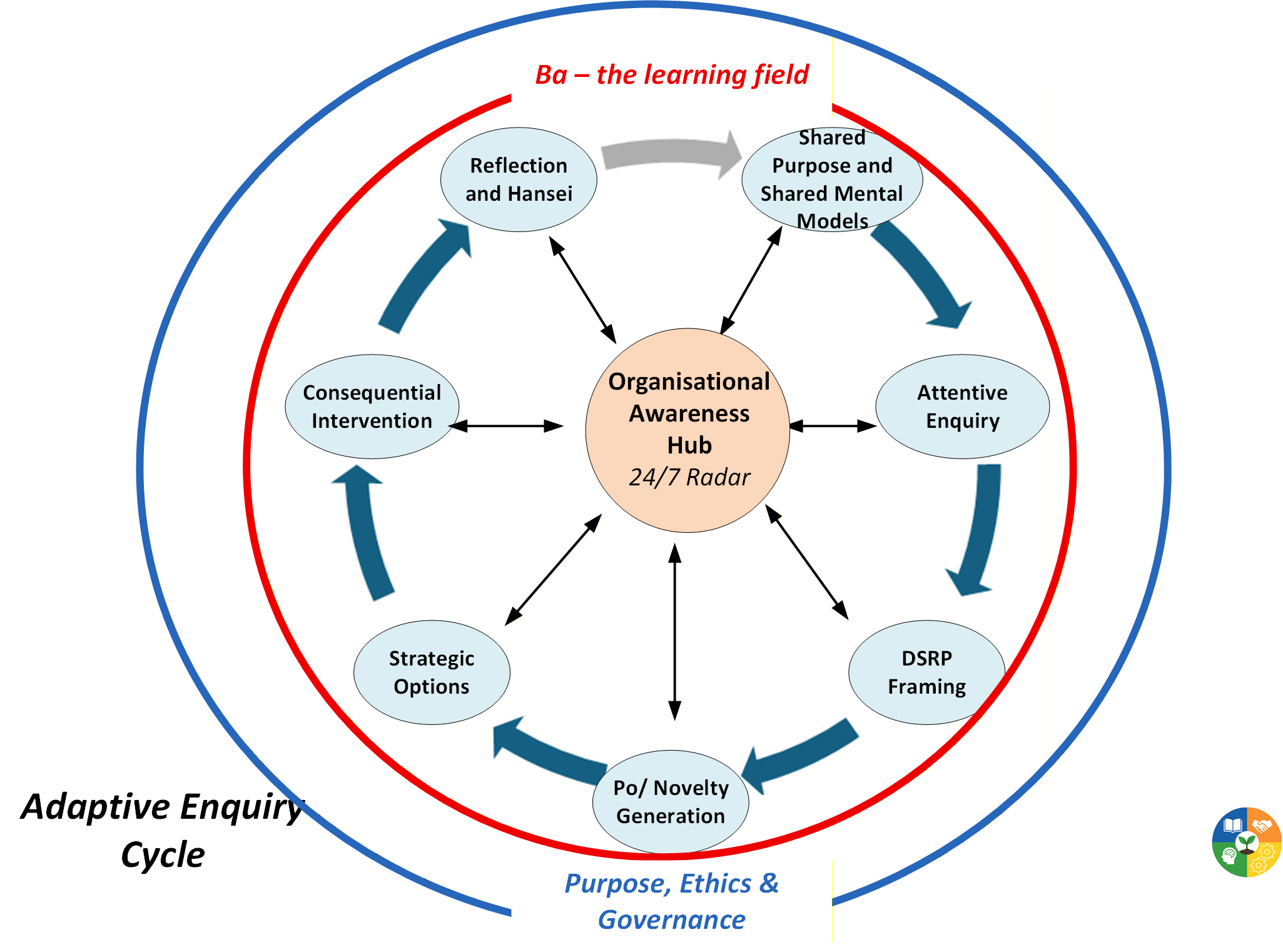
Figure 2: The Adaptive Enquiry Cycle — the Organisational Awareness Hub connecting attention, sensemaking, intervention and reflection.
In Figure 2, the Organisational Awareness Hub is at the centre of the Adaptive Enquiry Cycle, connecting:
- shared purpose and shared mental models,
- attentive enquiry,
- DSRP framing,
- possibility and novelty generation,
- strategic options,
- consequential intervention,
- and reflection and Hansei.
Signals arise from:
- people at Gemba,
- customers, employees, suppliers, communities and regulators,
- operational systems and internal and external data,
- complaints, compliments and near misses,
- process friction, decision delays and workload stress,
- changes in trust, participation and tacit contribution,
- weak-signal observations and environmental scanning,
- unintended consequences and transformation activity,
- and AI-supported research and pattern detection.
No single observer sees the whole field. The Organisational Awareness Hub connects partial perspectives, preserves their context, highlights contradictions, identifies missing viewpoints, and redirects attention when reality demands it.
The Hub continually asks:
- Are the assumptions still holding?
- Where is reality pushing back?
- Where are people compensating for weak design?
- Where are capitals being depleted?
- Where is the dominant value logic contradicting declared purpose?
- What requires a small adjustment, a different TOM option, or a new cycle of redesign?
Organisational Awareness is not merely reporting, dashboarding or feedback collection. It is the disciplined capability to select a limited number of high-quality, diverse and consequential signals, hold attention on them long enough to understand their meaning, and integrate what is learned into the wider system.
The Knowledge Operating System Keeps Architecture Alive
The Knowledge Base is not the Knowledge Operating System. The Knowledge Base preserves explicit organisational memory. The Knowledge Operating System is the wider socio-technical ecology through which that knowledge is developed, interpreted, socialised, used, challenged, governed and renewed.
Figure 3: The KOS Learning Cycle – experience, Hansei, understanding, hypothesis, intervention and consequence operating within Ba and the boundaries of Purpose, Ethics and Governance.
The KOS brings together:
- the Knowledge Base and Enterprise Architecture,
- Human Capital – skill, experience, judgement, craft and practical wisdom,
- Social Capital – trust, relationships, shared purpose, common language and willingness to contribute,
- Ba, communities of practice and Islands of Coherence,
- shared mental models and dialogue,
- Organisational Awareness and attention stewardship,
- Gemba, feedback, consequence and Hansei,
- technology and artificial intelligence,
- and governance, ownership and stewardship.
The Knowledge Base provides a stable point of reference. Human Capital gives people the capacity to understand and use it. Social Capital enables knowledge, meaning and experience to move across the organisation. Without this connection, a model can remain stored. At the same time, its meaning is lost. A procedure can remain approved even after its assumptions fail, and a glossary can remain accessible while different groups silently use the same words in different ways.
The KOS Learning Cycle shows how the Operating Model remains learnable. Experience is examined through Hansei. Understanding deepens. Hypotheses are formed and translated into interventions. Consequences generate new experience. Purpose gives direction, ethics establishes boundaries, and governance makes the use of knowledge answerable to principles and consequences.
The Knowledge Base holds the map. The Knowledge Operating System keeps the map in relationship with people, practice and reality.
Gemba Tests the Architecture and the Operating Model
Architecture belongs at Gemba – the place where reality teaches and learning becomes unavoidable. A model may seem coherent in a repository or governance forum yet still fail in practice.
At Gemba:
- roles may not match the actual task,
- information may not be available when required,
- decision rights may be unclear,
- processes may depend on unofficial workarounds and brilliant people acting as the organisation’s human integration layer,
- measures may drive harmful behaviour,
- exceptions may be more common than the model assumes,
- AI may generate plausible outputs that still require human judgement,
- and trust may be carrying coordination that formal design does not recognise.
This is not embarrassment. It is learning. Gemba exposes the gap between the model and lived reality, allowing the model to be corrected.
The model goes to Gemba. Gemba challenges the model. Hansei reflects. The organisation adjusts.
Architecture becomes workwear when people can use it at the point of work to understand capability, improve handoffs, clarify data meaning, locate decision rights, anticipate consequences, and redesign their practice. If it is only referenced by specialists and governance forums, it remains shelfware.
Governance, Ownership and Stewardship
Purpose, Ethics and Governance form the outer container of the Operating Model. Purpose gives direction. Ethics defines boundaries. Governance makes power answerable to purpose, ethics and consequences.
Governance is not the iron fist of compliance. It provides the principles, ownership, decision rights, escalation paths and review mechanisms needed to keep the Operating Model aligned with reality and accountable for its consequences.
Governance Owner
The Governance Owner is accountable for keeping the governance system visible, coherent, relevant, effective and aligned with purpose, ethics, reality and consequence. This role ensures that governance principles, forums, decision rights, stewardship arrangements and review processes continue to work together.
Capability Owners
Capability Owners maintain the whole-of-capability view across functions, processes, systems, information, roles and organisational boundaries. They protect the organisation from local optimisation and make capability dependencies, risks and consequences visible to decision-makers.
Data Owners and Data Stewards
Data Owners are accountable for the meaning, integrity, quality, access, protection, lifecycle and fitness of data for every downstream use. Data Stewards maintain that integrity in day-to-day practice within the capabilities where data is created and used.
Architecture Stewards
Enterprise Architects, Business Architects, Solution Architects, designers and planners act as Architecture Stewards. Their role is not to own the organisation’s models on behalf of the business, but to teach, mentor, facilitate, preserve coherence, clarify dependencies and help the business maintain its own shared organisational knowledge.
Stewardship is not the maintenance of documents. It is the care of organisational meaning over time.
Human and Social Capital
Adaptive Capacity depends on both Human Capital and Social Capital. The Operating Model configures both.
- Human Capital includes knowledge, skill, experience, judgement, expertise and craft.
- Social Capital includes trust, relationships, shared understanding, psychological safety, informal coordination and willingness to contribute.
Organisations can hire skills and contract expertise, but they cannot simply purchase trust, shared history, psychological safety or the willingness to contribute judgement under uncertainty. A model that ignores Social Capital may appear efficient while becoming brittle.
The brilliant people trap often reveals a hidden dependence on both capitals. Experienced people supply judgement and memory, while relationships enable coordination that the formal model does not provide. Removing them without understanding what they carry creates transformation debt.
Mindsets Shape the Model in Practice
While structures and governance are important, they do not dictate how people confront uncertainty. Mindsets influence what becomes aware, how information is interpreted, whether dissent prompts inquiry or threat, and the scope of considering consequences.
The central approach is the Scout Mindset: aim for the most accurate understanding of reality instead of defending a preferred view. Maintain curiosity, humility, and flexibility to shift focus or change course when trustworthy information, evolving circumstances, or consequences demand it.
A limited, defensive mindset can transform architecture into a display of certainty: polished diagrams, fixed target states, and confident plans that uphold the official narrative. Conversely, a broader, contextual mindset views models as provisional tools that need to reconnect with the whole, incorporate diverse perspectives, and be corrected by reality.
AI, Human Judgement and Kanban Architecture
Artificial intelligence emphasises the importance of Enterprise Architecture rather than diminishing it. AI demands a well-defined purpose, governed knowledge, shared definitions, reliable data, understood processes, transparent decision rights, and accountable human judgment.
AI can assist with:
- environmental scanning, research and synthesis,
- candidate Business Capability Models and Common Data Models,
- classification, retrieval and glossary development,
- scenario exploration and assumption testing,
- identification of relationships, contradictions and weak signals,
- red teaming and Socratic questioning,
- and translation of governed knowledge into useful working views at Gemba.
This framework supports Kanban Architecture by enabling individuals to access the necessary architectural knowledge precisely when and how they need it. AI can serve functions such as an apprentice modeller, research assistant, pattern detector, translator, and conversational interface to the governed Knowledge Base.
However, AI does not have organisational awareness, accountability, ownership of business data, understanding of relational contexts, or the ability to determine organizational actions. Additionally, it can generate convincing but false coherence, reinforce outdated knowledge, mask uncertainties through fluent language, and automate existing dysfunctions.
AI changes tasks. Architecture must redesign the work. Human beings remain accountable for meaning, judgement and consequence.
Changing the Operating Model Is a Consequential Intervention
Changing an Operating Model is not a neutral design exercise. It redistributes authority, workload, visibility, risk, knowledge, value and consequence.
Every significant design should therefore ask:
- Who decides?
- Who owns the risk and the data?
- Who carries the workload?
- Who gains or loses influence and visibility?
- What knowledge matters, and what knowledge may disappear?
- What work is automated or transferred?
- What relationships are strengthened or weakened?
- What will customers, employees, suppliers and communities experience?
- What measures will shape behaviour?
- What will people conclude the organisation truly values?
A TOM that enhances efficiency, but harms trust might diminish Adaptive Capacity. Centralized control models that silence local insights could lower awareness. Removing experienced personnel without retaining tacit knowledge may lead to transformation debt. An aesthetically pleasing model that can’t be implemented on the ground is essentially architectural theatre. The true measure isn’t whether the model appears coherent, but whether it makes the organisation more capable, aware, trustworthy, and receptive to learning.
Operating Model Coherence
A sustainable and adaptive Operating Model is not created by adding isolated digital, agile, AI or sustainability components. Purpose, governance, value logic, capabilities, processes, information, technology, measures, incentives, decision rights and stakeholder relationships must support one another.
Without coherence, the old model absorbs the new initiative:
- sustainability becomes marketing,
- agility becomes faster delivery into the same constraints,
- AI automates existing dysfunction,
- stakeholder engagement becomes consultation theatre,
- data governance becomes technical administration without ownership,
- and regeneration is abandoned when short-term margins tighten.
Mindset may initiate transformation, but the Operating Model determines whether the new mindset survives contact with organisational reality.
Common Failure Patterns
| Shelfware | Models are approved and stored but are not used, challenged or updated at Gemba. |
| Validation theatre | People are invited to endorse models they did not meaningfully shape or test. |
| Attention capture | Urgency, meetings, metrics and reporting consume the capacity needed to notice change. |
| Semantic fragmentation | Functions and systems use the same terms differently, or different terms for the same thing. |
| Key-person dependence | Critical capability rests on a small number of experienced people and informal relationships. |
| Tacit withdrawal and withholding | People retain important knowledge because speaking feels unsafe, futile or unwelcome. |
| AI certainty | Fluent output is mistaken for verified knowledge, shared understanding or responsible judgement. |
| Local optimisation | Functions improve their own performance while weakening the end-to-end capability or value stream. |
| Capital liquidation | Financial performance is created by consuming trust, knowledge, people, resilience or ecological capacity. |
Practical Enterprise Architecture and Operating Model Questions
Purpose and ethics
- What purpose must this model serve?
- What ethical boundaries and non-negotiable limits must shape it?
- What common good is the organisation expected to protect or contribute to?
Stakeholders and value
- Who experiences value, cost, risk and consequence?
- What does each affected stakeholder regard as success?
- How are value creation, delivery and capture connected?
Capability
- What must the organisation be able to do?
- Which capabilities must be protected, built, strengthened, regenerated or retired?
- Who owns the capability as a whole?
Work and value streams
- How does work actually happen?
- Where do formal processes differ from lived practice?
- Where are value, time, information or trust delayed, degraded or lost?
Information and systems
- What data and shared meaning are required?
- Where do ambiguity, duplication and poor integrity create risk?
- Which sources are authoritative, and who is accountable for their fitness?
- What does technology enable or constrain?
Decision and governance
- Who may decide, and within what boundaries?
- What trustworthy information and informed judgement are required?
- When is escalation necessary?
- How will drift, symbolic compliance and tacit withholding be detected?
Attention and learning
- What receives sustained attention?
- What realities, perspectives and consequences remain outside the frame?
- Which assumptions are being monitored?
- How will Gemba, feedback, consequence and Hansei change the model?
Connection to Adaptive Capacity
Within the Adaptive Capacity architecture:
- Purpose and Ethics provide direction and boundary.
- Governance makes power answerable to purpose, principles and consequence.
- Mindsets shape how reality is attended to and interpreted.
- Enterprise Architecture provides the shared map.
- The Knowledge Base preserves relatively stable organisational memory.
- The Current Operating Model describes how the organisation actually works.
- Scenario Planning explores possible future conditions.
- Target Operating Model options propose alternative configurations.
- Organisational Awareness monitors assumptions, attention, weak signals and consequences.
- The Knowledge Operating System keeps knowledge connected to people and practice.
- Gemba tests the model against lived reality.
- Hansei converts consequence into learning.
- Dialogue and sensemaking help people interpret what reality is teaching.
- Adaptive Capacity grows when the organisation can keep adjusting how it works without losing coherence, trust, purpose or judgement.
Core Insight
Enterprise Architecture is the shared organisational map. The Operating Model is the living configuration through which purpose, attention, value, capability, governance and consequence become everyday reality.
The Knowledge Base provides continuity. The Operating Model provides the adaptive superstructure. Organisational Awareness watches the assumptions. Gemba tests the design. Consequence teaches. Hansei turns experience into learning. Governance holds the whole system answerable to purpose and ethics.
The Operating Model is not a static design or a plank over the chasm. Done properly, Enterprise Architecture and Operating Model design become part of the bridge: from fragmented activity to coherent action, from shelfware to workwear, and from intention to a living capacity to adapt.
Connections Across the Pathway Knowledge Base
Related Source Notes
- Enterprise Architecture – The Language of Business Design
- Business Capability Modelling – Beyond Organisational Charts and Process Maps
- Common Data Models and Organisational Meaning
- Knowledge Operating System
- Information Quality is Not Binary – It Is Interpreted
- Activity Based Costing
- Line of Sight
- Gemba – Where Learning Becomes Real
- Gemba Tests Everything
- Hansei – Reflection That Forces Correction
- Consequential Intervention
- Accountability Is Structural
- When Compliance Replaces Judgement
- AI, Judgement and Organisational Learning
- How AI amplifies ethical failure – and why learning design matters
Related Subject Areas
- Governance
- Knowledge Operating System
- Organisational Awareness
- Mindsets
- Organisational Learning Ecosystem
- AI, Human Collaboration and Dialogue Design
References
Buchanan, A., & Kern, M. L. (2017). The benefit mindset: The psychology of contribution and everyday leadership. International Journal of Wellbeing, 7(1), 1-11.
Csikszentmihalyi, M. (2014). Attention and the holistic approach to behaviour. In Flow and the foundations of positive psychology. Springer.
DAMA International. (2017). DAMA-DMBOK: Data Management Body of Knowledge (2nd ed.). Technics Publications.
Galef, J. (2021). The Scout Mindset: Why Some People See Things Clearly and Others Don’t. Portfolio.
Gossen, M., Pakizer, K., Kropfeld, M., & Bocken, N. (2026). Towards strong sustainability: Exploring reconfigurations of sufficiency-oriented and regenerative business models. Business Strategy and the Environment.
International Organization for Standardization. (2021). ISO 37000:2021 Governance of organizations – Guidance.
McGilchrist, I. (2010). Reciprocal organization of the cerebral hemispheres. Dialogues in Clinical Neuroscience, 12(4), 503-515.
Ocasio, W. (1997). Towards an attention-based view of the firm. Strategic Management Journal, 18(S1), 187-206.
Ocasio, W., Yakis-Douglas, B., Boynton, D., Laamanen, T., Rerup, C., Vaara, E., & Whittington, R. (2023). It’s a different world: A dialog on the attention-based view in a post-Chandlerian world. Journal of Management Inquiry, 32(2), 107-119.
Sajjad, A., Eweje, G., & Raziq, M. M. (2024). Sustainability leadership: An integrative review and conceptual synthesis. Business Strategy and the Environment, 33, 2849-2867.
Senge, P. M. (1990). The Fifth Discipline: The Art and Practice of the Learning Organization. Doubleday.
Snowden, D. J., & Boone, M. E. (2007). A leader’s framework for decision making. Harvard Business Review, 85(11), 68-76.
Spezio, M. L. (2019). McGilchrist and hemisphere lateralization: A neuroscientific and metaanalytic assessment. Religion, Brain & Behavior, 9(4), 387-399.
Csikszentmihalyi, M., Abuhamdeh, S., & Nakamura, J. (2014). Flow. Flow and the foundations of positive psychology: The collected works of Mihaly Csikszentmihalyi, 227–238.