Organisations do not adapt because they possess more information.
They adapt because they maintain a continuous dialogue with reality.
Organisational Awareness refers to an organisation’s ability to continuously sense, interpret, understand, respond to, and learn from a changing environment. It helps the organisation remain connected to reality rather than becoming trapped inside assumptions, reports, internal narratives, or inherited ways of seeing.
From an organisational ecology perspective, Organisational Awareness is not merely a reporting task, management procedure, workshop, or feedback mechanism. It is a dynamic organisational ability that brings together attention, dialogue, judgement, learning, and adaptation.
Organisational Awareness begins with mindset. An organisation must be willing to see reality before it can design mechanisms to sense it. That willingness is shaped by purpose and ethics. Purpose provides the motivation for attention: why this reality matters. Ethics provides the boundary for attention and action: what consequences must not be ignored and what options are not permissible. Mindset then shapes behaviour: whether people are open, defensive, curious, fearful, extractive, or responsible in the way they engage with reality. Organisational Awareness is the capability that turns this orientation into designed attention, interpretation, action, consequence, reflection, and learning.
Ultimately, Organisational Awareness is the cultivated capacity to enter reality deeply enough that the organisation itself can be transformed by what it encounters.
Two failures of awareness
Organisations can lose awareness even when leaders genuinely believe they are listening. Two frequent pitfalls are wilful blindness and selective deafness.
Wilful blindness involves unconsciously ignoring evidence that challenges the preferred narrative, as acknowledging it might require action, responsibility, or cause discomfort.
Selective deafness occurs when only messages that align with the dominant story are heard, while warnings, concerns, and signals are overlooked.
Both issues can exist within leaders who truly see themselves as open and responsive.
That is why organisational awareness can’t rely solely on executive listening. It must be embedded through feedback loops, Gemba walks, psychological safety, trusted escalation channels, data integrity, weak-signal detection, dialogue, reviewing consequences, and questioning what current plans might be hiding.
Leaders may listen and still not hear. They may look and still not see. Organisational Awareness requires more than good intentions; it needs a sensing system.
Why Organisational Awareness Matters
Every organisation receives constant signals from both its internal and external environment.
- Customers change their behaviour as they are impacted by their changing environment and as they respond to an ongoing barrage of information.
- Employees notice emerging tensions as they sense changes in their colleagues and the organisation.
- Competitors introduce new products and services to catch the eye of customers.
- Technology continually evolves in a way that causes shifts in the business environment. Each evolutionary step demands a response.
- Communities respond to their broader social, political, and natural environments. And, like everyone else, the constant barrage of information.
- Regulation shifts as governments and regulatory bodies attempt to keep abreast of the changes.
- New innovations and ideas enter the space that may offer different paradigms in the way we work and live.
Many of these shifts are heralded by weak signals that begin to emerge long before major problems or opportunities become obvious.
The challenge is rarely the absence of information. It’s more likely the overload that comes with it and the need to constantly distinguish fact from fiction.
The challenge is whether the organisation notices these signals, interprets them wisely, evaluates its assumptions, and responds before reality forces change upon it.
Organisations often fail not because reality was hidden, but because they stopped looking and listening.
Organisational Awareness Design Defined
The deliberate design of physical, social, informational, technological and governance mechanisms that increase the organisation’s ability to detect meaningful shifts in patterns before they become major events.
Organisational Awareness is a Capability
Organisational Awareness sits above individual learning techniques. It coordinates how the organisation observes, interprets, questions, learns and adapts.
L1 Capability — Organisational Awareness Monitoring
Organisational Awareness Monitoring is the capability by which an organisation deliberately designs, observes, interprets, and responds to early signals indicating that a system may be shifting from one pattern of behaviour to another.
It supports the wider Organisational Awareness of the Ba/Basho social field by making significant changes visible earlier, connecting weak signals into emerging patterns, enabling scenario dialogue, and supporting small, ethical consequential interventions before problems harden into more damaging states.
It is not merely reporting, dashboarding, risk monitoring, or feedback collection. Those are mechanisms within the capability.
Its purpose is to help the organisation continually ask:
- What is normal?
- What is changing?
- What pattern may be emerging?
- What future state might this suggest?
- What small intervention could evaluate our understanding?
- What did reality teach us?
Capability Intent
Organisational Awareness exists to increase the organisation’s ability to:
- Detect weak signals earlier and improve the identification of subtle indicators.
- Recognise shifts in patterns rather than isolated events to observe broader trends.
- Distinguish normal variation from emerging drift for more accurate assessments.
- Understand potential future states to anticipate changes.
- Design early interventions that address significant consequences.
- Learn from outcomes to refine strategies.
- Update the organisation’s understanding of reality based on new insights.
It turns awareness from an accidental by-product of good people into an intentionally designed organisational capability.
Level 2 Capabilities
L2.1 Awareness Design
The deliberate design of physical, social, technological, informational and governance conditions that make important signals visible earlier.
Examples:
- Painting machines to detect oil leaks to predict potential failure.
- Meeting check-ins and check-outs to gain direct feedback on their appropriateness and effectiveness. Anything to avoid having pointless meetings that waste precious time and resources and distract people from productive, valued work.
- Gemba walks with eyes and ears engaged, looking for opportunities to improve and to avoid waste and potential problems.
- Sensor placement to detect anomalies in operational assets.
- Complaint collection and analysis to capture customer, employee, and stakeholder issues before they escalate.
- Social network monitoring to detect shifts in attitudes, values, and perceptions.
- Lifecycle event awareness so that people can be treated with empathy and understanding.
L2.2 Normal State Modelling
This is all about understanding what “healthy,” “normal,” “stable” and “coherent” patterns look like. It establishes a benchmark to compare against to evaluate for shifts.
Examples: normal repayment behaviour, normal participation, normal machine vibration, normal trust patterns, normal customer contact, normal project rhythm.
L2.3 Alternative State Modelling
Defining possible alternative states, the system may drift toward.
Examples: customer mortgage distress, employee tacit withdrawal, equipment failure, customer distrust, burnout, fraud, cyber compromise, social licence erosion.
L2.4 Feedback and Signal Monitoring
It monitors feedback signals received from structured and unstructured information. There are multiple types, including the well-known and common ones:
- Customer complaint.
- Customer compliment.
- Employee feedback.
- Community complaint.
- Regulator concern.
- Supplier issue.
- Near miss that avoided an accident.
- Audit observation.
- SCADA pattern shift.
- IoT anomaly.
- Social media sentiment.
- Informal network signal.
This is where the Activity-Based Costing (ABC) analogy is strong. Just as ABC made cost behaviour visible through activity types and cost drivers, Organisational Awareness makes reality visible through feedback types, signal sources, pattern shifts, and state-transition indicators.
L2.5 Pattern Recognition and Drift Detection
Emerging Pattern Detection refers to the ability to identify when several weak signals start forming a significant pattern. It enables organisations to differentiate between normal fluctuations and early indications that a customer, team, process, asset, or relationship might be changing. AI aids this process by spotting subtle signal combinations, while human judgment assesses their meaning, implications, and necessary responses.
This is where AI may become useful:
This repayment pattern, account reserve decline, and employment signal, coupled with rising interest rates, fuel costs, and AI-induced redundancies, may indicate an early shift toward financial distress.
or:
This silence in meetings, reduced informal participation, and the exit of an informal leader resemble early movement toward tacit withdrawal.
Caution: AI is useful where meaningful patterns can be detected from legitimate, non-threatening hard data. We put the second example in as something technologically possible, but there is a real danger when organisations manufacture data about social behaviour in order to make people machine-readable.
For formal bodies such as boards, councils or parliaments, attendance and attributed contributions may already be part of the legitimate record. In that context, AI could analyse change over time.
But in ordinary team life, creating equivalent data would require:
- formal attendance tracking for every interaction,
- attribution of every contribution,
- persistent recording;
- behavioural scoring,
- and some form of social surveillance.
This would dramatically change the social field being observed. People would become more guarded, less spontaneous and less willing to test half-formed ideas. The mechanism introduced to detect withdrawal would itself create withdrawal. People would continue to attend and contribute, but increasingly in ways designed to satisfy the monitoring system rather than reveal what they genuinely know, think or fear.
Before introducing automated monitoring, consider not only what the system will detect but also how monitoring will change behaviour, relationships, psychological safety and the quality of the information produced.
L2.6 Sensemaking and Scenario Dialogue
Turning signals into possible stories.
This includes narrative scenarios, Socratic questioning, DSRP framing, AI argumentation and collective judgement.
L2.7 Consequential Intervention
Designing small, early, ethical interventions before the system locks into the wrong attractor.
Examples: proactive hardship support, maintenance inspection, manager conversation, redesign of a meeting ritual, customer recovery action, fraud check, safety stop.
L2.8 Reflection and Integration
Learning from what happened and updating the organisation’s understanding of normal states, alternative states, signal quality, and intervention effectiveness.
Distributed Attention and Attention Stewardship
Attention is the finite psychic energy that enables people to select what enters consciousness, sustain engagement, interpret experience, and act. Because it is finite, an organisation cannot keep everyone continuously aware of everything. Organisational Awareness must distribute attention across the social field and then reconnect what is noticed into a coherent organisational understanding (Csikszentmihalyi, 2014).
Distributed Attention
Distributed attention involves multiple people, roles, technologies, relationships, and feedback mechanisms throughout the organisation and its broader ecosystem. Gemba staff focus on local work and spot emerging issues. Stakeholders like customers, communities, suppliers, and regulators observe impacts that often go unnoticed internally. Boundary-spanning roles link patterns across different functions. Data and technology enhance sensing capabilities, while the Awareness Hub integrates signals that no single observer could compile alone.
Distribution doesn’t imply fragmentation or random data collection. Each participant views from a specific position, with a partial perspective. Organisational Awareness arises when these partial insights are shared, connected, challenged, and interpreted collectively preserving their context.
A healthy distributed attention system therefore requires:
- Local autonomy to observe and escalate signals.
- Psychological safety and trusted channels for raising concerns.
- A variety of perspectives from both internal and external sources.
- Clearly defined interfaces for signals to travel through.
- Adequate context to maintain meaning.
- Shared forums for collective sensemaking.
Attention Stewardship
Attention stewardship involves intentionally managing the organisation’s limited mental resources by focusing on important issues. It understands that priorities, meetings, dashboards, targets, alerts, crises, and executive questions do more than share information—they shape what people pay attention to and what they overlook.
Attention stewardship does not control what people are allowed to see. Instead, its goal is to foster conditions where significant realities can be acknowledged without silencing dissent, new ideas, or inconvenient evidence. It safeguards both targeted attention, essential for effective action, and broad contextual awareness, crucial for identifying novelty, connections, subtle signals, and unexpected outcomes. These modes work together rather than as distinct organisational functions. (McGilchrist, 2010; Spezio, 2019).
Leaders, governance bodies, capability owners, stewards, and the Awareness Hub share responsibility for attention stewardship. Their task is to:
- make the current focus of organisational attention visible,
- protect people from unnecessary noise, interruption, and reporting burden,
- ensure that consequential signals are not crowded out by urgency or hierarchy,
- keep materially different interpretations alive long enough to be examined,
- notice which people, stakeholders, capitals, places, and time horizons are absent from attention,
- and redirect attention when evidence, changing circumstances, or consequences require it.
The danger is attention capture. A dominant operating model can consume most available psychic energy through constant urgency, targets, meetings, reporting, compliance activity, and crisis response. When maintaining the Current Operating Model consumes all available attention, little remains to notice that the model itself is failing.
The Awareness Hub therefore acts as an attention stewardship mechanism. It does not centralise all observation or attempt to monitor everything. It helps the organisation select, hold, connect, challenge, and redirect attention while preserving the distributed sensing capacity of the wider social field.
Attentional Discipline
Organisational Awareness depends on attention, but attention cannot be treated as an unlimited organisational resource.
Contemporary organisations operate within a constant flow of messages, meetings, alerts, dashboards, requests, opinions, and algorithmically selected information. Under these conditions, awareness can easily be mistaken for exposure. People may receive more information while understanding less.
The challenge is not to deal with everything. That is impossible.
The challenge is to select a small number of high-quality, diverse, and consequential signals and sustain attention on them long enough to examine their meaning.
The Attention-Based View describes this in terms of attentional quality (Ocasio et al., 2023).
In distributed and knowledge-based organisations, attention must be paid to:
- Stability — the capacity to sustain focus over time.
- Vividness — the capacity to preserve context and detail while retaining a broader view.
- Coherence — the capacity to connect diverse and potentially conflicting information into a meaningful whole.
Organisational Awareness therefore requires both discipline and agility.
Discipline is needed to resist distraction, avoid premature judgement, and remain with an issue long enough for patterns, assumptions, and consequences to become visible.
Agility is needed to redirect attention when stronger evidence emerges, assumptions fail, consequences differ from expectations, or the environment shifts.
Too little stability creates distraction and shallow reaction.
Too much stability creates fixation, tunnel vision, and strategic blindness.
The required capability is disciplined reorientation:
Hold attention long enough to understand reality, but not so rigidly that reality can no longer change the direction of attention.
The Organisational Awareness Hub supports this discipline by filtering rather than amplifying noise. It helps the organisation decide:
- Which signals deserve sustained attention?
- Why do they matter?
- What perspectives are missing?
- What evidence supports or contradicts the current interpretation?
- How long should the inquiry continue?
- What would justify changing the focus?
The Hub does not ask people to deal with everything continuously. It creates a governed process through which selected signals can be held, examined, challenged, and connected before action is taken.
The Organisational Awareness Cycle
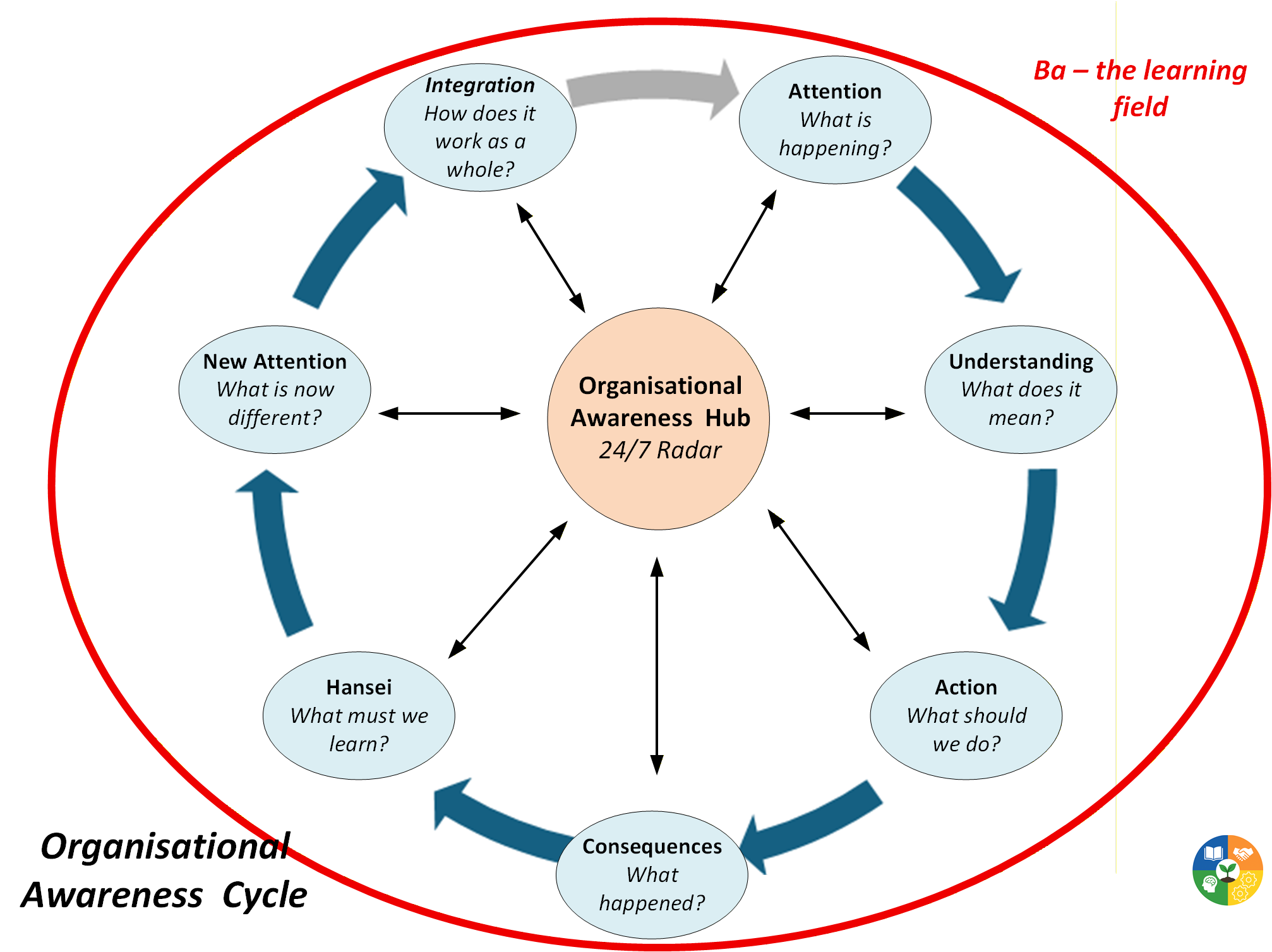
The Organisational Awareness Cycle provides a simple structure for maintaining continuous dialogue with reality. It sits inside Ba — the learning field — and is supported by the Organisational Awareness Hub, the organisation’s 24/7 radar.
Attention
What is happening?
The organisation observes its internal and external environment for signals, shifts, tensions, anomalies, weak signals, emerging patterns, and early impacts. At this stage, the goal is not to analyse immediately. Instead, it focuses on noticing, collecting, preserving, and highlighting what reality might be indicating.
Understanding
What does it mean?
Signals are interpreted through dialogue, shared mental models, multiple perspectives, data, Gemba evidence, stakeholder experience, and collective sensemaking. Understanding transforms these signals into meaningful insights. It involves asking what patterns might be emerging, which assumptions are being challenged, what risks or opportunities are arising, and what the organisation has yet to understand.
Action
What should we do?
The organisation determines its course of action, which could range from a minor intervention, an experiment, process change, priority shift, governance decision, customer response, risk management, or a comprehensive redesign. Any action taken should be meaningful, ethical, appropriately scaled, and aligned with the overall purpose.
Consequences
What happened?
The organisation monitors events based on whether action was taken or not. This encompasses intended results, unforeseen effects, stakeholder impacts, cost changes, trust levels, operational difficulties, data problems, risk shifts, and behavioural changes.
Hansei
What must we learn?
Hansei promotes disciplined reflection by prompting the organization to examine what was misunderstood, overlooked, or founded on faulty assumptions, along with what succeeded, caused harm, or needs change. This approach transforms consequences into opportunities for learning rather than assigning blame, making excuses, or engaging in performative acts.
New Attention
What is now different?
Following action and reflection, the organisation’s awareness evolves and does not revert to its previous state. It observes anew, guided by a transformed understanding. New Attention prompts questions about shifts in perception: what has changed, what is now visible, which weak signals have emerged, and what the organisation must focus on now.
Integration
How does it work as a whole?
Integration links learning to the broader system, allowing the organisation to update its mental models, knowledge, operating model, governance, capabilities, processes, data, systems, metrics, and working methods. This prevents learning from staying isolated, temporary, or confined to meetings. Instead, integration transforms awareness into Adaptive Capacity.
The Organisational Awareness Hub
At the centre of the cycle sits the Organisational Awareness Hub.
Its purpose is not simply to collect information or centralise attention.
Its purpose is to steward distributed attention and maintain a 24/7 dialogue with reality.
The Hub continuously integrates weak and strong signals emerging from:
- Feedback, both formal and informal, can flow from one node to one or more other nodes.
- Gemba is key; this is where reality continuously produces signals, both weak and strong.
- Customer observation, complaints, compliments, suggestions, reviews, etc.
- Employee feedback, comments, suggestions, and challenges.
- Data, both structured and unstructured, internal and external.
- Behavioural pattern shifts among stakeholders and personas of interest, sometimes strong, sometimes weak.
- Ethical tensions detected from stakeholders, including employees, customers, suppliers, and the broader public.
- Operational performance captured in information systems, collected, analysed, organised, tagged, and collated from structured and unstructured data.
- Strategic transformations as they take place and evolve.
- Environmental scanning across the business, social, and environmental ecosystems.
- AI-assisted environmental scanning, research, and analysis.
- AI dialogue to collect, collate and make sense of all of the above.
Rather than serving as a repository of information or a command centre for attention, the Hub functions as the organisation’s living attention-stewardship capability, continuously asking:
- What are we noticing?
- What might this mean?
- What assumptions are we making?
- What evidence supports them?
- What evidence contradicts them?
- What should we observe next?
Dialogue Rather Than Decision Support
Traditional decision support systems seek to provide answers.
Organisational Awareness seeks to improve the quality of organisational inquiry.
Human–AI collaboration therefore becomes a Dialogue Loop rather than a transaction.
AI contributes by:
- detecting weak signals,
- identifying emerging patterns,
- constructing alternative narratives,
- applying Socratic questioning,
- challenging assumptions,
- highlighting contradictory evidence,
- and supporting collective sensemaking.
People contribute:
- judgement,
- ethics,
- context,
- values,
- experience,
- responsibility,
- and stewardship.
Reality determines whether the organisation’s understanding proves correct.
Organisational Awareness and Adaptive Capacity
Adaptive organisations are distinguished not by perfect prediction, but by their capacity to remain continuously connected to reality as circumstances evolve.
Organisational Awareness strengthens:
- adaptive capacity,
- organisational learning,
- strategic thinking,
- innovation,
- resilience,
- governance,
- trust,
- knowledge creation,
- and long-term organisational coherence.
It transforms learning from an occasional activity into a continuous organisational capability.
Shared Mental Models, Trust, and Cooperation
The Organisational Awareness Cycle does more than help the organisation notice and respond to change. Each turn of the cycle also builds shared mental models, trust, and cooperation.
- Attention helps people notice reality together.
- Understanding helps them make sense of what is being noticed.
- Action tests shared judgement.
- Consequences reveal whether the organisation understood well enough.
- Hansei turns consequence into learning.
- New Attention changes what people are able to see next.
- Integration embeds that learning into the wider system.
Over time, repeated cycles of attention, understanding, action, consequence, reflection, and integration help build shared mental models: common ways of seeing the work, the system, the risks, the patterns, and the consequences.
This is where the cycle supports both SECI and DSRP. SECI helps knowledge move between tacit and explicit forms. DSRP helps people distinguish, connect, relate, and view situations from multiple perspectives. Together, they strengthen the organisation’s ability to learn with reality.
When this cycle is repeated honestly, people begin to trust the process. They see that signals are not ignored, difficult truths are not buried, action is evaluated against consequence, and learning is carried back into the organisation.
That trust supports cooperation.
As cooperation improves, people share more openly, challenge assumptions more safely, contribute knowledge more freely, and participate more actively in sensemaking. This strengthens shared mental models. Stronger shared mental models then improve cooperation further.
Trust and cooperation reinforce each other. As people cooperate, trust grows. As trust grows, people cooperate more. Over time, this strengthens shared mental models and builds Adaptive Capacity.
This creates a virtuous cycle:
- As people cooperate, trust grows.
- As trust grows, people cooperate more.
- As cooperation improves, shared mental models strengthen.
- As shared mental models strengthen, Adaptive Capacity grows.
But this cycle is not automatic.
When signals are ignored, unseen consequences accumulate. When reflection turns to blame, people stop sharing what they know. When leaders practise selective deafness, trust is eroded. The virtuous cycle can then reverse into a vicious one.
Instead of shared mental models, people retreat into siloed thinking. Instead of cooperation, they turn to patch protection: safeguarding their area, their reputation, their workaround, or their local version of reality.
That is why Organisational Awareness must be cultivated as a core capability rather than left to goodwill. It is the social and cognitive discipline that enables an organisation to keep learning from reality.
Universal Governance Principles Applied to Organisational Awareness
Organisational Awareness is grounded in the organisation’s Universal Governance Principles. These principles apply to everyone, across every capability, role, and organisational boundary. They are repeated here because staying connected to reality depends, especially on their consistent practice. Their standard form is maintained within the Governance Subject Area.
Overriding mindset: Scout Mindset
‘Seek the best available understanding of reality rather than defend a preferred position. Stay curious, humble, and ready to shift focus or change direction when evidence, changing circumstances, or consequences require it.’
Universal Principles
1. Reality First
Mindset: Acceptance of reality with humility.
Why: Good decisions depend on understanding reality, not protecting assumptions or preferred narratives.
What: Seek the best available understanding of what is actually happening.
Where: Across the organisation and its external environment.
When: Before, during and after significant decisions and actions.
Who: Everyone.
How: Stay connected to Gemba, affected stakeholders, trustworthy information, observable consequences, and informed judgement.
2. Shared Attention
Mindset: Striving for coherence while embracing individuality.
Why: Complex situations require sufficient shared attention for coordinated action.
What: Build shared attention around matters of consequence without suppressing disagreement or diverse perspectives.
Where: Across teams, functions, capabilities, leadership, and organisational boundaries.
When: Whenever priorities are established, reviewed, or challenged.
Who: Everyone, with leaders and stewards responsible for creating the conditions.
How: Select a limited number of high-quality and diverse signals, make the focus of attention visible, and protect inquiry from unnecessary distraction.
3. Pursue Knowledge of the Unknown
Mindset: Scout Mindset.
Why: Organisations survive by discovering what their current understanding does not yet explain.
What: Seek weak signals, contradictory evidence, emerging patterns, and gaps in the prevailing account of reality.
Where: Everywhere, particularly at Gemba and at the edges of the organisation.
When: Continuously, and especially when certainty appears unusually comfortable.
Who: Everyone.
How: Question the map, test assumptions, follow consequential anomalies and remain willing to change direction.
4. Embracing a Range of Perspectives
Mindset: Have the humility to accept that your view is not the whole view.
Why: No person, profession, function, or stakeholder sees the entire system.
What: Seek and integrate materially different perspectives before making consequential decisions.
Where: Within the organisation and among affected external stakeholders.
When: Before major commitments and whenever uncertainty, disagreement or potential harm is significant.
Who: Everyone, with decision-makers responsible for ensuring relevant voices are included.
How: Use dialogue to explore differences, reveal blind spots, and build sufficient shared understanding without forcing artificial consensus.
5. Speak the truth.
Mindset: Honesty and openness.
Why: Hidden problems grow, while silence allows false narratives and harmful conditions to persist.
What: Report reality honestly, raise concerns and refuse silent complicity.
Where: Wherever work is performed and consequences are experienced.
When: As soon as a material concern, contradiction or emerging harm becomes visible.
Who: Everyone.
How: Speak with honesty and respect, protect psychological safety, provide trusted escalation paths, and hold leaders accountable for listening and acting.
6. Learn and Adapt
Mindset: Stop, reflect, learn, and adapt.
Why: Without stopping, experience passes unexamined. Reflection turns consequences into learning, and learning sustains awareness and enables adaptation.
What: Reflect on outcomes and improve the organisation’s understanding, attention, and behaviour.
Where: Across every capability.
When: After significant events, decisions, actions, and changes.
Who: Everyone.
How: Use feedback, Hansei, dialogue and organisational learning to identify what happened, what was misunderstood and what must change.
Core Insight
Organisational Awareness is an organisation’s ability to remain consistently aligned with reality. Techniques such as feedback, Gemba, dialogue, Hansei, scenario planning, and AI-supported inquiry are not independent disciplines. Instead, they function as complementary tools that collectively help organisations to detect issues earlier, gain a deeper understanding, make smarter decisions, and adapt relentlessly.
Csikszentmihalyi, M. (2014). Flow and the foundations of positive psychology: The collected works of Mihaly Csikszentmihalyi. Springer.
Galef, J. (2021). The scout mindset: Why some people see things clearly and others don’t. Penguin.
McGilchrist, I. (2010). Reciprocal organization of the cerebral hemispheres. Dialogues in Clinical Neuroscience, 12(4), 503–515.
Ocasio, W., Yakis-Douglas, B., Boynton, D., Laamanen, T., Rerup, C., Vaara, E., & Whittington, R. (2023). It’s a different world: A dialog on the attention-based view in a post-chandlerian world. Journal of Management Inquiry, 32(2), 107–119.
Spezio, M. (2019). McGilchrist and hemisphere lateralization: A neuroscientific and metaanalytic assessment. Religion, Brain & Behavior, 9(4), 387–399.