SN — Prefabricated Architecture
From bespoke modelling to reusable, regenerative organisational knowledge.
- What it is
Prefabricated Architecture is an approach to developing organisational architecture from reusable, integrated models of established good practice, rather than repeatedly designing the same foundational structures from scratch.
These models provide a starting point for investigating an organisation, understanding its circumstances, and developing a coherent, connected Knowledge Base.
Prefabricated components may include:
- Business Capability Models (BCM), including L1, L2 and L3 capabilities.
- Business Objects and canonical Entity Types within a Common Data Model (CDM).
- Relationships, classifications, lifecycle states and business rules.
- Patterns of activities, processes, decisions and value creation.
- Definitions, constraints and governance requirements.
The components are maintained as governed, reusable architectural assets. They can be assembled, adapted and integrated using AI-assisted modelling, with XMI providing one means of exchanging structured models with repositories such as Sparx Enterprise Architect.
Prefabricated does not mean pre -validated for the organisation adopting it.
The assembled architecture remains candidate knowledge until tested against the organisation’s operational reality.
Organisations repeatedly invest time and resources rediscovering, modelling and documenting capabilities, information and relationships that are already reasonably well understood elsewhere. Much of this knowledge is subsequently lost, fragmented or rendered obsolete as organisations change.
Prefabricated Architecture offers a different starting point.
Instead of building each organisational architecture from scratch, it draws upon reusable, integrated models of established good practice. Guided by the Human–AI Knowledge Base (HAK) methodology and an investigation of the organisation’s purpose, stakeholders and operating environment, AI can rapidly assemble and adapt these components into a coherent candidate architecture.
But generation speed is not the measure of success.
The candidate architecture provides a foundation for informed enquiry, not a predetermined solution. Through Kanban Architecture, manageable portions of the model are brought to Gemba, where people examine their meaning, challenge assumptions, assess consequences and progressively develop validated organisational knowledge.
The objective is to eliminate needless reinvention while directing human effort towards understanding, learning and regenerating the organisation’s capabilities
- Why it matters
Traditional enterprise architecture is often commissioned as a bespoke, point-in-time exercise.
Specialists investigate familiar problems, reconstruct capabilities and information models, publish their findings, and move on. As the organisation changes, much of the knowledge becomes outdated, inaccessible or lost.
The next initiative repeats the exercise.
This creates several forms of waste:
- Repeated discovery and modelling of widely understood business concepts.
- Fragmented and incompatible descriptions of the same organisational reality.
- Dependence on specialist knowledge that may disappear when people leave.
- High costs of maintaining and reconciling architectural models.
- Limited organisational learning from successive transformation initiatives.
AI changes the economics of architecture development. It becomes possible to generate and integrate substantial candidate architectures rapidly.
Prefabrication extends that opportunity by reusing knowledge already developed and refined elsewhere.
The objective is to spend less effort rediscovering common structures and more effort understanding what makes an organisation and its circumstances different.
- How it works
Prefabricated Architecture operates through three complementary disciplines.
Prefabrication — Reuse established knowledge
An integrated collection of architectural components provides an initial foundation.
Components have defined meanings, relationships, boundaries, provenance and governance requirements. Assess their suitability against the organisation’s purpose, operating environment, and intended outcomes.
Human–AI Knowledge Base Development — Investigate and integrate.
Using the HAK guideline, AI helps people investigate the organisation and its operating environment, identify candidate stakeholders and outcomes, and develop a connected candidate architecture.
Select, adapt, combine, or challenge existing components as needed.
AI can identify missing relationships, conflicting definitions, inconsistencies and opportunities for reuse.
The resulting architecture is held in a governed repository where its elements and relationships can be traced and revised.
Kanban Architecture — Validate and regenerate
The candidate architecture is progressively brought into use through manageable Subject Areas, typically aligned with L3 capabilities.
Subject Areas are pulled into Gemba according to business need, where people with relevant knowledge and experience test their meaning, relationships, assumptions and consequences.
Validated findings update the shared Knowledge Base. Changes may also trigger review of connected components and reusable patterns.
Generate holistically. Validate by pull. Learn continuously.
- What it is not
Prefabricated Architecture is not:
- A collection of templates to be imposed on every organisation.
- An industry reference model assumed to be correct because it is widely used.
- A substitute for stakeholder engagement or contextual investigation.
- A mechanism for automating architectural decisions without human accountability.
- A completed operating model ready for implementation.
Common patterns provide useful hypotheses, not universal truths.
Two organisations may share similar capabilities while differing fundamentally in purpose, relationships, operating arrangements, stakeholder consequences and constraints.
Reuse provides a starting point. It does not determine the destination.
5. Prefabricated and Kanban Architecture in Practice
The following illustration shows how reusable architectural knowledge can be transformed into an organisation-specific, progressively validated Knowledge Base.
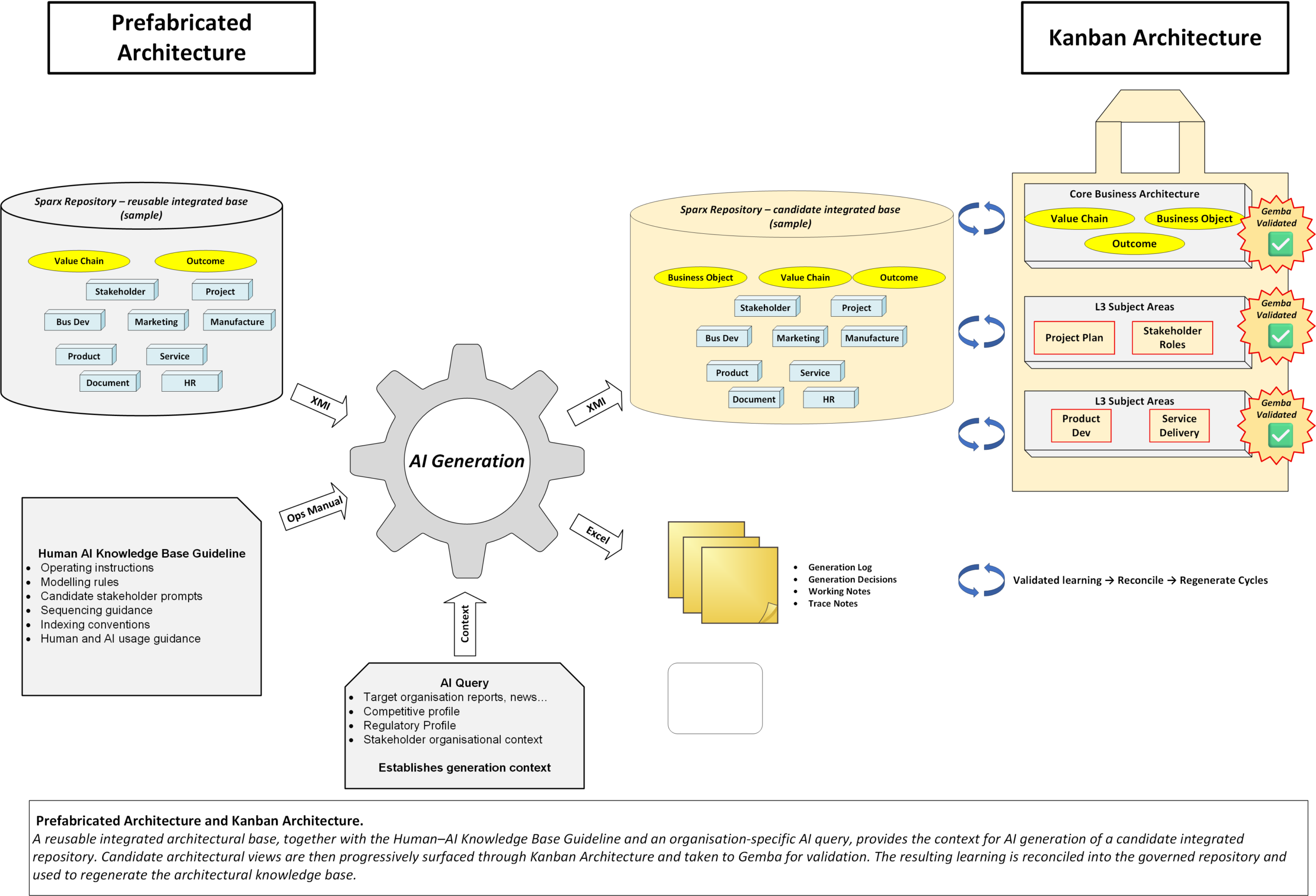
On the left, Prefabricated Architecture provides an integrated base of reusable models, supported by the HAK Guideline and an AI query establishing the organisational context. AI develops a candidate integrated architecture, retaining generation decisions and supporting notes.
On the right, Kanban Architecture progressively brings the core architecture and manageable L3 Subject Areas into Gemba for human examination and validation.
The resulting learning is reconciled with the governed repository, and affected architectural knowledge is regenerated. The process continues as new needs, evidence and circumstances emerge.
Prefabrication accelerates generation. Kanban governs validation. Together they enable continuous organisational learning and regeneration.
- Governance and regeneration
Reusable architectural components need explicit governance.
Each component should retain its identity, definition, provenance, version, relationships and validation status. Ownership and decision rights must be clear, and changes should not silently compromise semantic integrity.
The distinction between established reusable knowledge and locally validated organisational knowledge must be preserved.
When operational experience reveals a better understanding, the organisation revises its Knowledge Base. Where appropriate, that learning may also inform improvements to the reusable component itself.
This creates the possibility of a shared, continuously improving architectural commons: an ecosystem of reusable knowledge developed through contribution, stewardship and responsible use.
Such a commons would require agreed standards, semantic interfaces, governance and ethics. Open participation alone would not guarantee integrity.
- The bigger picture
Prefabricated Architecture, HAK and Kanban Architecture provide a complementary approach to organisational knowledge development:
Prefabricated Architecture — reuse integrated knowledge rather than repeatedly reinventing it.
Human–AI Knowledge Base Development — investigate, assemble, adapt and connect candidate organisational knowledge.
Kanban Architecture — progressively validate, learn, apply and regenerate that knowledge through engagement at Gemba.
Together, they shift architecture from a succession of bespoke projects towards an enduring organisational capability for learning and adaptation.
The objective is not faster production of architectural diagrams.
It is to develop shared organisational knowledge that stakeholders can understand, challenge, use, and continually regenerate in service of the common good.
Related
- Human–AI Knowledge Base Development
- Kanban Architecture
- Business Capability Model
- Common Data Model
- Knowledge Operating System
- Gemba
- Purpose, Ethics and Governance
For a glimpse at the repository see.
Using the Human–AI Knowledge Base Tool: A NaturFlourish Example
Origin: Developed as part of the Prefabricated + Kanban Architecture proposition presented in Human–AI Data Modelling and Kanban Architecture, DAMA, 2026.