Understanding how organisations learn, adapt, and fail over time
Organisations are often treated as engineered systems.
In practice, they behave more like living systems.
They adapt—or fail to adapt—depending on how learning, relationships, structure, and action interact over time.
Organisational Ecology offers a way to understand this dynamic.
The Primary Flow
At its simplest, organisations function through a continuous flow:
Purpose → Field → Learning → Structure → Adaptation
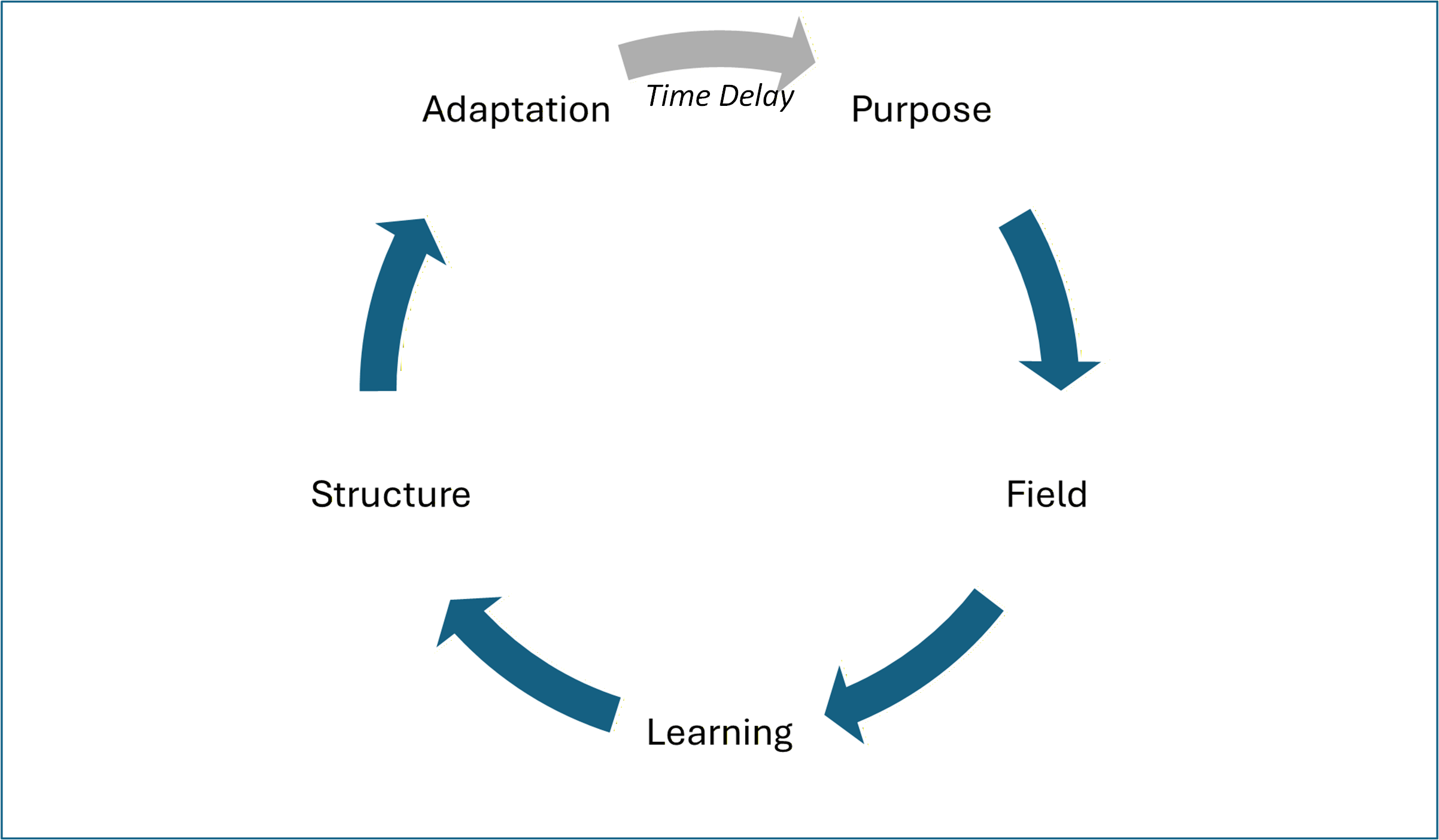
Ecological Cycle of Organisational Adaptation
This is not a linear process.
It is a reinforcing loop, continuously shaped by experience and feedback from reality.
The return from adaptation to purpose is delayed and often filtered.
What this means in practice
Adaptation does not come from:
- strategy alone
- systems alone
- or leadership intent
It emerges from:
- how people interact and build shared understanding
- how knowledge is tested at Gemba
- how structure responds to what is learned
- how the organisation lets go of outdated assumptions
When the system is healthy
- Signals from the environment are recognised
- Assumptions are tested, not defended
- Capabilities evolve with need
- Trade-offs are made consciously
When the system breaks down
Predictable patterns appear:
- Monoculture fragility — lack of diversity in thinking
- Silver bullet reflex — preference for large solutions over learning
- Validation theatre — appearance of alignment without reality
- Quick-fix cycles — short-term fixes that reinforce long-term problems
👉 These are not isolated failures.
They are signals that learning has broken down.
Practical Insight
The question is not:
“Do we have the right strategy?”
It is:
“Are we learning and adapting in response to reality?”
🧭 In the Source Notes
Purpose and Boundary
At the top of the system sits Holistic Purpose, guided and constrained by Ethics.
Together, these define:
- Direction (what matters)
- Identity (who we are)
- Boundary (what is acceptable)
Purpose provides coherence.
Ethics prevents drift.
For more details, see:
Purpose and ethical boundary (Basho)
Purpose as the Anchor for Organisational Sensemaking
Purpose Emerges from the Field
The Organisation Social Field (Ba)
The organisation lives in its social field.
This is not a fixed structure, but a dynamic relational space that forms and evolves as people interact.
Within this field:
- Social capital provides the underlying strength of relationships—built through trust, shared norms, and network connections.
- Shared context emerges in each situation—shaping how people interpret events, communicate, and act together.
The social field is therefore continuously forming, dissolving, and reforming in response to the situations the organisation faces.
The practice of working within the social field—through dialogue, challenge, and shared sensemaking—is explored in Lead, Transform and Navigate.
For more details, see:
Social field (Ba) and social capital
Learning and Knowledge Creation (SECI)
Learning is not a training activity.
It is a continuous process of knowledge creation through:
- Shared experience.
- Dialogue.
- Reflection.
- Practice.
This is represented through learning patterns:
- Islands of coherence — small groups where shared understanding forms and decisions become aligned
- Shared knowledge creation — ideas are developed collectively rather than handed down
- Gemba (the reality interface) — where work is actually done and assumptions are tested against real conditions
- Knowledge “mycelium and soil” — the informal networks and relationships through which knowledge spreads and takes root
Here, tacit knowledge is surfaced, tested, and refined.
Learning becomes real when it is shared, tested in practice, and reinforced through experience.
For more details, see:
Subject Area – The Learning Environment
Subject Area — Gemba: Where Learning Becomes Real
Subject Area: Trust — The Key to Cohesion, Learning and Contribution
Social Media, Tacit Knowledge, and the Missing Link
SECI: Not a Knowledge Model — A Learning System in Motion
Structure and Adaptation
Knowledge becomes effective only when it is embedded in how work is organised.
This is the ecological structure of the organisation:
- Business capabilities — the interdependent structure of what the business does, and the contribution each makes.
- Roles and responsibilities — who is accountable for action and decision-making.
- Constraints on how action is taken — the boundaries within which action is taken (regulatory, ethical, operational).
- Capacity — the organisation’s ability to mobilise its capabilities, people, and resources to act effectively in a given situation.
Structure is responsive when:
- Capability alignment improves
- The underlying capabilities remain stable
- But how they are interpreted, connected, and prioritised improves.
- Ownership and roles adapt
- It should not be locked to legacy org charts unless those charts are aligned with business capabilities.
- The relative emphasis on business capabilities will shift as the organisation adapts to environmental challenges.
- Accountability shifts to reflect reality because it is capability-based.
- Interfaces between capabilities improve
- Data modelling across the business capabilities leads to a common language for business integration.
- Handoffs and coordination become clearer as the interrelationships and dependencies are better understood.
- With a common model across the organisation, people see things more holistically, reducing siloed thinking.
- This is where most learning shows up as the whole system’s view becomes more apparent.
- Constraints are updated
- Policies and operational rules evolve in response to learning.
- Increased visibility of data and dependencies enables practices such as proactive data quality management.
- A deeper understanding of stakeholders and their dependence on business capabilities informs both system design and engagement.
- Ethical constraints remain stable, while operational constraints adapt to changing conditions.
Together, these changes reflect a shift from static structure to a system that continuously aligns itself with reality.
For more details, see:
Subject Area: Business Capability Model — Structuring What the Organisation Must Do
Business Capability Modelling — Beyond Organisational Charts and Process Maps
Subject Area: Business Capability Model — Structuring What the Organisation Must Do
Common Data Models and Organisational Meaning
Subject Area: Data Modelling — Negotiating Meaning
SECI as Learning Throughput — The Engine of Adaptive Capacity
Ethics — Designing with Consequences in Mind
Adaptive Dynamics
Through repeated cycles, the organisation develops adaptive capacity:
Responding to challenges.
- Environmental signals are recognised and taken seriously.
- Decisions are made under uncertainty, with trade-offs clearly understood.
- Actions are adjusted as new information emerges, rather than defended.
- The organisation responds to what is happening, not to what it expected to happen.
Regenerating capability
- Capabilities are strengthened, reconfigured, or replaced as conditions change.
- Skills, tools, and knowledge are continually refreshed through use and learning.
- Obsolete practices are retired rather than maintained out of habit.
- The organisation builds capacity to do new things, not just to improve existing ones.
Making explicit trade-offs between efficiency and resilience under different conditions
- Efficiency is prioritised where conditions are stable and predictable.
- Redundancy and flexibility are maintained where uncertainty and risk are high.
- Short-term optimisation is balanced against long-term viability.
- Trade-offs among cost, speed, and robustness are made explicit.
Letting go of outdated assumptions (unlearning)
- Assumptions are surfaced and tested against current reality.
- Practices that no longer fit are consciously abandoned.
- Contradictory evidence is engaged with, not dismissed.
The organisation makes space for new ways of thinking by letting go of old ones.
Adaptation is not planned in detail. It emerges from the interaction of learning and action over time.
Together, these reflect an organisation that adapts not by reacting faster, but by aligning more closely with reality over time.
Failure Patterns
When the system is unbalanced, predictable failure patterns emerge:
- Monoculture fragility
- Silver bullet thinking
- Validation theatre
- Quick-fix reflex
These are not random failures.
They are systemic signals that learning has broken down.
🧭 From the Guidelines of Adapt, Survive and Flourish:
- Quick Fixes that Fail — short-term solutions reinforce the problem over time.
- Normal Response vs Adaptive Response — organisations default to restoring stability rather than building capability.
- Silver Bullet Reflex — large-scale solutions are preferred over the slower work of capability development.
- Triple Bottom Line tension — overemphasis on one dimension destabilises the whole system
👉 These are not isolated behaviours. They are structurally embedded responses to pressure and uncertainty.
📖 Narrative Example From Adapt, Survive and Flourish, NaturFlourish CEO Sam:
- IT “quick fixes” create long-term data fragmentation.
- Poor systems integration.
- Siloed thinking across the business with no common language.
- We don’t trust our data.
- Consultants deliver solutions without knowledge transfer, and we are in an expensive pay-for-service cycle.
- Evidence is accepted without testing relevance
👉 The system appears to function, but our capability is eroding over time.
Why failure occurs
Failure is rarely caused by lack of effort or intent. It is caused by:
- Responding to a challenge before understanding the problem holistically and going for a ‘quick fix’ or ‘silver bullet’.
- Reinforcing existing assumptions without testing.
- Optimising for fast results within a flawed time frame.
Learning appears to occur, but the system is reproducing the conditions of failure.
Failure and Fragility
For more details, see:
Trust — Why People Stop Contributing
Psychological Safety — Why People Stay Silent
When Documentation Kills Learning
Why Organisational Learning Becomes Fragile — Even When Everything Looks Right
👉 Organisations do not adapt because they are well designed. They adapt because they learn together and stay aligned to reality over time.