Definition
A Triple Bottom Line Balanced Scorecard is a strategy and measurement model that links actions, capabilities, stakeholder outcomes, and system-level consequences across the dimensions of Planet, People, and Prosperity.
Why It Matters
Kaplan and Norton originally developed the Balanced Scorecard to help organisations translate strategy into action through a balanced set of measures. The classic model included financial, customer, internal process, and learning and growth perspectives.
Its deeper value lies not simply in its containing multiple measures. Its value was that it linked those measures into a strategy map. Measures were not isolated Indicators. Cause-and-effect relationships connect them.
That matters for Triple Bottom Line thinking.
Planet, People, and Prosperity cannot be managed as three separate reporting columns. They are connected:
- A decision that improves one measure may weaken another. A cost reduction may increase profit while damaging supplier viability.
- A productivity gain may improve short-term performance while increasing burnout, reducing learning, or degrading trust.
- An environmental investment may reduce risk, strengthen reputation, improve resilience, and create future value.
The important question is not simply:
What are we measuring?
It is:
How do these measures relate to one another, and what consequences do they reveal?
From Scorecard to System Map
A conventional scorecard can easily become a dashboard: a list of indicators, traffic lights, and targets.
A Triple Bottom Line Balanced Scorecard must do more than report performance. It must help leaders understand how value is created, sustained, weakened, or destroyed across the wider system.
Kaplan and McMillan’s updated Balanced Scorecard for Triple Bottom Line strategies provides a useful starting point. They argue that organisations pursuing financial, environmental, and societal outcomes need to adapt the classic Balanced Scorecard architecture.
In their updated model:
- Financial becomes Outcomes.
- Customer becomes a Stakeholder.
- Internal Processes remains Processes.
- Learning and Growth become Enablers.
This shift is important because Triple Bottom Line strategies are rarely delivered by a single organisation acting alone. They depend on suppliers, customers, employees, communities, regulators, ecosystems, partners, and other actors across the value chain.
The ASF Interpretation
In Adapt, Survive and Flourish, the Triple Bottom Line Balanced Scorecard is treated as a DSRP exercise.
Distinctions
The first task is to make clear distinctions.
What counts as Planet?
What counts as People?
What counts as Prosperity?
What is an outcome, an enabler, a process, a stakeholder expectation, or a capability?
Without clear distinctions, organisations confuse activities with outcomes, effort with impact, and reporting with learning.
Systems
The second task is to define the system.
A business does not create value in isolation. It operates within value chains, supply networks, communities, ecosystems, labour markets, regulatory systems, and social institutions.
The system boundary matters.
A narrow boundary may show improved margins.
A wider boundary may reveal supplier stress, customer distrust, ecological degradation, or declining social licence.
In the ASF, a primary tool for determining boundaries is Enterprise Architecture. In particular, the Business Capability Model is a hierarchical structure of business capabilities (what the business does) and provides an internal perspective. Part of the external perspective concerns how it relates to external organisations, such as supply chains and distribution networks. It also captures data and performance measures at the capability level.
For more insight, see Enterprise Architecture.
Enterprise Architecture is the foundation layer of the Knowledge base, providing the operational perspective on the organisation’s technology systems, processes, and stakeholder perspectives.
For more insight, see Knowledge Base.
A useful Triple Bottom Line Balanced Scorecard must therefore ask:
What system are we measuring, and what systems are we affecting?
Relationships
The third task is to understand relationships.
This is the heart of the model.
Each measure should connect to other measures through contribution logic:
How does measure X contribute to Y and Z?
For example:
- Supplier payment practices may affect supplier trust, quality, resilience, and innovation.
- Psychological safety may affect voice, weak-signal detection, learning, and risk management.
- Energy intensity may affect cost, emissions, regulatory exposure, and reputation.
- Training investment may affect capability, internal mobility, retention, and adaptive capacity.
- Local procurement may affect regional resilience, community trust, and supply-chain continuity.
Within Enterprise Architecture, the Common Data Model is a foundational part of the Knowledge Base. It captures the organisation’s entities, their attributes, and relationships. Data is the raw material for reporting systems.
For more insight, see Enterprise Architecture.
The value of the scorecard lies in making these relationships visible.
A metric without relationships is just a number.
A metric with relationships becomes part of a strategy map.
Perspectives
The fourth task is to recognise perspective.
Different stakeholders experience value and consequence differently.
- A board may see a return on investment.
- Employees may see workload and safety.
- Suppliers may see margin pressure or partnership.
- Customers may see trust, quality, and effort.
- Communities may see employment, disruption, or contribution.
- Ecosystems may reveal degradation or renewal.
A Triple Bottom Line Balanced Scorecard must therefore include stakeholder perspectives, not merely organisational preferences.
In ASF, the crucial tool for understanding these stakeholders is Stakeholder Engagement.
For more insight, see Stakeholder Engagement.
The question is not only:
What do we think we are achieving?
It is also:
What do the affected stakeholders experience as a result of our actions?
Value Chain, Capability, and Cost
The Balanced Scorecard also connects naturally to Business Capability Modelling and Activity-Based Costing.
A value chain shows how value is created.
A Business Capability Model shows what the organisation must be able to do.
Activity-based costing can reveal the cost of performing those capabilities and activities. Projects, initiatives, and capabilities are costed at the Activity level by analysing and capturing the Task Types that make up that Activity. Then, at the execution level, the actual expenditure is captured at the task level.
This matters because slogans do not deliver Triple Bottom Line performance. It is delivered through real work, real processes, real capabilities, and real resource use.
Activities are defined at Level 3 capabilities. So, at this level, we carry measurable costs, risks, dependencies, emissions, labour impacts, supplier impacts, or community consequences. If these are not visible, leaders may optimise one part of the system while damaging another.
The ABC Source Note explains how L3 capabilities, activities, task types, tasks, planned cost, actual cost, and cost objects connect. This matters because TBL outcomes are created through real work and real resource consumption, not through reporting categories.
For more insight, see Activity Based Costing
A Triple Bottom Line Balanced Scorecard should therefore connect:
- outcomes to stakeholders
- stakeholders to value propositions
- value propositions to processes
- processes to capabilities
- capabilities to costs, resources, relationships, and consequences
This is where the model becomes operational.
Completing the Loop
A good strategy map not only flows downward from strategy to action.
It also loops back upward from consequence to learning.
- Actions generate outcomes.
- Outcomes create feedback.
- Feedback challenges assumptions.
- Assumptions shape future decisions.
The cycle is complete when Planet, People, and Prosperity outcomes inform changes to processes, capabilities, stakeholder relationships, investment priorities, and strategic intent.
Without this loop, the scorecard becomes reporting.
With the loop, the scorecard becomes a learning tool.
Red Flags
A Triple Bottom Line Balanced Scorecard becomes weak when:
- Measures are listed but not linked.
- Activities are confused with outcomes.
- Stakeholder perspectives appear assumed rather than directly sourced or verified.
- Financial measures dominate all other consequences.
- Environmental and social metrics are considered as compliance standards.
- Process measures do not assess whether stakeholders’ expectations are met.
- The value chain is overlooked.
- Supplier and community impacts are invisible.
- Feedback does not change action.
- Reporting replaces learning.
When this happens, the organisation may appear responsible while remaining disconnected from consequence.
The Feedback Hub: Reports Are Only Snapshots
A Triple Bottom Line Balanced Scorecard should not be viewed as a static report, since a report merely reflects performance at a specific moment. Instead, it is a snapshot of an evolving system.
The real value lies in the feedback cycle that surrounds the report.
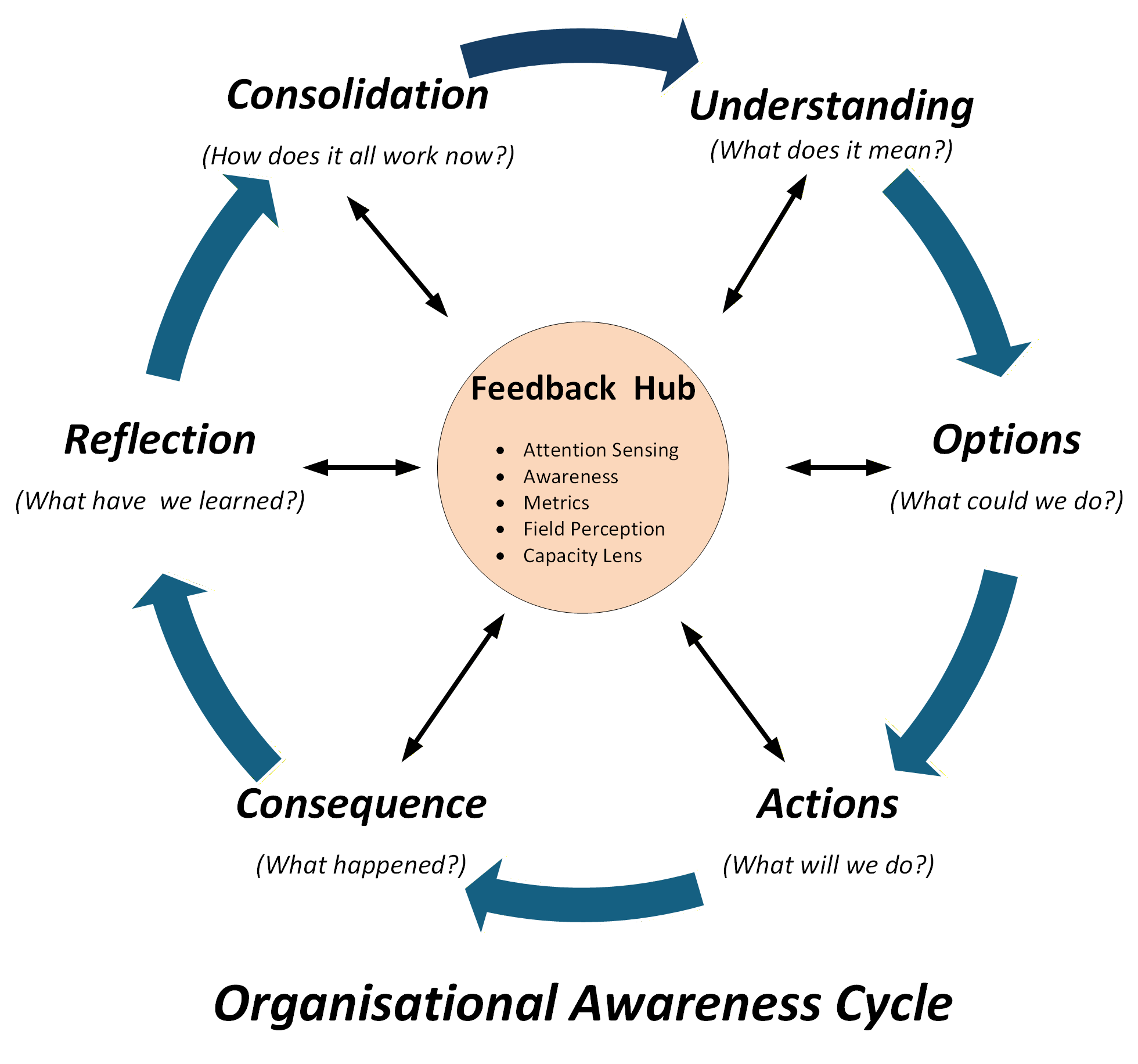
The Organisational Awareness Cycle reframes the purpose of the Triple Bottom Line Balanced Scorecard. Conventional dashboards are often treated as the endpoint of performance management—a means of confirming whether targets have been achieved. In an adaptive organisation, the dashboard is a means, not an end. Its purpose is to enhance organisational awareness by making patterns, relationships, weak signals and emerging trends visible. The measures themselves do not create learning or better decisions; they stimulate attentive enquiry, dialogue and reflection. Through Hansei, organisations move beyond asking “Did we achieve the target?” to asking “What does this result tell us? What has changed? What should we understand differently?” In this way, the dashboard becomes part of the organisation’s awareness infrastructure, supporting continuous sensing of the organisational field, the generation of strategic options, and wiser, consequential interventions that strengthen adaptive, economic, and ecological capacity.
Actions create consequences. Consequences generate feedback. Feedback supports sensemaking. Sensemaking changes understanding. Changed understanding should then influence future decisions, priorities, capabilities, measures, and actions.
In this sense, the scorecard is not the learning system. It is an artefact produced by the learning system.
A useful Triple Bottom Line Feedback Hub brings together:
- quantitative measures,
- stakeholder experience,
- Gemba observation,
- weak signals,
- unintended consequences,
- trends over time,
- relationships between measures,
- and evidence of learning and changed action.
The purpose is not simply to ask:
Did we meet the target?
It is to ask:
What is the system telling us?
A report may show that supplier costs have fallen. The Feedback Hub asks whether supplier trust, quality, innovation, and resilience have also changed.
A report may show that employee productivity has increased. The Feedback Hub asks whether burnout, psychological safety, learning, and retention are being affected.
A report may show that emissions have reduced. The Feedback Hub asks whether the reduction reflects genuine system improvement or merely a shift of impact elsewhere in the value chain.
The Feedback Hub, therefore, connects measurement to consequence and consequence to learning.
Without this feedback cycle, Triple Bottom Line reporting risks becoming another form of organisational theatre: polished, periodic, and disconnected from action.
With the feedback cycle, the scorecard becomes part of adaptive capacity. It helps the organisation see what is changing, test whether its assumptions still hold, and adjust its actions in response to reality.
The report is the snapshot.
The Feedback Hub is the learning loop.
The Adaptive Capacity Cycle and the TBL Balanced Scorecard
A Triple Bottom Line Balanced Scorecard should not be treated as a static report. A report captures performance at a point in time. It is a snapshot of a living system.
The real value lies in the learning cycle that surrounds it.
The Adaptive Capacity Cycle provides a framework for understanding this. It moves through:
Feedback Hub
At the centre of this cycle sits the feedback hub. This hub draws together signals from the organisation and the wider system: measures, stakeholder experience, weak signals, Gemba observations, unintended consequences, and changes over time.
The Capacity Lens asks:
- How is Adaptive Capacity changing?
- How is Economic Capacity changing?
- How is Ecological Capacity changing?
The report says what happened.
The scorecard shows how things are connected.
The adaptive cycle determines what must change.
Understanding
The cycle begins with understanding.
What is happening across Planet, People, and Prosperity? What do the measures, weak signals, stakeholder voices, and Gemba observations suggest? Are the trends improving, deteriorating, or shifting in unexpected ways?
At this stage, the scorecard helps leaders move beyond isolated metrics. It provides a structured way to interpret what the system may be telling them.
Options
Understanding should lead to options.
What could the organisation do? What interventions might improve outcomes without shifting harm elsewhere? What choices could strengthen the organisation and the wider system of which it is part?
A TBL Balanced Scorecard should make trade-offs visible. It should help leaders see whether one option improves short-term financial performance while weakening supplier resilience, employee wellbeing, customer trust, or ecological conditions.
Actions
Options must eventually become action.
This is where strategy enters the value chain. Actions occur through processes, capabilities, investment decisions, supplier relationships, customer practices, governance, technology, and day-to-day work.
A scorecard that is not linked or connected to action becomes a reporting artefact. It may describe performance, but it does not shape it.
Consequence
Every action creates a consequence.
Some consequences are intended. Others are unintended. Some appear quickly, while others emerge slowly through relationships, behaviours, stakeholder responses, ecological effects, or system delays.
A Triple Bottom Line perspective matters because consequences rarely stay inside one neat category. A decision made for financial reasons may have social effects. A social initiative may affect trust, productivity, and reputation. An environmental decision may affect cost, risk, resilience, and stakeholder confidence.
The purpose of the scorecard is to help make these consequences visible.
Feedback Hub
The Feedback Hub is where the TBL Balanced Scorecard becomes useful.
It gathers evidence from:
- Planet outcomes
- People outcomes
- Prosperity outcomes
- stakeholder experience
- process performance
- capability and enabler measures
- value-chain effects
- weak signals
- Gemba observations
- unintended consequences
- trends over time
The question is not simply:
Did we meet the target?
The deeper question is:
What is the system telling us?
- A report may show that supplier costs have fallen. The Feedback Hub asks whether supplier trust, quality, innovation, and resilience have also changed.
- A report may show that productivity has increased. The Feedback Hub asks whether burnout, psychological safety, learning, and retention have been affected.
- A report may show that emissions have reduced. The Feedback Hub asks whether this reflects genuine system improvement or merely a shift of impact elsewhere in the value chain.
The Feedback Hub connects measurement to consequence, and consequence to learning.
Reflection
Feedback only becomes learning through reflection.
Reflection asks:
- What did we misunderstand?
- Which assumptions were wrong?
- Which relationships between measures are now clearer?
- What consequences were hidden, delayed, or underestimated?
- Which stakeholder perspectives were missing?
- What should we stop doing, continue doing, or change?
This is where Hansei and double-loop learning become important. The organisation is not simply asking whether it achieved its targets. It is asking whether its assumptions, measures, actions, and strategy still make sense.
Consolidation
The last step is consolidation. What has been learned sufficiently to influence future decisions?
Consolidation can result in adjustments to strategy, measures, targets, capabilities, governance, stakeholder engagement, investment priorities, operating models, or purpose.
This marks the conclusion of the learning process. The outcomes of actions shape future insights, options, and initiatives.
Without this loop, the TBL Balanced Scorecard risks becoming another layer of reporting.
With this loop, it becomes part of Adaptive Capacity.
Reports, Scorecards, and Learning
The distinction is important.
- A TBL report is a snapshot.
- A TBL Balanced Scorecard is a structured feedback system.
- The Adaptive Capacity Cycle is the learning system.
Used well, the scorecard helps the organisation understand how actions affect Planet, People, and Prosperity, and how those consequences should shape future decisions.
Used poorly, it becomes a polished report that describes performance without changing behaviour.
- A scorecard without a feedback loop reports performance.
- A scorecard with a feedback loop builds Adaptive Capacity.
In Summary
A Triple Bottom Line Balanced Scorecard is not a dashboard of good intentions.
It is a system map of value, capability, relationships, consequences, and learning.
Its purpose is to help leaders see how actions contribute to Planet, People, and Prosperity outcomes, and how those outcomes feed back into future decisions.
Used well, it connects strategy to consequences.
Used poorly, it becomes another reporting artefact.
The test is simple:
Does the scorecard help the organisation learn how its actions affect the wider system?
If not, it is not a strategy map. It is wallpaper.
Related Glossary Items
- Triple Bottom Line
- DSRP
- Consequence
- Consequential Intervention
- Feedback
- Business Capability Model
- Activity Based Costing
- Stakeholder Engagement
- Adaptive Capacity
- Social Capital and Human Capital
Related Source Notes
- Triple Bottom Line: From Profit to Prosperity
- Source Note: The Three Capacity Lens
- Source Note – Consequential Intervention
- Business Capability Modelling — Beyond Organisational Charts and Process Maps
- Common Data Models and Organisational Meaning
Related Subject Areas
- Subject Area – Stakeholder Engagement
- Subject Area — Feedback
- Subject Area: Ethics and Consequential Intervention
- Subject Area — Adaptive Thinking Systems, Design Thinking and Strategic Thinking
- Subject Area: Enterprise Architecture — Foundation of Shared Knowledge
- Organisational Ecology – How Organisations Learn and Adapt