Deep Dive
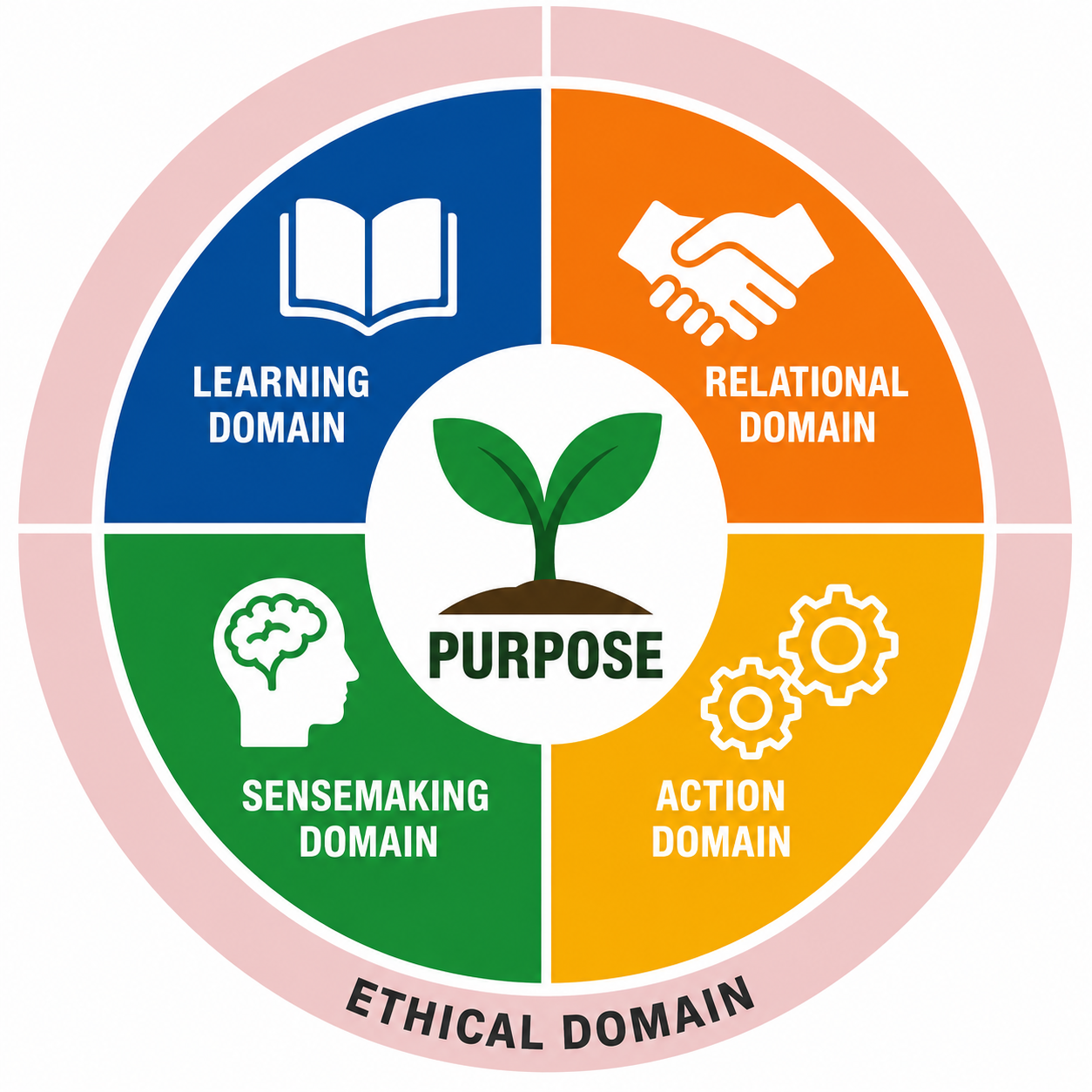
👉 The domains, patterns and source notes that shape how organisations actually learn, relate, act, and adapt.
These Source Notes sit within a broader body of work across three books:
- Adapt, Survive and Flourish — establishes the core model
- Lead, Transform and Navigate — brings it into practice
- Evolve: Patterns for Living Organisations — reveals the underlying patterns
Together, these works explore how organisations develop Adaptive Capacity — the ability to learn, adapt, and act effectively in a complex and changing environment.
👉 Below the source notes are Subject Areas that provide a great depth of detail and understanding.
Purpose – the anchor at the centre
- Purpose constrains interpretation and aligns action under uncertainty
- Shared vision aligns understanding across stakeholders
- The common good constrains action under uncertainty
With it, organisations can act coherently under uncertainty.
Purpose is expressed as a balanced commitment to Planet, People, and Prosperity—
not as competing priorities, but as a shared constraint on action.
Purpose sits at the centre of this model — orienting action, shaping judgement, and aligning the system as a whole.
Purpose as the Anchor for Organisational Sensemaking
Personal Survival and Adaptation in a World of AI Disruption
Purpose Emerges from the Field
Personal Survival and Adaptation in a World of AI Disruption
⛵ Domains and Source Notes
These domains introduce the core patterns, tensions, and concepts that shape organisational adaptive capacity.
Each Source Note is designed as a focused, “mind-sized” exploration of a specific idea.
Ethical Domain
How values and constraints shape decisions and consequences
Sensemaking Domain
How organisations interpret reality and frame what matters.
Relational Domain
How relationships shape trust, alignment, and coordinated action.
Learning Domain
How organisations build, test, and adapt knowledge — or fail to
Action Domain
How intent is translated into capability, execution, and outcomes.
🤿 Subject Areas
Subject Areas provide deeper and more structured exploration of specific disciplines, practices, and modelling approaches referenced throughout the pathways and Source Notes
Action Domain
Sensemaking Domain
Subject Area – Enterprise Architecture & Operating Model
Subject Area — Organisational Awareness
Subject Area — Co-Creating Purpose
Subject Area — Knowledge Operating System
Subject Area – Managing Complexity
Subject Area – The Learning Environment
Subject Area: Enterprise Architecture — Foundation of Shared Knowledge
Subject Area: Triple Bottom Line and the Balanced Scorecard